


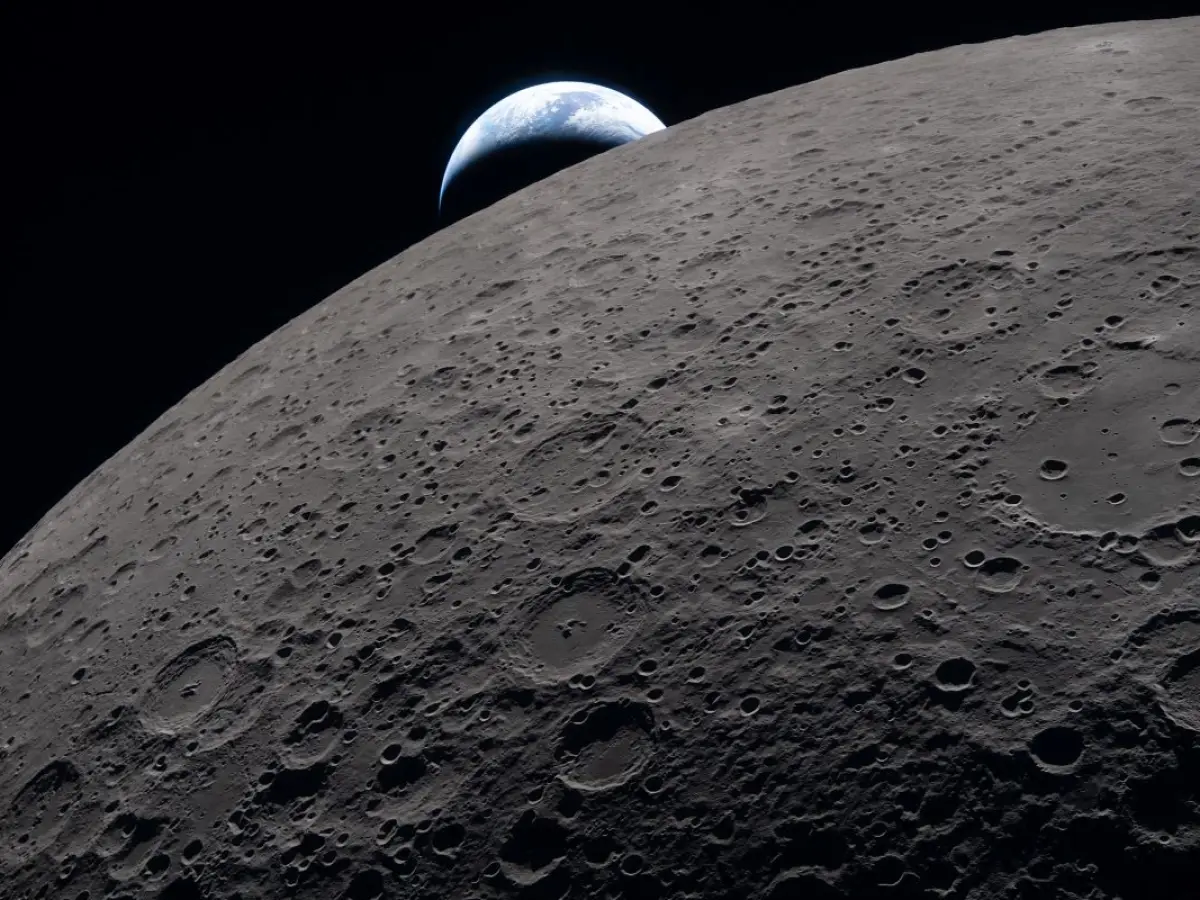

On 6 April 2026, as the Orion space capsule travelled behind the far side of the Moon, four people broke a record that had stood for fifty-six years: they travelled as far as 406,771 kilometres from Earth, further than anyone had ever gone before, including Apollo 13.
Their mission, Artemis II (a ten-day flight culminating in a splashdown in the Pacific), has been described as humanity’s return to deep space. And rightly so. Yet, the most significant news is not about the distance travelled, but the map that journey is drawing: on board, alongside three NASA astronauts, was the Canadian Jeremy Hansen, the first non-American to leave low Earth orbit, and behind them stood a coalition of 70 signatories. Today, no one goes into space alone, and the choice of travelling companions says a great deal about the state of the world.
That is the fundamental premise of astropolitics: the space race is not an exotic appendage of international relations, but rather its projection. And, increasingly, the relationship is bidirectional: what happens in orbit reshapes the balance of power on Earth.
Two Moons, one single planet
Let’s start with some numbers. As of July 2026, the Artemis Accords – the framework of principles promoted by the United States and NASA in 2020 to regulate lunar exploration – have 70 signatories: the latest, Mauritius, joined on 17 July. Recently restructured, the Artemis programme aims to return humanity to the lunar surface by 2028 and to build a base there for a prolonged and sustainable presence by 2035.
Halfway around the world, both literally and figuratively, the culmination of the lunar programme is the International Lunar Research Station, the base that China and Russia intend to build at the lunar south pole over the next decade (the announced date is 2036), along with its own group of participants, joined by around ten partners including Azerbaijan, South Africa and Kazakhstan.
These are two alternative legal and industrial frameworks, two ways of interpreting the rules – starting with those governing resource extraction – and, in particular, two competing timetables. The speed at which the first bloc is expanding is in itself a diplomatic indicator: in 2024 alone, there were 19 new signatories to the Artemis Accords, the highest number in a single year, and recruitment continues summit after summit, often in contexts that seem to have more to do with Earth-based foreign policy than with extra-planetary activities.
China’s programme is, for now, proceeding smoothly: on 30 October 2025, the China Manned Space Agency confirmed being “on track” to meet the target of sending two taikonauts – as Beijing calls its astronauts – to the lunar surface by 2030, and had announced the previous August that the Lanyue lander had successfully passed the integrated moon landing and take-off test, conducted in the artificial craters of Huailai, in Hebei. In the meantime, probes are leading the way: Chang’e 7 in 2027 and Chang’e 8 in 2029 will both target the lunar south pole, conducting experiments on the use of local resources. In contrast, as previously reported, the US timetable has had to be reorganised: on 27 February 2026, NASA Administrator, Jared Isaacman, announced that Artemis III, in 2027, will be a test of in-Earth-orbit docking, designed to demonstrate the reliability of two lunar landers: one built by Elon Musk’s SpaceX and the other by Jeff Bezos’s Blue Origin. The lunar landing will be postponed to Artemis IV, scheduled for early 2028. Artemis V will return to the Moon by the end of that same year.
On paper, that puts them two years ahead of Beijing. On paper.
Nevertheless, it would be a one-sided interpretation to view the new Moon Race as a remake of the Cold War. The world reflected in space today is no longer contested between two superpowers, as it was in the 1960s when the United States and the Soviet Union competed for extraterrestrial primacy: it is a multipolar, ambiguous and cross-cutting world. India, which was the first to reach the Moon’s polar regions with Chandrayaan-3, has signed the Artemis Accords without abandoning its cooperation with Moscow; among the 70 signatories are Rwanda, Bangladesh and Senegal, countries which, until a few years ago, were barred from any space ambitions, let alone participation in the new lunar adventure. Today, they view space access as a ticket to the economy that really matters.
The economics of gravity
The economy, indeed: according to Novaspace’s Space Economy Report (January 2026), the space sector reached a global value of $626.4 billion in 2025, with a trajectory pointing towards $1 trillion by 2034. The most telling figure, however, is another: out of global public spending ($137.4 billion), 54%, or $73.5 billion, is now allocated to defence, more than is spent on civilian programmes. In other words, governments no longer fund space merely for prestige or to develop scientific programmes, but because they regard it as critical infrastructure, on a par with ports and electricity grids. The rest of the value is generated by the market: satellite services, connectivity, Earth observation – in other words, the invisible fabric underpinning navigation, communications, finance and weather forecasts for everyone reading these lines.
This is underscored, quite literally, by a view from above: as the European Space Agency (ESA) notes in its Report on the Space Economy 2026, there were 324 orbital launches last year, an all-time record driven by mega-constellations. With one significant point to highlight: of the approximately 16,000 active satellites catalogued by astrophysicist Jonathan McDowell, nearly two-thirds belong to a single entity, which is not a government, but Starlink.
SpaceX’s constellation for broadband and low-latency connectivity – in other words, “internet from space” – comprises over 10,800 operational satellites. A private entity owns and controls the vast majority of the eyes and antennas orbiting above our heads. This is a historical anomaly, which the war in Ukraine has turned into a strategic issue, as Starlink terminals have become the backbone of communications at the front line. Here too, the relationship is reciprocal: the international balance of power has come to depend on orbit, and those who control or even own orbital slots have found themselves playing a geopolitical role.
The sky as an arsenal
The context explains the rest: in 2025, according to estimates by the Stockholm-based SIPRI, global military spending reached nearly $2.9 trillion, and a growing proportion of this is directed towards space. A prime example is the Golden Dome, the multi-layered missile defence shield announced by the Trump administration in January 2025 (in the wake of the presidential inauguration): an initial allocation of 25 billion in the budget bill signed on 4 July 2025, a stated cost of 175 billion, and the ambition to intercept any airborne threat, from ballistic missiles to hypersonic weapons systems and even drones, through a network of sensors and orbital interceptors by 2029. The objective is technically ambitious, enough to have prompted a much higher cost estimate from the Congressional Budget Office, which in May 2026 projected that the Dome could cost up to 1,200 billion over 20 years.
Europe aims to respond with the IRIS² constellation, approximately 290 satellites for secure communications, and defence budgets, which, according to NATO, reached a total of $1.4 trillion across the allies in 2025. It is significant, in this regard, that Ariane 6, the new European heavy-lift launcher, launched its commercial career by carrying strategic satellites, such as the French CSO-3, Sentinel-1D and the new Galileo satellites: payloads that reflect sovereignty, security and Earth observation even before they consider the market. Far from being a mere accounting detail, this is a sign that even the Old Continent has ceased to regard space as a scientific luxury and has begun, albeit belatedly, to treat it as an operational domain – a reality that NATO formally recognised in 2019.
Throughout all this, there is a lesson to be drawn beyond the figures: none of the earthly disputes of recent years – tariffs, wars, the rare-earth supply chain, artificial intelligence – is disconnected from space technologies and activities. Technological sanctions are driving China towards self-sufficiency even in orbit; competition in artificial intelligence is fuelling demand for satellite data and, looking ahead, for orbital computing power; SpaceX aims to build a constellation capable of delivering computing power from space; Nvidia and Google, like China, share similar objectives. Consider Starcloud-1, the small satellite which, in November 2025, placed the first Nvidia H100 GPU ever flown in space into orbit, even successfully training a language model there; or Project Suncatcher, the cluster of 81 satellites that Google is developing with Planet for extra-atmospheric distributed computing.
Meanwhile, the raw materials crisis suddenly renders plausible the prospects of lunar mining that the Chang’e 8 mission already plans to test. This means that whoever reaches the Moon’s south pole will not merely plant a flag but also establish a legal precedent in front of the whole world, since the rules governing the use of extraterrestrial resources will, in effect, be written by whoever exploits them first.
To understand just how tangible the transition towards a new global political order is, one need only look up. In orbit, multipolarism is already in operation, with its variable-geometry alliances, its private oligopolies, and its arsenals under construction. We all live under the same sky, as Confucius reminded us. Except that, today, that sky is the most up-to-date map of our balance of power. And no map has ever remained neutral for long.
DOWLOAD AND READ ISSUE #64 OF RENEWABLE MATTER: SPACE ECONOMY
Cover: © NASA