


For issue 64 of Renewable Matter, we invited three leading figures in space research to join us at the Think Tank round table: an astronaut, an astrobiologist and an astrophysicist. We explored economic and strategic issues with them, but we also discussed sustainability, the (terrestrial) environmental crisis and the future of space exploration and the search for extraterrestrial life.
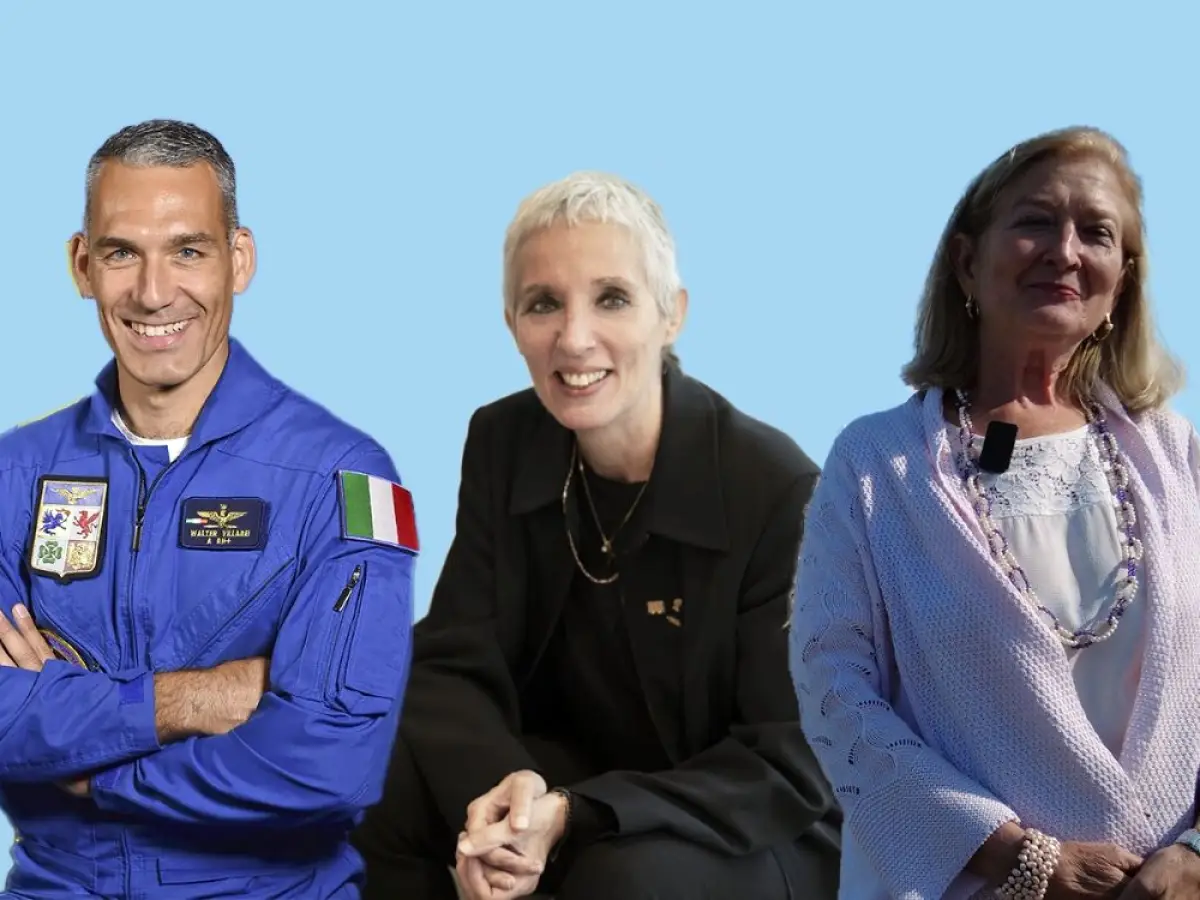
Colonel Walter Villadei, an engineer and astronaut, outlined the next steps in European space exploration, emphasising Italy’s important role. With Nathalie Cabrol, director of the Carl Sagan Centre at the SETI Institute, we explored the possibility of life in the universe, also reflecting on how astrobiology is proving to be a valuable ally in understanding and managing the extreme changes that are disrupting our planet. Finally, with Patrizia Caraveo, president of the Italian Astronomical Society, we discussed orbital pollution and the urgent need to apply ecological principles to space as well. Below is a preview of the interviews you can read in Renewable Matter #64.
Walter Villadei: Space Is a Driver for the Economy
The goal of the new race to the Moon is to establish a continuous, sustainable and safe presence on our satellite. And amongst European countries, Italy is at the forefront with its space industry. Emanuele Bompan discussed this with Walter Villadei, colonel in the Italian Air Force.
Villadei is the Armed Forces’ first space engineer and the first Italian astronaut to pilot a space shuttle. After graduating from the University of Naples Federico II, between 2008 and 2012 he became the first European since the days of the USSR to complete the full cosmonaut training programme at Star City in Russia. On 29 June 2023, he led the Virtute-1 mission with Virgin Galactic, the first Italian and European suborbital flight. On 18 January 2024, he took off as pilot of the Crew Dragon Freedom on Axiom Mission 3 “Voluntas” (Ax-3) bound for the International Space Station (ISS), where he spent 18 days. Since 2022, he has been living in Houston, where he heads the Italian Air Force’s representative office for space access. We reached him at the Axiom Space offices, where he is working, amongst other things, on the development of the new lunar spacesuit.
Nathalie Cabrol: Astrobiology as a Mirror to Understand Life on Earth
On 14 February 1990, the renowned astrophysicist and writer Carl Sagan persuaded NASA to point the Voyager’s camera towards Earth. The image, captured from a distance of 6 billion kilometres, has gone down in history as the Pale Blue Dot. That faint blue dot, “a mote of dust suspended in a sunbeam”, served as a reminder to everyone of the fragility of our planet and our need to protect it. But in a sense, it also highlighted its “non-uniqueness”.
It was, in fact, the prelude to what the Franco-American astrobiologist Nathalie Cabrol, Sagan’s successor, describes as a “second Copernican revolution”: the discovery of exoplanets. From the 1990s to the present day, more than 6,000 have been identified, several of which have similar characteristics to Earth and are potential worlds capable of supporting life. And Cabrol has no doubt that we are not alone in the universe.
Director of the Carl Sagan Centre at the SETI Institute in Mountain View and senior researcher at the NASA Astrobiology Institute (NAI), Nathalie Cabrol has been working in the field of planetary sciences for forty years. She studies the extinct lakes of Mars, the atmosphere of Venus and the moons of Saturn, as well as the most extreme environments on Earth, to investigate the conditions under which life emerges and persists, convinced that astrobiology is, above all, a fantastic mirror through which to understand our origins.
Giorgia Marino interviewed her about the search for life in the universe and how the study of other planets can help us cope with the extreme changes taking place on our own planet.
Patrizia Caraveo: The Atmosphere Is the Space Economy’s Dumping Ground
Patrizia Caraveo does not mince her words, nor does she believe in half-measures. Astrophysicist at INAF and one of the world’s leading experts on neutron stars, she is, as president of the Italian Astronomical Society, perfectly qualified to discuss orbits and collisions with the authorities.
Not a fan of space adventurers or the deregulation of the space economy, the author of Space Ecology: From Earth to Moon and Mars (Springer, 2025) presents a case, documented orbit by orbit, against the idea that space is a place where the rules of planet Earth – on pollution, common goods and civil liability – simply do not apply. Emanuele Bompan met her to discuss all this.
DOWLOAD AND READ ISSUE #64 OF RENEWABLE MATTER: SPACE ECONOMY
Cover: Walter Villadei, Nathalie Cabrol and Patrizia Caraveo