


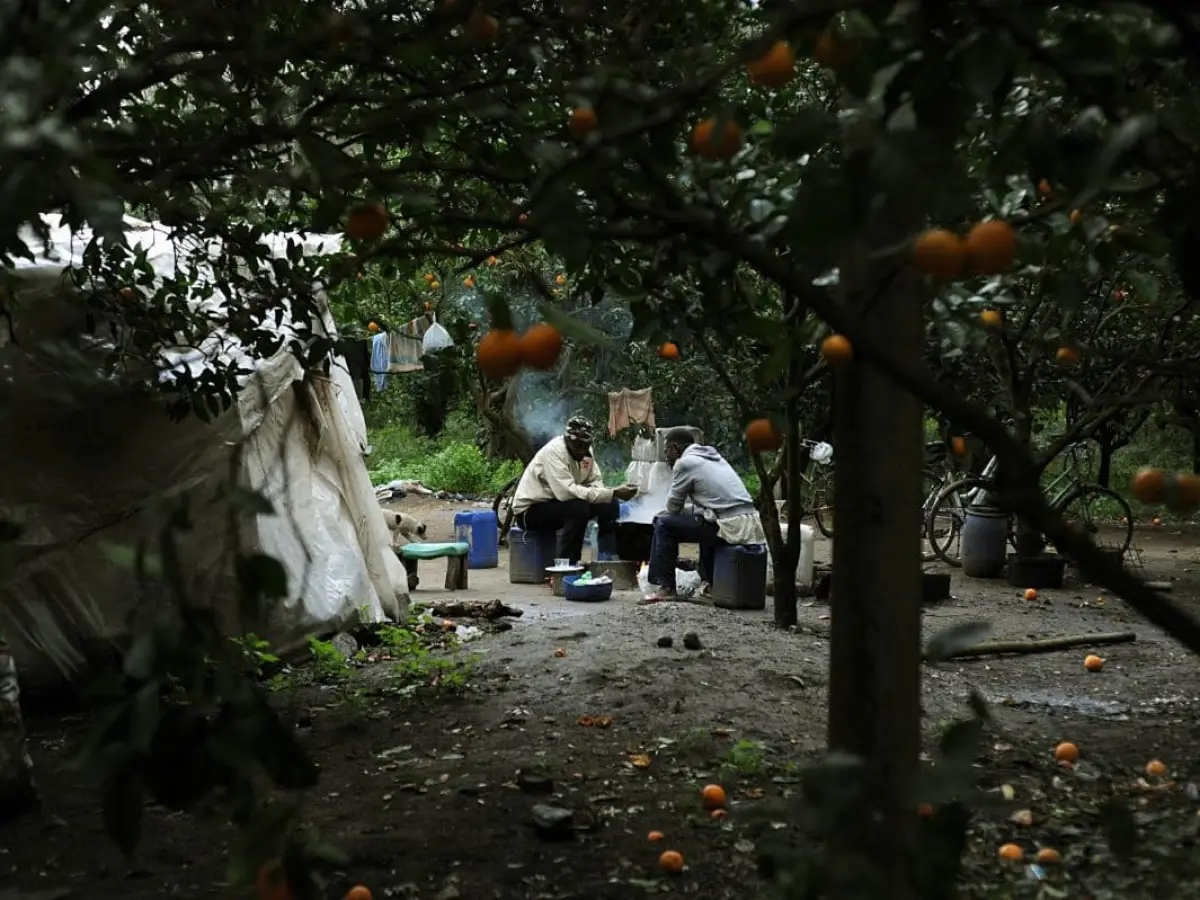

In the European Middle Ages, the term “serfdom” referred to a legally defined status that fell somewhere between slavery (servus) and free man, in that the individual was not considered property, but did not benefit from certain fundamental rights, such as the freedom to choose where to live or the type of work to undertake.
Serfs, however, have not disappeared: even today, millions of workers in the primary sector are exploited, deprived of basic human rights and, in the worst cases – such as forced labour on fishing vessels – even reduced to temporary slavery.
The International Labour Organisation (ILO) estimates that 50 million people currently live in conditions of slavery: 28 million of them are subjected to forced labour, mainly in Africa and Asia. The vast majority of these are in the agricultural, livestock and fishing sectors.
Exploitation and abuse, from fishing vessels to crop fields
Among the most shocking stories to emerge in recent years is the exploitation of hundreds of thousands of Indonesian, Uyghur and North Korean workers on Chinese-flagged fishing vessels, exposed by journalist Ian Urbina through his The Outlaw Ocean Project. Trapped aboard mega-fishing vessels catching tuna or squid for months or even years in appallingly unsanitary conditions, malnourished and often abused by their superiors and captains. No contact with their families, their passports confiscated.
While the sea is a particularly challenging environment when it comes to monitoring abuse occurring in international waters, the situation on agricultural farms is equally complex. Underpaid workers, deprived of their documents, abused and raped, even murdered for refusing to bow to their tormentors. Reports from NGOs and human rights organisations are full of such cases: from Mexico to Indonesia, from Brazil to Afghanistan, from Eritrea to Nigeria.
In the US, as the crackdown on irregular migrants has intensified, cases of abuse have surged, in particular sexual violence against workers, who are unable to report their attackers out of fear of reprisals and legal action. “The perpetrators think they can do whatever they want, confident that their victims won’t report the abuse for fear of being fired, arrested or deported,” explains Mónica Ramírez, founder and president of Justice for Migrant Women, an Ohio-based organisation that supports immigrants working in the catering sector.
The phenomenon of illegal employment in agriculture in Italy
In Italy, the issue of illegal employment in the agricultural sector – i.e., the exploitative and underpaid treatment of workers, most of whom are migrants – is especially serious. According to ISTAT, 200,000 people – 55,000 of whom are women – are employed illegally in the Italian agricultural sector. The CGIL trade union believes that these figures are actually an underestimate. Workers in illegal labour schemes face reprisals and abuse, work over 12 hours a day, and receive an average gross annual wage of just over €6,000.
This is all done to keep wholesale prices low and boost competition in the large-scale retail sector, despite the fact that many citizens are unwilling to pay a fair price for food. The case of Satnam Singh’s death – left to die after an accident in the fields of the Agrilovato agricultural cooperative in Borgo Santa Maria, in the province of Latina – has exposed a system of widespread illegality and criminality in the local countryside, which is also present in other Italian provinces.
Such as in the Capitanata area, near Foggia, where 7,000 farm labourers live in desperate conditions, paid €3.50 per crate of tomatoes harvested. One recent case occurred in early April, when Alagie Singath, a 29-year-old farm labourer who had been living in a shack in the Torretta Antonacci slum for at least five years, took his own life by hanging. Or in Vittoria, in the Ragusa area – the town with the highest number of abortions per capita in Italy – where abuse of female greenhouse workers is a daily occurrence.
A serious risk for agri-food businesses
Today, human rights violations of this kind are unacceptable and pose a serious risk to agri-food companies, which are required to strictly monitor their supply chains. According to Sustainalytics Morningstar, the divide between those with robust systems to monitor abuses and those without results in significant valuation spreads. A single supplier exposed for labour rights violations can lead to import bans, production stoppages, legal costs and the loss of contracts – all before the issue even surfaces in a sustainability report.
The February 2026 KnowTheChain benchmark assessed 45 of the major players in the global food & beverage sector: the average score was 15 out of 100 for the prevention of forced labour, a decline from the 2023 assessment. Packaged goods and meat products received the lowest score, 12 out of 100. All of these are, of course, major European retail brands.
The issue of fair pricing, meanwhile, is an urgent matter that needs to be addressed. Inflation aside, we pay far too little for food, given its central role in our nutrition and survival, shifting the extra costs onto farm labourers (and the environment). The gap between what an exploited farm worker earns and the final price paid by the consumer is estimated at between 2,000 and 3,000%, a figure that often benefits middlemen and retailers.
Finally, the reputational damage from allegations of forced labour can have far-reaching consequences, ranging from consumer boycotts to plummeting share prices, as has happened, for example, in the tuna and tinned tomato industries. This applies, however, to the agribusiness giants. The dark side remains that of the middlemen, small-scale illegal producers, and unmonitored, unbranded retailers, who operate with impunity, without concern for impacts or reputation. What matters is maximising profit at the expense of everyone else.
Cover: African farm labourers harvesting oranges in San Ferdinando, in the Gioia Tauro Plain (Reggio Calabria), in front of an abandoned farmhouse where they live in inhumane conditions. Photo by Francesco Mollo, Fotogramma / IPA Agency