

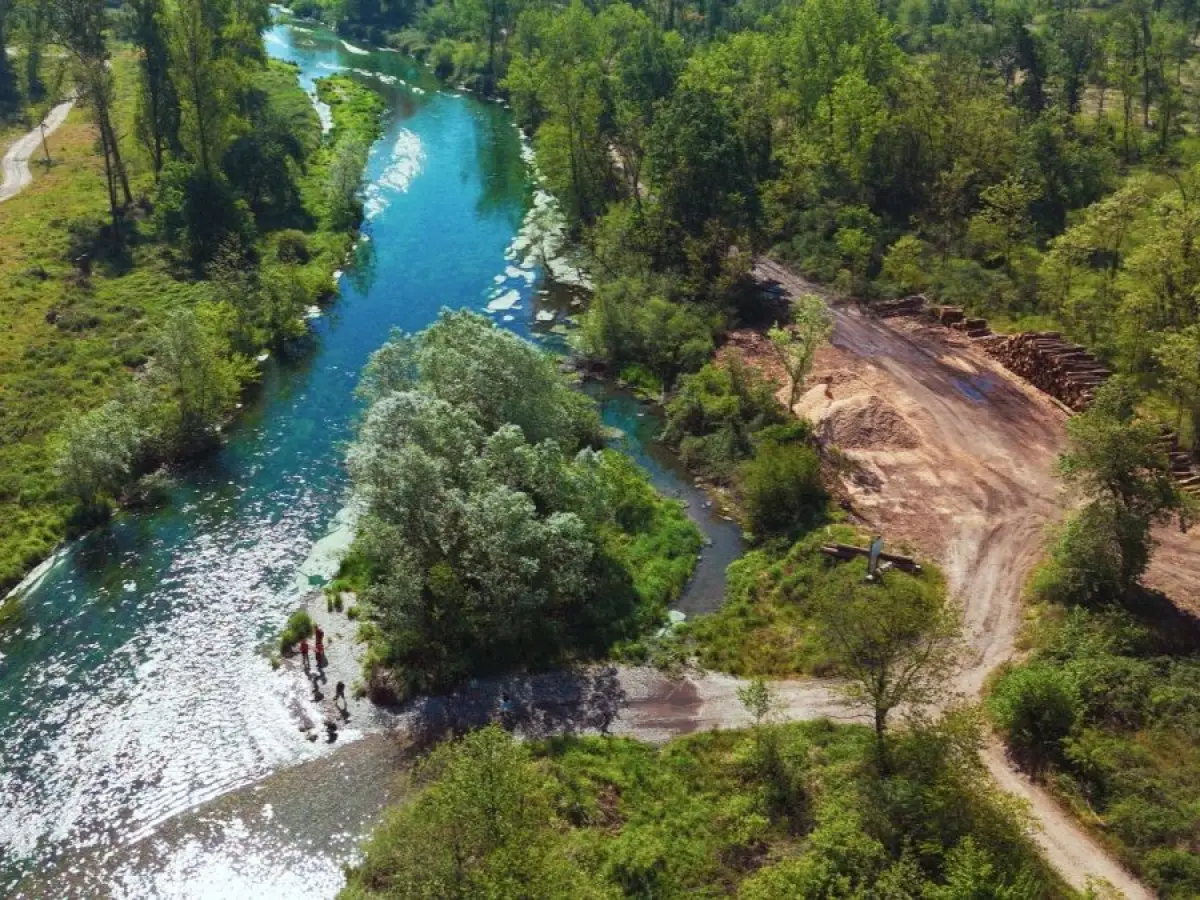

In July 2023, powerful winds swept through the Ticino Park with a force unusual even for an ecosystem accustomed to floods, erosion and the natural rhythms of a river landscape. Gusts exceeding 100 kilometres per hour felled thousands of trees within a matter of hours, including on Isola dell’Ochetta (named after its goose-like shape) in the municipality of Cassolnovo, in the province of Pavia. The storm devastated one of the Lower Ticino Valley's most valuable wet woodland habitats. Alders, poplars, oaks and pedunculate oaks were knocked to the ground, leaving a fragmented landscape and more vulnerable ecosystems. Beyond the loss of trees themselves, the consequences of that event also include the spread of invasive species, habitat loss and a reduction in the area’s biodiversity.
Nearly three years on from what has been described as the Ticino's own "Storm Vaia", the first reforestation project in the Ticino Park, promoted by Microsoft Italia and delivered with the technical and scientific support of the non-profit organisation Rete Clima, active in sustainability and decarbonisation projects, has entered a new phase. The initial operational stage, the planting of the trees, has now been completed. The most delicate task, however, begins now: supporting the woodland through its long process of ecological recovery. Renewable Matter visited the site to see how the project is progressing.
Microsoft and Rete Clima's commitment to the Ticino Park
The project forms part of the “ecological compensation” measures linked to land consumption resulting from the construction of Microsoft's first cloud region data centres in Italy. It also contributes to a broader programme aimed at restoring natural capital and territorial regeneration. "Together with Microsoft, we are delivering a reforestation project founded on robust technical and scientific principles, capable of restoring biodiversity and resilience to an area affected by extreme weather events, while continuing the path set out through our Foresta Italia campaign," explains Paolo Viganò, founder of Rete Clima.
"Restoring the woodland on Isola dell'Ochetta is about far more than an environmental intervention; it represents a commitment to local communities and the surrounding area," said Robert Zielonka, Community Affairs Manager at Microsoft Italia. "We want this initiative to become an opportunity for collaboration and participation, involving Microsoft Italia employees in activities that help make the places where we live and work more sustainable and welcoming."
As Viganò adds, "Microsoft's original obligation covered 11.7 hectares of reforestation, but the company chose to go beyond that commitment, restoring 12.96 hectares and planting just under 6,000 trees," including oaks, poplars, hornbeams, field maples, hazel and hawthorn.
The woodland after the storm
Field operations have been coordinated by the consultancy Terra Viva. “First of all, we had to clear – or rather, we are still clearing – the area of the fallen trees,” says the firm's owner, Gabriele Sguazzini, pointing to large stacks of logs and piles of woodchip lining the paths, all of which will be recovered through the biomass supply chain.
The near-total destruction of the tree cover created ideal conditions for invasive species such as black locust, tree of heaven and American pokeweed to spread. Without intervention, the ecosystem would have faced gradual ecological simplification: an abundance of plants, but belonging to only a handful of species, unable to recreate the ecological complexity typical of the Ticino Park's native woodland. Black locust is a good example — a versatile and visually pleasing plant, but a non-native one that spreads rapidly, gradually smothering native oak woodland. "What we're trying to achieve through this project," Viganò explains, "is to stay ahead of the natural colonisation of invasive pioneer species through the reforestation of native seed-bearing species instead."
The aim is therefore to rebuild the original oak woodland gradually through a mosaic of different species, arranged in groups of trees and shrubs designed to encourage natural ecological succession. It is an approach that views the woodland not as a uniform collection of trees but as a complex living system, made up of varied spaces, complementary ecological niches and also of different ages. "One aspect of biodiversity that is often overlooked is the chronological one," Sguazzini explains. Trees of different ages not only vary in shape, size and height, but also provide different ecological niches for nesting birds and animals seeking shelter.
The storm also altered the relationship between flora and fauna. The large clearings left by fallen trees, for example, have encouraged the return of ungulates, particularly roe deer. On the one hand, their presence also attracts natural predators such as wolves; on the other, they pose a threat to the newly planted saplings by feeding on them. This dynamic highlights just how forest regeneration is never simply a matter of planting trees, but rather a delicate process of ecological restoration.
The woodland's recovery, however, will unfold on a timescale that bears little relation to the pace at which extreme weather events are reshaping the landscape. "We'll begin to see a substantial cover developing after around ten to fifteen years," says Sguazzini. “But this is still an early stage, given that we’re talking about forests that are at least a hundred years old.”
Satellite monitoring and the role of local communities
With the planting phase complete, the project now moves into its more technical and long-term stage, involving maintenance, irrigation, mowing and multi-year ecological monitoring. This initiative will be monitored both through field surveys and via Forest Hub, the platform developed by Rete Clima to integrate satellite data, ecological observations and community contributions. "Through our platform, people can share the information they collect with an artificial intelligence, which will then extract information from these databases to compare with satellite data," Viganò explains.
Rete Clima agronomists Francesco Patriarca and Diego Scaglia, who are responsible for forest monitoring, demonstrated how the satellite platform works. Satellites operated by the European Space Agency (ESA) collect daily imagery of the area, providing data on photosynthetic activity and forest cover. Satellite data alone, however, cannot tell the whole story. "For example, a satellite cannot distinguish whether the woodland it is observing is healthy or under stress, or whether it is made up of native or invasive species. Through the platform, I can see how much photosynthesis the plants are carrying out. If it is low, I know the forest is under stress, but I still don't know why."
That is why on-the-ground inspections by Rete Clima's technical teams remain essential, alongside the “non-technical” contributions of citizen science, meaning the active involvement of the public in collecting simple data on the presence and abundance of species in an area. A single photograph uploaded to a Citizen Science platform by an individual taking a stroll can, for example, reveal the appearance of an invasive species at a specific location within the woodland.
It is a model that brings together forest ecology, technology and public participation in an attempt to transform the care of the land into a collective and ongoing practice. Reforestation is not simply the act of planting trees, but the beginning of an enduring partnership between trees, people, ecosystems and the landscape.
Cover: photo by Rete Clima