


When Chilean ambassador Julio Cordano was elected the new President of the Intergovernmental Negotiating Committee (INC) tasked with drafting an international plastics treaty, on 7 February in Geneva, civil society urged him to “restore trust [in the negotiations] by restoring transparency, promoting neutrality, enabling effective decision-making and ensuring adequate access and representation for civil society in the talks”.
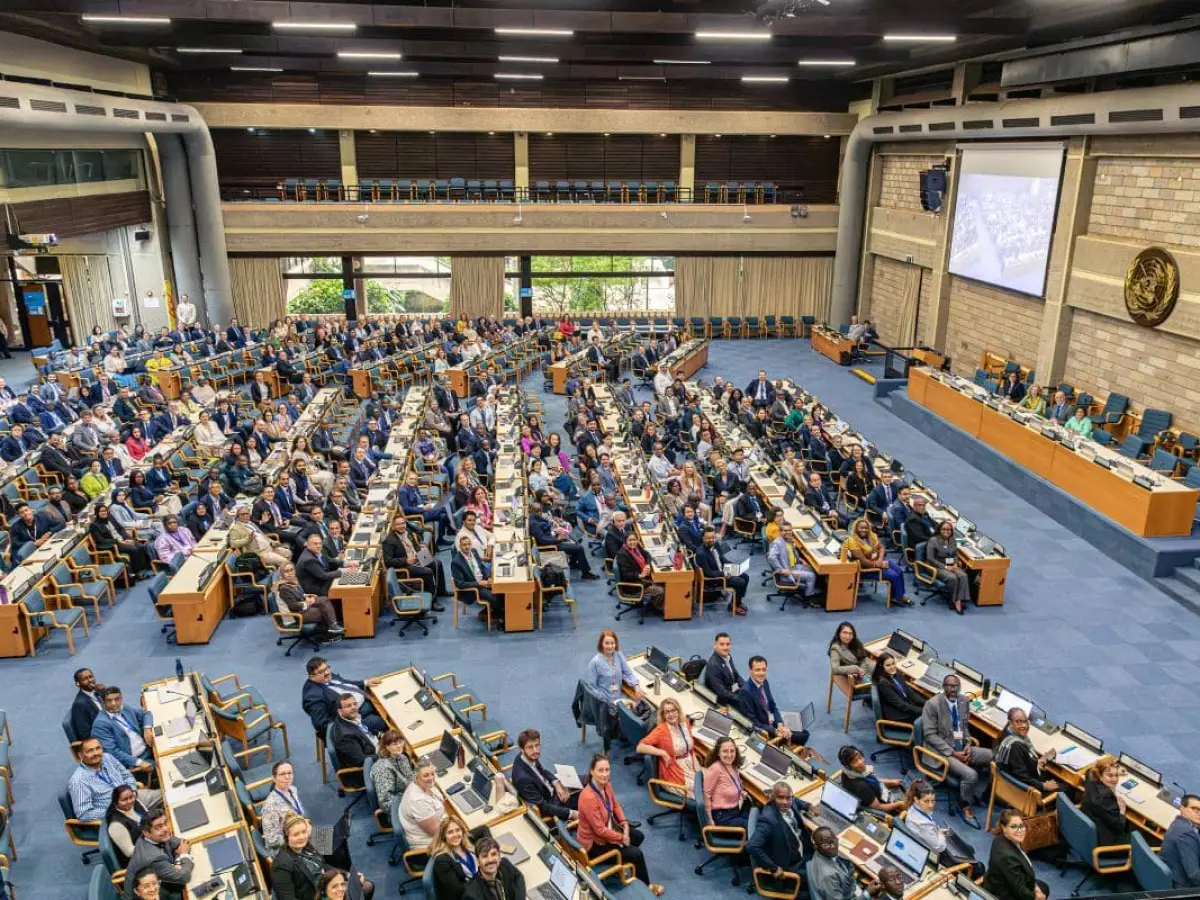
Five months later, after a series of informal closed-format meetings, and following the first in-person (but closed-door) meeting of all heads of delegation (HoDs) held in Nairobi from 30 June to 3 July, significant doubts remain about the structure of the process.
Low ambition worries Pacific countries
"Ahead of the meeting, we released a press reaction in which we shared our concern on the proposed structure of the meeting, which sidelined key issues such as production and chemicals of concern", David Azoulay, Environmental Health Program Director at the Center for International Environmental Law, told Renewable Matter.
"Resolution 5/14 gave this Committee a mandate covering the full life cycle of plastics, and the life cycle begins at production, not at the landfill”, Sivendra Michael, Permanent Secretary for Ministry of Environment and Climate Change, Fiji Government, tells us from Nairobi. “For Pacific Small Island Developing States, binding global measures on primary plastic polymers and on chemicals and products of concern are not maximalist demands; they are the minimum the mandate and the evidence require, alongside serious provisions on the existing plastic pollution already accumulated in our ocean. Our concern coming into Nairobi was never that these issues would be rejected outright, but that they would be quietly set aside — and omission is also a decision. We have worked to keep them squarely on the table, and we expect the reference document that follows this meeting to reflect the proposals supported by a large majority of members. The Pacific remains flexible on how obligations are sequenced and supported — through finance, technology and a just transition — but not on whether they exist. A treaty without them is a waste agreement, and large ocean states did not come to Nairobi to negotiate a waste agreement.”
From the outset of the negotiations, three groups of countries emerged: those with high ambition, aligned with the scientific evidence and calling for binding global rules; those with low ambition, mostly petrochemical states concerned about the consequences of a treaty that includes limits on overproduction and restrictions on hazardous chemicals; and a “middle group” of undecided countries. These divergent interests mean that, despite the original goal of concluding an agreement by 2024, there is still no shared draft text.
The extended fifth session of the Intergovernmental Negotiating Committee (INC-5.2) ended abruptly and without agreement in Geneva in August 2025, followed by the resignation of the previous chair, Luis Vayas Valdivieso. Cordano was elected to prepare the ground for INC-5.4, which is expected to take place in early 2027 and aims to finalise an agreement.
“We are also very worried that the new Chair seems to be pushing for lowest common denominator, by proposing a treaty structure that mirrors that of the UNFCCC [a bottom-up type of agreement, without global binding regulations and without a cap on production]. That would result in a very weak treaty that will lock-in the growing plastic pollution for decades to come”, Azoulay added.
Disproportionate visibility for less ambitious states and an uncertain roadmap
Azoulay also questions the process itself, in which "a lot of the work is conducted in small behind-closed-door meetings excluding civil society and rights holders and very limited transparency" and in which a “small number of oil producers hold the process”.
France shares this view. In a note read during the EU Environment Council on 24 June, it warned that the series of informal closed-format meetings organised since the start of the year "have given disproportionate visibility to the least ambitious States". By "addressing the plastic life cycle through a restrictive lens", these meetings have created “a magnifying effect that is detrimental to the achievement of an ambitious and operational instrument, as called for through the Nice Call signed by 98 countries”. Thus, “the risk that partial agreements may be reached on the issues with the broadest consensus, while no progress is achieved on the most difficult issues”.
Another concern is the uncertainty surrounding the roadmap. The preparatory documents for the Nairobi meeting were published only a few days beforehand: on 16 June for the agenda, including the thematic clusters and list of topics to be addressed, and on 23 June for the document setting out the guiding questions for discussion. “A less than ideal situation, as it did not leave enough time to study the documents,” one observer told Renewable Matter.
Even the date on which the chair will publish the reference document, a summary of the discussions held in Nairobi, has not yet been officially announced.
“None of the difficult issues has magically disappeared”
In May, Cordano appointed Alex Godoy-Faúndez as scientific adviser to the chair’s team of the Intergovernmental Negotiating Committee (INC) on plastic pollution. Godoy-Faúndez is an associate professor at Universidad del Desarrollo, a private university founded in Concepción, Chile, in 1990, where he also serves as director of the Sustainability Research Centre & Strategic Resource Management within the Faculty of Engineering and heads the Waste-to-Energy Research and Technology Council (WtERT).
“I do not know him and obviously have nothing against him personally”, David Azoulay tells us. “The challenge we are seeing is that he has not written in the peer-review literature on plastics and cannot be considered a plastic expert. This is potentially problematic because he might have a potential bias towards incineration and this can be an issue.”
Since the start of the negotiations, the group of ambitious countries has advocated a treaty covering the entire plastics life cycle, particularly binding upstream measures to regulate production. The low-ambition group, by contrast, has promoted a treaty focused on waste management, with only downstream provisions.
“Plastics pollution derives from across the plastics lifecycle, and its impacts are broad and complex, affecting the climate system, human health, ecosystems and the many economies that depend on them”, an anonymous source tells Renewable Matter. “Failing to include measures on overproduction or dangerous chemicals will not make these challenges disappear. On the contrary, the harmful impacts and the costs of addressing them will only increase.”
Restrictions on civil society participation
In formal letters sent to the INC chair and Bureau, the Global Alliance for Incinerator Alternatives (GAIA), the International Pollutants Elimination Network (IPEN) and the International Indigenous People’s Forum on Plastics (IIPFP) highlighted the lack of transparency and meaningful opportunities for observer participation, both in the informal meetings and the small committee involving the chair and delegates over recent months, and in the webinars with observers. In the latter, participants could see and interact only with Cordano, without knowing who else was attending or what views they held on the issues under discussion.
GAIA, IPEN and IIPFP called, among other things, for the regular publication of reports from heads-of-delegation meetings; live-streaming of those meetings for INC-accredited observers; timely access to all relevant working documents; and the opening of any in-person intersessional meetings to observers, including the next heads-of-delegation meeting (HoD) to be held in Bangkok, Thailand, from 27 to 30 September.
"Since the start of the negotiations [in 2022] the Scientists Coalition for an Effective Plastics Treaty have had bilateral meetings with around 70 different countries, some of them on multiple occasions. We always observe Chatham House Rules, we never share with whom we speak", Richard Thompson, Professor of Marine Biology and founder of the International Marine Litter Research Unit at the University of Plymouth, told Renewable Matter. Thompson is one of the co-coordinators of the Scientists Coalition for an Effective Plastics Treaty, an international network of diverse, independent scientific and technical experts seeking to contribute with scientific knowledge to decision makers and the public involved in the negotiations towards a global agreement to end plastic pollution.
"During the last six months the opportunities for negotiators and scientists to meet face to face have decreased markedly”, Thompson adds. “We asked if we could attend in the margins of the recent HoDs meeting in Nairobi, but our request was declined. We hope that UNEP and the Chair will find means to facilitate face-to-face interactions between negotiators and observers in the margins of the HoDs meeting in Bangkok. In my view accurate robust scientific evidence will help members come together and find a common ground” says Thompson. “We [the Scientists’ Coalition] are available to speak with any country relating to their evidence needs and can arrange virtual meetings, in any time zone, and in different languages, but face to face discussions in the margins of the negotiations are usually more productive”, says the researcher, pointing to the Scientists’ Coalition website where policy briefs and scientific summaries are available in English, French and Spanish.
"The science has never been the obstacle in this process”, Sivendra Michael explains. “The evidence on plastic pollution is robust, convergent and increasingly urgent, and independent researchers — including the Scientists' Coalition for an Effective Plastics Treaty — have placed policy-ready science directly into delegations' hands at every session. The barriers are structural. Many Pacific delegations number two or three people covering parallel streams, while at recent sessions fossil fuel and chemical industry lobbyists have outnumbered the independent scientists in the venue. Access to information is not the same as the capacity to absorb and deploy it under negotiating pressure. That is why Pacific Small Island Developing States have consistently called for independent science to be institutionalised within the instrument itself — through a strong science-policy interface with robust conflict-of-interest safeguards — and for evidence, including the Indigenous and traditional knowledge systems of communities who live with this pollution every day, to be kept at the centre of the room, especially as the process moves through more informal settings."
Plastic pollution can be reduced even without a global agreement
Renewable Matter contacted Cordano to ask whether civil society participation would be guaranteed at the upcoming meeting in Bangkok and whether there would be formal opportunities for delegates and scientists to meet. Cordano had not responded by the time of publication.
An anonymous source close to the negotiations told Renewable Matter that following the Nairobi meeting “several new ideas are circulating, and ambition is still on the horizon”, but did not answer whether delegates had discussed possible alternatives to the INC process.
The Bending the curve study, produced by Eunomia on behalf of the Environmental Investigation Agency (EIA), shows that plastic pollution could be significantly reduced even without a universal agreement. The EIA developed four scenarios for the period 2025–2040, reflecting realistic political configurations that could emerge from the negotiations, either through flexibility mechanisms built into the treaty architecture to allow more ambitious countries to move ahead, or through alternative cooperation agreements, such as a “coalition of the willing”, should the negotiations fail to reach an agreement.
Under a business-as-usual scenario, global plastic production would reach 766 million tonnes by 2040, with corresponding increases in plastic waste leaking into the environment and greenhouse-gas emissions. Coordinated action by high-ambition countries would reduce production by 16–18% below this baseline; if China joined, the reduction would reach 38%; and if the undecided “middle countries” also came on board, production could fall by around 45%, to roughly 420 million tonnes by 2040. In this final scenario, mismanaged plastic waste would more than halve and cumulative emissions would fall by more than ten gigatonnes of CO₂.
For this reason, the EIA advises governments to explore alternatives to the INC process, including plurilateral agreements or protocols under existing multilateral environmental agreements (such as the Basel Convention), to mitigate the risk of failing to achieve an ambitious outcome within the INC.
Cover: The final day of the conference in Nairobi, 3 July, photo by © Ahmed Nayim Yussuf/ UNEP