


The most recent proposal to revise the European Regulation on Persistent Organic Pollutants (1021/2019 POPs) places a crucial issue for European environmental policies back at the centre of the debate: how to reconcile the reduction of hazardous substances with the actual functioning of circular economy supply chains, which depend on the quality and availability of waste to be recycled? The amendment specifically calls for lowering the concentration thresholds for PCBs (polychlorinated biphenyls) in recycled products and, consequently, also in waste to be recycled.
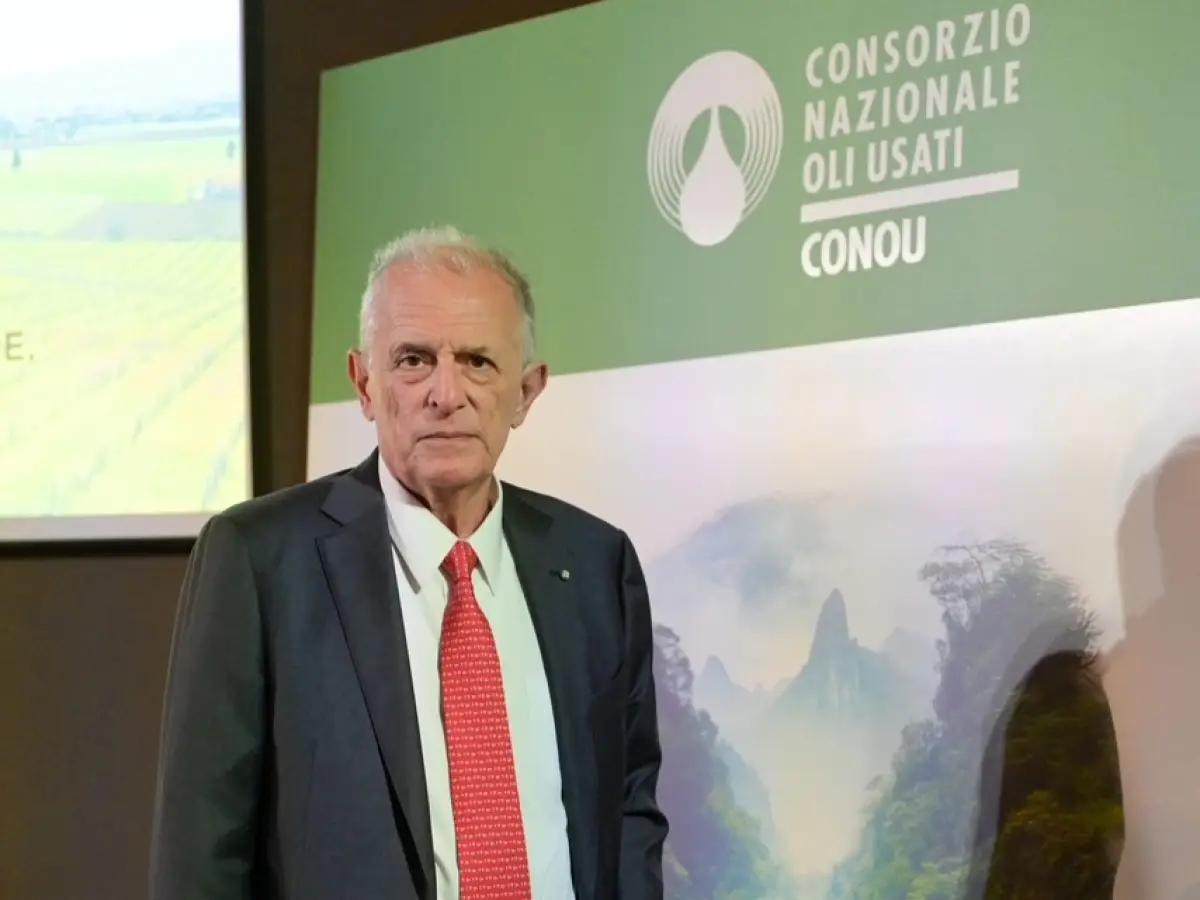
According to Riccardo Piunti, president of the National Consortium for Used Mineral Oils (CONOU), the measure risks causing environmental effects that contradict the stated goals of zero pollution. “The POPs Regulation is a tool that targets many pollutants and is rightly kept up to date. The problem arises from a very specific amendment, the one on PCBs, where the practical effects on the supply chain have not been fully assessed,” Piunti immediately clarifies in an interview with us.
Regeneration versus combustion: the risk of an Italian paradox
“PCBs, now banned industrial chemicals, were gradually eliminated starting in the 1970s, with the European Union banning them in the early 1980s, imposing increasingly stringent restrictions through the POPs Regulation and subsequent amendments,” explains Piunti. “In Italy, production stopped in 1984. Today, the lubricant industry no longer uses PCBs, and used oils generally contain negligibly low levels, mainly deriving from the (certainly improper) disposal of obsolete electrical equipment, such as small pole-mounted transformers, still visible today outside our cities, in the countryside.”
In Italy, in the meantime, the used mineral oil supply chain has developed over the years a model based almost exclusively on regeneration. “For many years now, Italy has been regenerating virtually all used oil, 98% of the 188,000 tonnes collected in 2024. Regenerated base oils are equivalent to virgin oils; they can be mixed without any problems and cover about one-third of national demand.” This balance, however, is at risk of being disrupted by the new thresholds introduced in the POPs Regulation currently being defined, significantly modifying the requirements on PCBs under the EU regulation on persistent organic pollutants.
According to CONOU estimates, even with a limit of 5 ppm, about 15% of the volumes – almost 30,000 tonnes per year – would no longer be regenerable. “With a limit of five, I would already have an operational disaster,” warns Piunti. “With 2.5 ppm (current hypothesis), we risk talking about huge percentages of oil to be sent for combustion.” An option that, in the Italian context, is by no means neutral. “In Italy, there are no facilities to burn it,” he continues. “There are few equipped cement plants, and they handle limited volumes. This means that the oil would have to travel abroad, to Germany or France, to be burnt. A wonderful touristic journey for the oil, at the expense of the climate and CO₂ emissions and, above all, the priority given to regeneration by the 2018 Waste Directive.”
Limits, measures and transition
The situation is made even more critical by the issue of measurement methods. Used oil is a complex, “dirty” medium that requires specific analytical tools. “The method we use today has a reliability threshold of around 4 ppm,” explains Piunti. “Going below that without a suitable method is no easy task. We require a system that works on complex materials and provides rapid responses: a tanker cannot wait two weeks to know what to do.”
Furthermore, the issue takes on a European dimension when considering the differences between countries. “France and Germany have significant amounts of oil that is already being burnt,” notes Piunti. “Moving a threshold certainly changes less for them than it does for us. For us, it changes everything.” There is a risk of competitive distortion that penalises the most advanced regeneration systems. “There is a European directive that says regeneration must be a priority. We really do apply that priority, and now we find ourselves in difficulty precisely because of that.”
Hence the proposal for a gradual approach. “We are not asking to stand still,” Piunti clarifies. “PCBs must be reduced; we all agree on that. Their levels are gradually decreasing, and no one is adding them deliberately. An intermediate threshold of 10 ppm for three years would allow us to find better methods and take advantage of the natural depletion of circulating PCBs. But let's do it in a non-traumatic way.”
The idea is based on the model of exemptions provided for other sectors, such as the dye industry – where PCBs are still widely used – currently subject to 25 ppm upon entry into force of the regulation and 10 ppm for the following three years. “Three years would be enough time to study better methods, understand what happens below 4 ppm and allow for the natural depletion of PCBs still in circulation.” The bottom line, concludes Piunti, is that environmental limits can no longer be set in an abstract way: “We used to say: this stuff is polluted, let’s burn it, and that’s that. Today, that no longer works. When we set a limit, we have to ask ourselves what the impact will be on the circular economy, on which the future and credibility of the European ecological transition depend.”
This content is produced thanks to the support of sponsors
Cover: Riccardo Piunti