



From Belém - In Brazil, there exists a very clear legal right, ratified over thirty years ago in an international treaty: the Consulta Previa Livre e Informada (CLPI). It stipulates that indigenous peoples must be consulted before the state approves projects, construction works, concessions or policies that impact their territories.
Not after, not halfway through the process, not “somehow”: before. Yet, this right, established by Convention 169 of the Organização Internacional do Trabalho (OIT), is treated by Brazil as a mere technicality, a bureaucratic nuisance to be circumvented whenever possible, delayed when convenient, and reluctantly applied when there is no alternative.
Because often, there is a wide gap between what states sign and what they actually implement. But the Consulta is not folklore: it is democratic power. It is meant to prevent decisions made from above from becoming established facts for communities that are the first to suffer the impacts of “major projects”: roads, dams, ports, mines.
It is a counterbalancing tool, a means of “checks and balances”, designed to act as a legal brake and protect those who live in, know and protect the most fragile ecosystems. The document is clear: indigenous peoples are “highly qualified” to evaluate the impact of these projects, exactly because they live in those territories. They are a living archive of environmental and social records, and therefore the Consulta becomes politically inconvenient for those who see the Amazon only as a storehouse of resources to be extracted.
The strength of this right also lies in the deep connection between communities and their territory. For indigenous peoples, their spaces are an extension of their identity, as memory repositories and as a guarantee of cultural survival. With massive deforestation and predatory activities, the risk is that in the coming decades there will be no more forests to protect and no culture to preserve ancestral knowledge.
Thaigon Arapiun, indigenous leader of the Baixo Tapajos community, reiterates it with fury and intensity: “The governor wants to arrange a consultation with us, but there should be no consultation afterwards. The consultation must be prévia, livre and informada.” These few words explain the entire process of self-determination of Brazil's indigenous peoples. In fact, ILO Convention 169, ratified by Brazil in 2003 and implemented in 2004, stipulates that consultation must be conducted through the representative institutions of these populations, with appropriate procedures that respect their cultures. “Livre” means that there must be no coercion or external pressure; “prévia” implies that dialogue takes place before the decision and not after; “informada” demands that all relevant information be shared in a clear and accessible manner so that communities can consciously assess the impacts of the works or policies.
But despite formally recognising the CPLI, Brazil, in practice, regards it more as an optional requirement, and communities have often complained of “resistência na aplicação do direito” (resistance to the application of the law). Easy to understand why: the Consulta is a tool that deprives institutions of the possibility of “acting first, explaining later”. It imposes transparency. It dictates time. It requires debate.
This is precisely the reason it is treated as an accessory loophole rather than a democratic foundation. And this is exactly why the word demarcão (demarcation) has echoed so loudly outside and inside the corridors of COP30 in these past few weeks. It is the clamouring demand of Brazil’s indigenous peoples to see their territories recognised and, above all, protected.
The demarcation of indigenous lands is, in fact, an administrative and legal process through which the state recognises and defines the boundaries of territories traditionally occupied by indigenous peoples. Mainly managed by the National Indigenous Peoples Foundation (FUNAI), this process involves a series of complex phases: anthropological studies, ministerial approvals, legal disputes and the physical demarcation of the territory constitute a bureaucratic process that is often exhausting and protracted.
Interests linked to agribusiness, the mining industry and logging exert strong political pressure to hinder demarcations, fuelling constant conflict between the state, indigenous communities and economic lobbies. In this scenario, demarcation continues to be a political and social act of enormous importance, the outcome of which directly influences the future of indigenous populations and the preservation of Brazilian ecosystems.
A few steps in this direction seem to have been taken: 10 indigenous lands, spread across Brazil's five regions, are entering the physical demarcation phase after the signing of ordinances declaring their territorial boundaries. The act was signed by the Minister of Justice and Public Security, Ricardo Lewandowski, on Monday 17 November, on Indigenous Peoples' Day celebrated during COP30 and after the wave of protests that characterised the UN summit as well as that of indigenous populations.
The truth, however, is that this is only a partial victory: twenty other indigenous territories remain outside this first phase of demarcation, hanging in the legal limbo of the state. Indigenous land is subject to constant struggles and threats, yet if there is one thing the world has witnessed with its own eyes, it is that the strength of these traditional peoples is not destined to diminish. On the contrary, the strength of those fighting for their rights is more intense than ever.
Read also: COP30: Time to act for the defenders of the planet
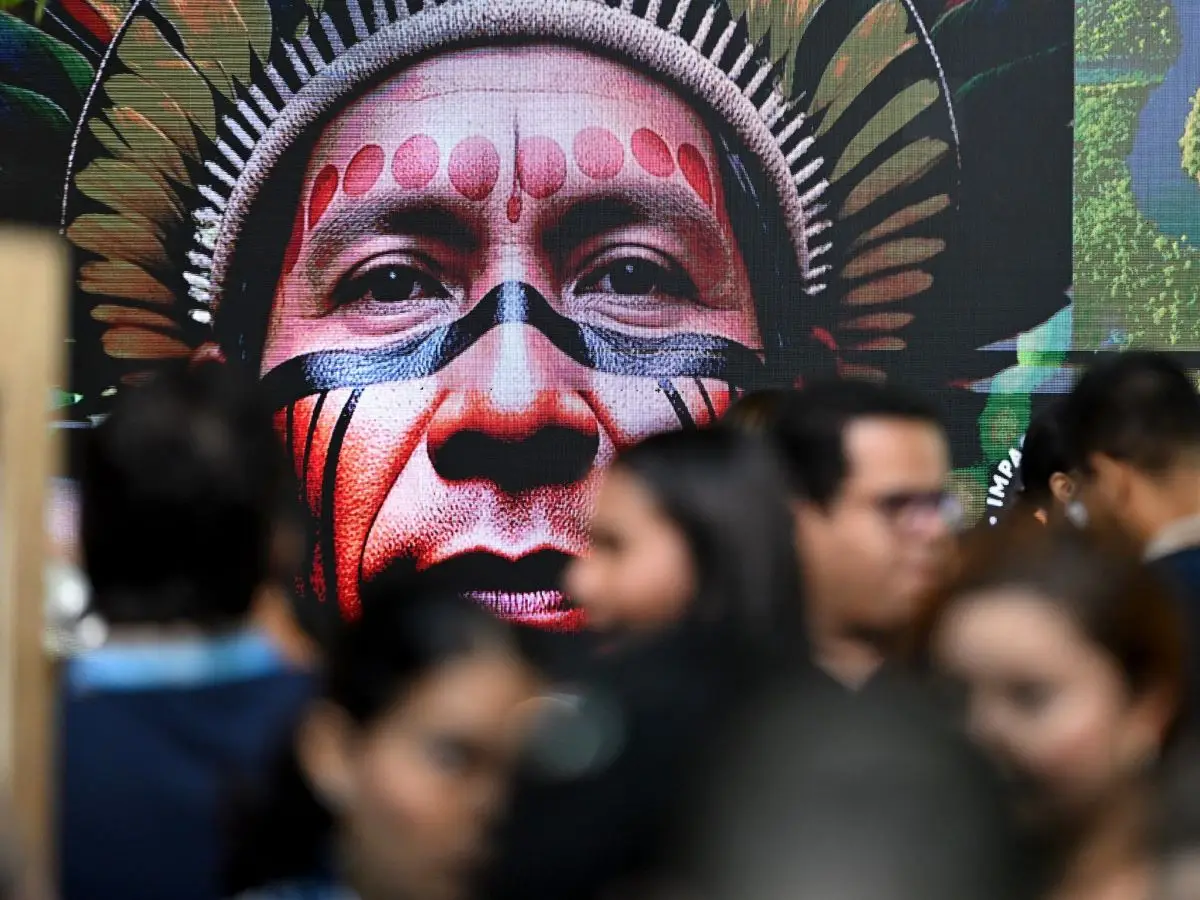
Cover: visitors down the corridor of the Green Zone at COP30. Photo by Alex Ferro/COP30