


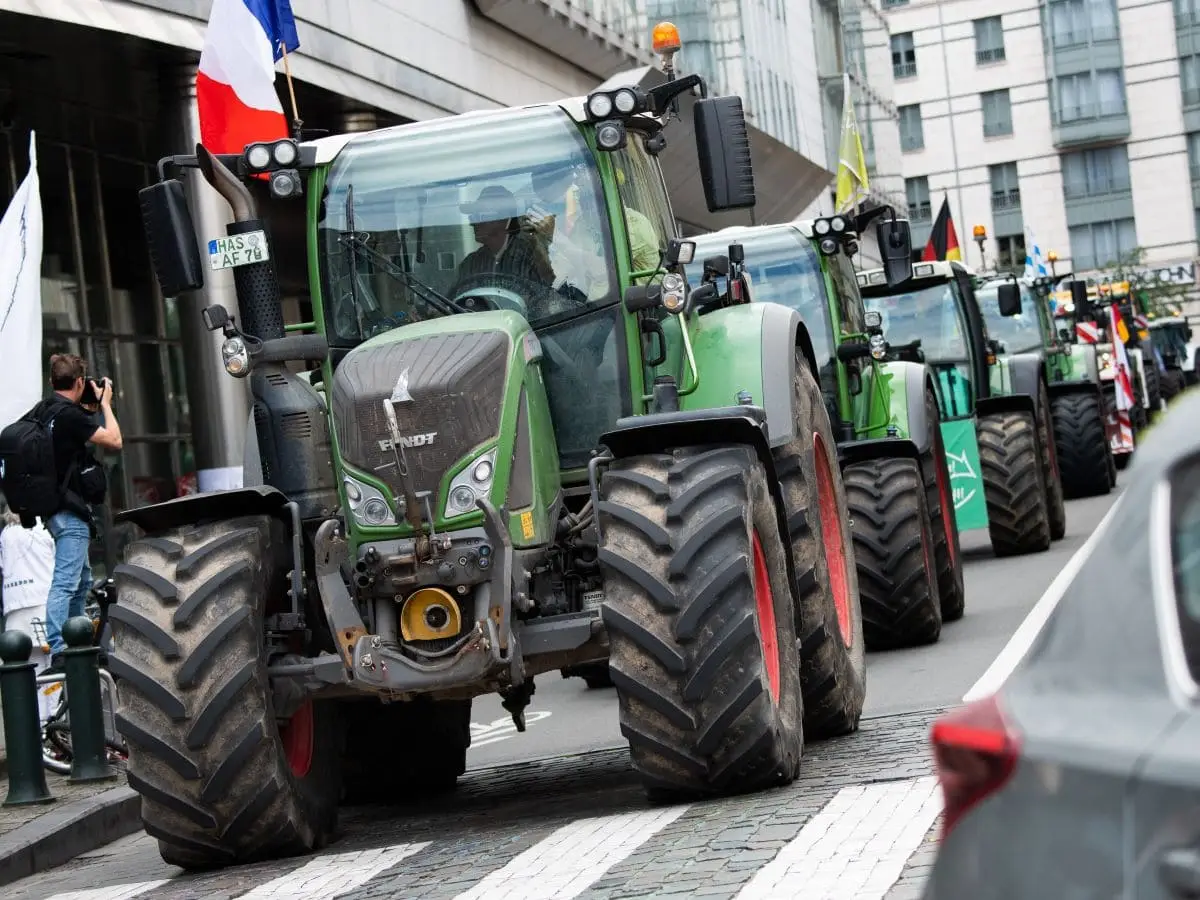

The European Union has decided to delay the ratification of the long-negotiated free trade agreement with Mercosur until January, following mounting political opposition and large-scale protests by European farmers in Brussels. The decision was taken on Thursday at the end of the European Council, one of the most consequential summits in recent years, where leaders also discussed financial support for Ukraine.
A postponed agreement with major economic stakes
Negotiations on the EU–Mercosur agreement, involving Argentina, Bolivia, Brazil, Paraguay and Uruguay, began in 2000 and have lasted over 20 years. Once ratified, the deal would create a market of about 780 million people, covering nearly 25% of global GDP, and would progressively eliminate tariffs on most goods traded between the two blocs, according to experts cited by Associated Press.
Despite its economic and geopolitical relevance, the agreement faces strong resistance from several EU member states, notably France and Italy, which fear negative impacts on their agricultural sectors. The postponement was reportedly secured after a phone call between Italian Prime Minister Giorgia Meloni and Brazilian President Luiz Inácio Lula da Silva. During the call, Meloni assured Lula that Italy would work to reassure domestic farmers and that the agreement would be signed in January. Lula later said Meloni was sure she could convince Italian farmers and asked for “a week, ten days, a month at most”.
According to Associated Press, the delay was agreed by European Commission President Ursula von der Leyen, European Council President António Costa and Meloni, on the condition that Italy would support the agreement in January. France, however, remains firmly opposed. President Emmanuel Macron reiterated that the deal “cannot be signed.”.
Voting rules and political uncertainty
For the agreement to enter into force, it must be approved by the Council of the European Union with a qualified majority: at least 15 member states representing 65% of the EU population. At the same time, a “blocking minority” of four countries representing at least 35% of the population could still derail the process. Given their demographic weight, Italy and France play a decisive role.
While Mercosur countries see the agreement as particularly advantageous for Europe, they remain interested in finalising it to expand agri-food exports to the EU. European producers, however, warn of unfair competition, especially in the meat sector, due to lower production costs and less stringent environmental and sanitary standards outside the EU. The European Union recently approved additional safeguard clauses, but it remains unclear whether these measures will be sufficient to overcome political resistance.
Farmers’ protests and economic concerns
The postponement came amid intense protests in Brussels. According to the Police of Brussels Capital, around 1,000 tractors and 8,000 demonstrators from Belgium, Italy, France, Spain and Germany gathered in the city on 18 December. Farmers demanded a Common Agricultural Policy that is “strong, common and well-funded after 2027”, “fair and transparent trade” and “real simplification and legal certainty”.
Coldiretti president Ettore Prandini warned that agri-food is Europe’s leading export sector and accused the Mercosur agreement of “once again selling off agriculture and agri-food”. He stressed the principle of reciprocity, arguing that imported products should respect the same rules imposed on EU farmers. Coldiretti estimates that cuts of €90 billion in the next EU budget framework would mean €9 billion less for Italy, threatening a national agri-food supply chain worth €707 billion, employing 4 million people and expected to reach €73 billion in exports in 2025.
Protests escalated into clashes near Place du Luxembourg, where demonstrators threw produce and set fires. Police responded with water cannons and tear gas, while public transport services were disrupted. Palazzo Chigi confirmed Italy’s position in a statement, reiterating that the government is “ready to sign the agreement as soon as the necessary answers are provided to farmers”. As negotiations continue, the Mercosur deal remains a litmus test for the EU’s ability to balance trade liberalisation, agricultural protection and geopolitical strategy.
Cover: Farmers protesting in Brussels in June 2024, photo by Bogdan Hoyaux © European Union, 2024