

The maturation of domestic environmental policies, programs and institutional capacity has contributed to the emergence of an ideology of Chinese global environmentalism that China has begun to deploy globally. This is a top-down, state-led developmental version of environmentalism that is beginning to put pressure on global environmental norms forged in the US and Europe.
Just days before Donald Trump’s inauguration in January 2017, Chinese President Xi Jinping levied a not-so-subtle criticism of the US in a keynote speech at the World Economic Forum in Davos. “As the Chinese saying goes, people with petty shrewdness attend to trivial matters, while people with vision attend to governance of institutions.” Moments later, he added: “We should honor promises and abide by rules... The Paris Agreement is a hard-won achievement which is in keeping with the underlying trend of global development. All signatories should stick to it instead of walking away from it as this is a responsibility we must assume for future generations”.
The remark was a reference to Trump’s campaign promise to withdraw the US from the Paris Agreement, and Xi’s point could not have been clearer. China was a responsible nation and a leader on environmental matters. The US was not. Western and Chinese media amplified the message, never mind China’s staggering level of GHG emissions or its continued buildout of coal-fired power plants. This marked an intensification of what former Australian prime minister Kevin Rudd has called the “new geopolitics of China’s climate leadership” (2020).
The official doctrine of Chinese environmentalism has been elaborated predominantly for China’s domestic context. A 2022 People’s Daily article, for example, spelled out the content of “Xi Jinping Thought on Ecological Civilization” in some detail. A few things stand out. This is a vision that first and foremost is led by the CCP (rather than the people or private sector). It speaks in civilizational terms; that is, civilizations flourish when ecology flourishes and civilizations have fallen when nature falters. The goal is harmonious coexistence of man and nature, although the exact definition of this remains unclear.
This connects Xi Jinping Thought directly to early Chinese notions of “harmony between man and nature” (tiānrén héyī), “the Way (Tao) follows nature,” (dàofǎ zìrán), and “take things in moderation” (qǔzhī yǒudù). The environment is a source of economic prosperity. Eco-civilization has a notion of collective justice because a healthy environment contributes to the welfare of all people. Xi Jinping Thought expressly recognizes eco-civilization as a “profound revolution in development concept” and a radical move away from earlier, coarser concepts of development. It includes a specific call for “coordinated management of mountains, rivers, forests, fields, lakes, grasslands, and sand systems,” which has manifested itself within China in the so-called “ecological redline” (shēngtài hóngxiàn) program – a massive nationwide zoning project. It calls for “systems,” “rule of law,” and individual action from Chinese citizens to help implement eco-civilization. [...]
[Above all], Chinese global environmentalism is a developmental concept. It was initially concerned with environmental limits on development and then evolved into an idea of green development as a vehicle for “higher quality growth.” The “core idea” of Chinese ecological civilization is Xi’s “two mountains theory.” While the concept has some historical resonance within China, its international translation – green is gold – comes across as purely developmental.
That is, the environment is a source of prosperity. One high-profile platform for the slogan was a UN Environmental Program (UNEP) report by Chinese authors entitled Green is Gold: The Strategy and Actions of China’s Ecological Civilization, in which ecological civilization is presented as a Chinese contribution to the UN 2030 Agenda for Sustainable Development (UNEP 2016).
Chinese leaders have incorporated this green rhetoric into Xi-era foreign policy language. Thus, Xi has promised to “make green a defining feature of Belt and Road cooperation” (China’s key Xi-era outbound investment strategy) with “cooperation on green infrastructure, green energy and green finance.”
Green framings mesh seamlessly with China’s general foreign policy language about promoting a “community of shared destiny” and providing the world with “shared benefits” and “global public goods.” These core concepts are qualified with reference to a hodge-podge of values such as “extensive consultation,” “joint contribution,” “policy coordination,” “infrastructure connectivity,” “unimpeded trade,” “connectivity,” “financial integration,” and “people-to people bonds.” This is a gauzy invocation of green values as a way to pursue a broader panoply of positive Chinese virtues.
Beyond this, China continues to position itself as a defender of Global South interests and to characterize the country as “the largest developing country in the world” (PRC SCIO 2021a). This includes continued invocation of the concept of “common but differentiated responsibilities” and the Five Principles of Peaceful Coexistence. These emphasize sovereignty and the right of developing countries to take more time in meeting global environmental goals while also obtaining help from developed nations. These arguments also draw strength from postcolonial discourses that see aspects of Western environmentalism as hypocritical or self-interested (i.e., that Western nations are asking the Global South to “do as we say, not as we do”). Chinese official rhetoric has also begun to emphasize the “civilizational” aspects of Chinese governance through programs like the Global Civilization Initiative, launched in 2023. The ostensible purpose of the initiative is to emphasize the importance of diversity of civilizations and discourses and to suggest that the Western “rules based international order” is only one acceptable approach among others (Xi 2023).
Underlying all of this is the notion that the steadying Leviathan of Chinese state power at the helm of a broader Chinese civilization is essential to achieving the utopian, win-win visions of Chinese global environmentalism.
These ideational aspects of Chinese global environmentalism are spelled out in an ever-growing body of policy and guidance documents. China’s strategic aims for its outbound green activities appeared for the first time in the April 2017 document Guidance on Promoting Green Belt and Road, issued by the Ministry of Environmental Protection (MEP), Ministry of Foreign Affairs (MFA), NDRC, and Ministry of Commerce (MOFCOM), to promote “the ecological civilization philosophy” and to build a “community with a shared future for mankind.”
The Xi era has also been marked by a growing proliferation of foreign language materials designed to convey Chinese ideas on global environmentalism to international audiences. These ideas are now regularly advanced through leadership speeches at the highest levels, official foreign policy statements, state-run media, and other publications. The four-volume set of Xi Jinping’s speeches, The Governance of China, published between 2013 and 2022, contains more than two dozen speeches on global and domestic environmental matters. The China Pavilion at annual UNFCCC climate negotiations is replete with books such as Xie Zhenhua’s China’s Road of Green Development, and Zhou Dadi’s Toward a Green and Low-Carbon Future: China’s Energy Strategy. The magnum opus of Chinese outbound messaging may be a 775-page English-language edited volume featuring essays from more than 70 leading Chinese scholars and researchers, entitled Beautiful China: 70 Years Since 1949 and 70 People’s Views on Eco-civilization Construction.
Overall, the gist of the message is that China’s approach to governance and its pursuit of its own self-interest will benefit the rest of the world in developmental and environmental terms. The most powerful idea here remains the notion that Chinese governance can deliver outcomes that other systems cannot. The subtext is that a Chinese-style approach to governance – with top-down, technocratic party-state leadership, marketization within bounds, and emphasis of economic over civil rights, among other things – is better suited to deliver these results.
While some commentators have argued that China is in a more ideological age with the ascent of Xi Jinping, the global message here is a pragmatic one as old as politics itself – come with me and I will give you the things that you desire.
A central question is what practical role green ideology plays in Chinese global activity. Does it do any real work or is it mere rhetoric? What is clear is that this is a massive effort to transform Chinese thinking about what constitutes “development” and the proper relationship of man and nature. Less resource intensive or polluting forms of growth are now prized in a way that they were not just a few decades ago. Whereas clean technologies are being presented as a “green scam” at the outset of the second Trump administration in the US (US White House 2025), they are seen as desirable “higher quality” development in China (Qiu 2024; People’s Daily 2025). The Chinese ideology also neatly creates a framework for China to take advantage of political economy dynamics that play in the country’s favor. Thus, China is seeking to escape the middle-income trap by aggressively cultivating advanced clean technology industries. This strategy helps to mitigate energy security risks, reduce strains on the environment and public health, and bolster China’s global reputation through contributions to global development and environmental goals.
Most of all, it is a strategy for China to capture the benefits of what it sees as an inevitable global transition to clean energy technologies (Boyd 2012) action on the ground.
How will contradictions between man and nature, development and the environment, or China and the rest of the world be resolved in practice? The doctrine of eco-civilization is beginning to have real bite domestically where it is altering China’s economic structure, industrial behavior, and land use patterns. However, there is no guarantee that this will continue, say, if the economy falters or leadership changes. Even if ideology translates into praxis domestically, it is likely to play out differently abroad. Might Chinese green ideology, for example, demand greater ecological protection at home, while tolerating greater environmental impacts globally in the name of development or simply due to weaker global governance capacity or concern?
Courtesy of the author: an analysis drawn from the essay Chinese Global Environmentalism (Cambridge University Press, 2026)

DOWLOAD AND READ ISSUE #62 OF RENEWABLE MATTER: CHINA
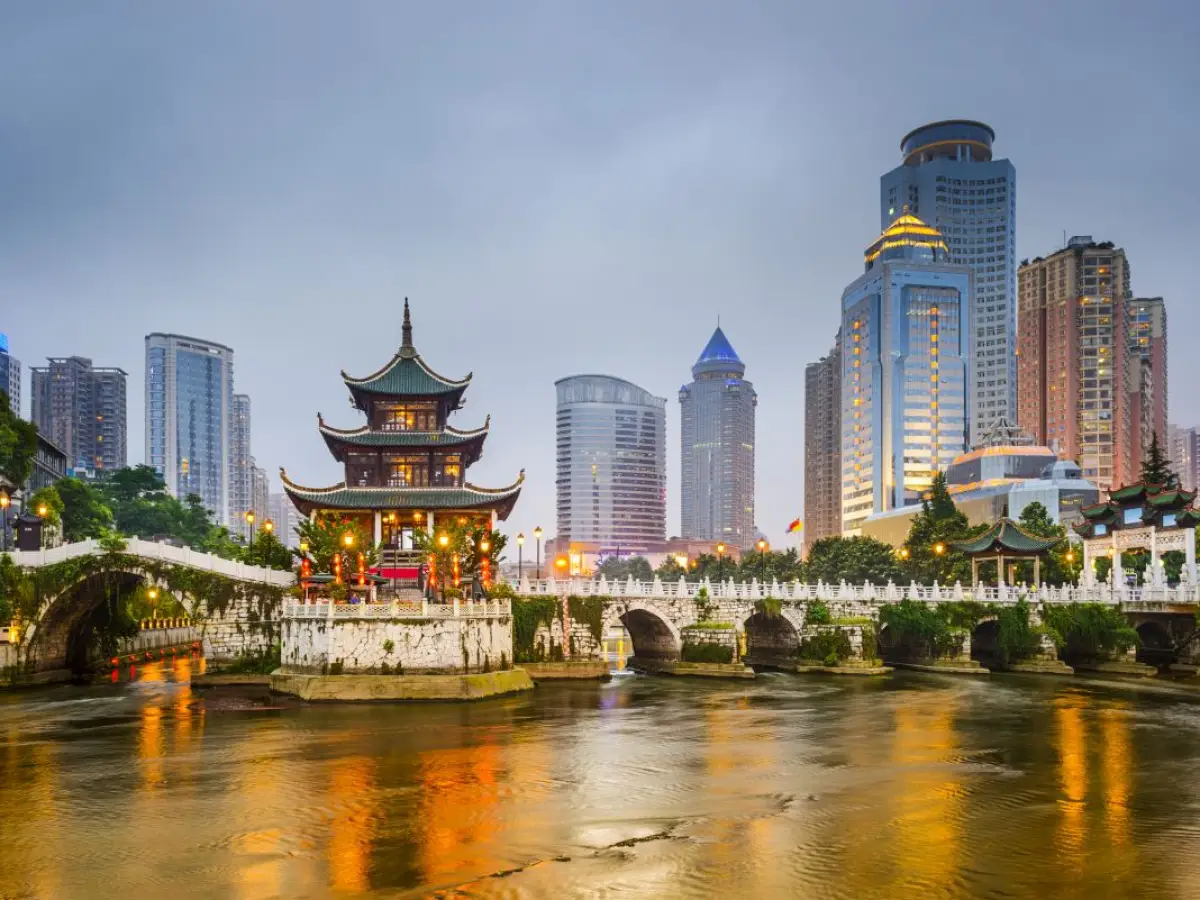
Cover: the skyline of the Chinese city of Guiyang, photo by Envato