


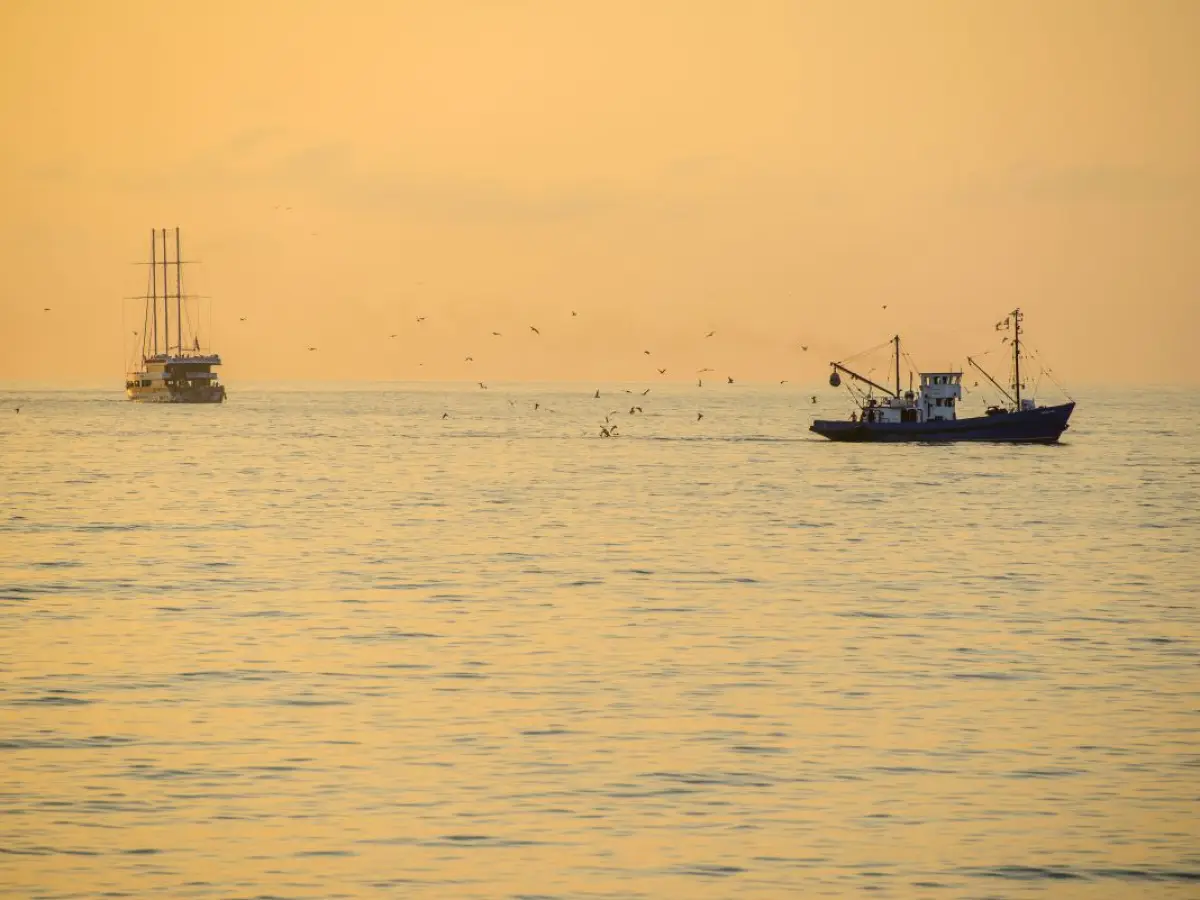

On a map, the waters of the Tyrrhenian Sea off Tuscany and of the Ionian Sea off Apulia are designated under Natura 2000, the EU network meant to protect vulnerable habitats and species. Underwater, however, trawl nets are still dragged across the seabed, causing profound environmental impacts. In September, ClientEarth and Legambiente, supported by Blue Marine Foundation, decided to take action against the Italian authorities over these two marine protected areas (MPAs), asking them to enforce the EU Habitats Directive by assessing the impacts of bottom trawling and, where needed, restricting it. The move is part of a broader European strategy to defend MPAs in court, pursued by the MPA Legal Coalition: eleven organisations, including ClientEarth, Environmental Justice Foundation, Oceana, Seas At Risk and Blue Marine, that connect national legal actions to a coordinated effort at the European level.
Italian government data shows that MPAs cover around 11% of the country's waters. However, a Greenpeace analysis found that only less than 1% is effectively protected, a long way from the 30% target for 2030. The first site, Tutela del Tursiops Truncatus, covers roughly 374,000 hectares off Tuscany within the Pelagos Sanctuary, the cross-border marine mammal reserve shared by France, Italy and Monaco and one of the largest MPAs in Europe. The area was designated as a refuge for bottlenose dolphins, yet the NGOs call it a "paper park" because bottom trawling is generally still allowed.
The second, Litorale di Gallipoli-Isola di Sant'Andrea, is in Apulia and hosts seagrass meadows and reefs. Much of it has never been mapped, and trawlers continue to work in it. Remarkably, about a third of the Mediterranean's bottom trawlers sail under the Italian flag, according to ClientEarth, putting heavy pressure on fish populations and marine habitats.
"These two sites were chosen because they share the same weaknesses and issues," underlines Francesco Maletto, Ocean Lawyer at ClientEarth. "Both MPAs were designated for Posidonia meadows and coralligenous habitats, but in both bottom trawling takes place and they lack the mapping needed to manage them. The Tuscan site is also much smaller than the Pelagos Sanctuary, a cross-border conservation area with scarce regulation and inadequate enforcement."
The gap between protection on paper and in practice
The legal claim brought forward by ClientEarth and Legambiente does not call for new legislation, but for the effective enforcement of the existing one. "The rules are set and they are ambitious. We do not need to change them; we need to apply them and make them work," explains Maletto, who points to an enforcement gap: the distance between protection on paper and protection in practice.
The legal basis is Article 6 of the EU Habitats Directive. Under it, authorities must prevent the deterioration of designated habitats, and any activity that could affect a site may go ahead only after its impact has been assessed and proven harmless. In Italy, that assessment is known as VIncA (Valutazione di Incidenza). "Trawling takes place in these areas indiscriminately, without any evaluation of its impacts," says Maletto. "That assessment is mandatory, yet it is not being done for fishing. These are obligations already in force in our legal system, but politics often lacks adequate enforcement to respect them." Maletto points out a distinction between Natura 2000 sites and Italy's national MPAs. Trawling is already banned in the latter, so the problem does not arise there. The issue lies in the Natura 2000 sites, where the measures needed to protect habitats, such as bans and zoning, have not been put in place.
From administrative requests to the Lake Vico precedent
The Italian case is still at an early stage, since the organisations have not yet gone to court. They have submitted administrative requests asking the competent regional authorities to take the necessary measures to protect the two sites. "If the authorities act on this request, we get real change without needing to go to court," John Condon, Lead Lawyer of the Marine Ecosystems team at ClientEarth, explains to Renewable Matter. "If they do not, we will consider whether it is necessary to escalate the matter to the Administrative Court to bring about real change."
The Habitats Directive obliges authorities to take actual measures to prevent habitat damage, whether they act on their own or are later ordered to by a court. This law is built to require action, and the Italian case offers a precedent. In 2024, ClientEarth won a landmark ruling from the Council of State on Lake Vico, which for the first time recognised that this part of the Habitats Directive can be directly enforced. Condon adds that "the court ordered the Lazio region to take real corrective steps within six months, and the ruling could not be appealed". A similar outcome for the two marine sites, he points out, "could mean the authorities are legally required to take meaningful action in the water, such as mapping the seabed, assessing the risks of bottom trawling on the protected area, and putting in place real protective measures, possibly including trawling restrictions".
A legal strategy on a European scale
The Italian case is part of a broader scenario, with litigation over bottom trawling in protected areas now under way in France, Spain, the Netherlands and Germany. In May, the District Court of The Hague ruled that Dutch trawlers could no longer fish in the Dogger Bank protected area without a permit and an environmental assessment. Linking these efforts is what the MPA Legal Coalition was created for, and according to Condon, it adds value in three ways. The first is coordination, because, instead of proceeding in isolation, national actions converge into a broader European strategy.
The second is a shared evidence base. Members from different NGOs exchange legal analysis, scientific evidence and lessons from their own cases, which is important because EU law requires decisions affecting protected sites to rest on the best available science. And yet, Condon points out, "destructive activities such as bottom trawling continue to be authorised in marine protected areas despite extensive evidence" of their potential impacts.
The third is pressure on the European Commission. Coalition members have filed two complaints covering six Member States: Denmark, France, Germany, Italy, the Netherlands and Spain. They ask Brussels to ensure compliance with the Habitats Directive and to use its enforcement powers where necessary.
National cases and Commission complaints, Condon explains, are "closely connected, but they serve different and complementary purposes". National cases like the Italian one are tied to specific sites, yet their implications can reach further, because the obligations stem from common EU law, and a ruling in one country can set a precedent for others. The complaints to the Commission work at a different level. They target systemic non-compliance, and the sites they cite serve as "representative examples" of wider failures. If Brussels opens infringement proceedings, a Member State can be required to bring its entire governance framework into line with EU law, not just the single area at issue.
The 30% by 2030 target
The EU has pledged to protect 30% of its seas by 2030, but the Coalition argues that areas which exist only on a map should not count towards that goal. Legambiente has made a similar call, asking for the ban of bottom trawling in MPAs by 2030, in line with the EU's 2023 fisheries action plan.
For both Maletto and Condon, the rules are already written and what is missing is their application, and courts are only one way to get there. "Our approach is constructive; litigation is an important tool, but it has to drive good policy," Condon concludes. "We engage very closely with policymakers in Brussels and across Europe by providing clear and pragmatic policy recommendations to ensure that MPAs work both for the environment and coastal communities. Acting collectively enables us to demonstrate that shortcomings in MPA management are not isolated national problems but reflect wider implementation and enforcement gaps across Europe."
Also read: Nothing fishy about fish: consumer demand drives push for more sustainable seafood
Cover: Envato image