


This article is part of the thematic channel The Water Observer: subscribe to our newsletter and receive exclusive contents from the world of water
One hundred and ten European citizens; not a single sample was free of TFA – trifluoroacetic acid (an ultra-short-chain PFAS) – detected in the blood of all volunteers involved in an exploratory study. Concentrations were approximately four to five times higher than the combined levels of the four long-chain PFAS analysed. This finding highlights a gap at the heart of the political debate: for the most abundant substance among those measured, there is still no health reference value that would allow the risk to be assessed based on blood levels.
The report, commissioned by the Greens/EFA Group, presents the interpretation of the data carried out by researchers at Vrije Universiteit Amsterdam, based on analyses of the samples conducted at the University Medical Centre Hamburg-Eppendorf. The study focused on four long-chain PFAS (PFOS, PFOA, PFHxS and PFNA), referred to as EFSA-4, and five ultra-short-chain PFAS.
The samples were collected in the summer of 2026, while 79 of the 110 participants completed a questionnaire on possible exposure factors. This sample, therefore, does not represent the entire European population but rather serves as an indicator to test the scope of monitoring and the effectiveness of policies in reducing exposure.
Data from the TFA study
The report, presented to the European Parliament, addresses two issues: the persistence of exposure to “historic” PFAS and the need to better understand exposure to ultra-short-chain molecules. “We launched an analysis campaign looking for both the best-known PFAS and those that the lobbies want to protect by claiming they do not accumulate in our bodies,” Cristina Guarda, a MEP representing the Greens/EFA, explains to Renewable Matter. “The result is plain for all to see: poisoned blood. We tested 110 people across nine European countries, and in every single one of them we found TFA, the smallest and most indestructible of the PFAS. A substance that ECHA classifies as toxic to reproduction.”
The median level of TFA – a pollutant resulting from the degradation of numerous fluorinated compounds – and even of other PFAS is 21.2 nanograms per millilitre, compared with 4.6 for the sum of the EFSA-4. The compound accounts for approximately 81% of the mass of the detected PFAS: a proportion referring to the substances identified in the study, not to the entire PFAS family. According to the report, the median is the highest yet reported in human serum; this does not mean that every individual value constitutes a record. Among other ultra-short-chain compounds, only PFPrA was detected in 23% of participants and at relatively low levels.
The report, however, distinguishes between persistence in the body and repeated exposure. Unlike long-chain PFAS, TFA is eliminated quicker. The concentrations observed therefore suggest frequent exposure to significant amounts in everyday life; they do not indicate biological accumulation similar to that of historical compounds.
Measurable risk and uncertain risk
For the EFSA-4, all of which occurred in the samples, a health-based comparison is possible: 27 out of 110 participants (25%) exceeded the serum reference value of approximately 6.9 nanograms per millilitre derived from the EFSA assessment. Exceeding this value does not equate to a diagnosis but indicates levels at which health effects cannot be ruled out. Four of the 46 women of reproductive age exceed the reference value, linked to the protection of their children’s developing immune systems.
“There is no alternative: PFAS must be banned, and the phasing out of the production and use of these substances must be planned, supported and carried through,” continues Guarda. “We can no longer wait, nor can we allow ourselves to be the ones to pay the price. If the Commission and Member States vote against the ban on PFAS, they will be knowingly complicit in an environmental and public health crime.”
For TFA, however, there is no applicable threshold for serum concentrations. The report refers to the recommendation by ECHA’s Risk Assessment Committee to classify it as toxic to reproduction and to EFSA’s reduction of the acceptable daily intake to 0.014 milligrams per kilogram of body weight. An ingested dose, however, is not directly comparable to a blood concentration: the results therefore do not allow for a conclusive assessment of individual risk from TFA.
The sources of exposure also remain to be clarified. Reported consumption of fish, seafood and meat is associated with higher levels of long-chain PFAS. For TFA, an inverse association with meat consumption emerges, but dietary information is insufficient to explain this. No clear relationships emerge with bottled water or tap water, non-stick cookware or reported proximity to industrial sources: this absence of associations, given the study design, does not prove that these factors are irrelevant.
From analysis to financial liability
PFAS pollution is taking an increasingly heavy health and environmental toll. In 2019, the Nordic Council of Ministers estimated that the health costs alone of exposure within the European Economic Area ranged from 52 to 84 billion euros per year. A journalistic investigation coordinated by Le Monde, however, put the cost of reclaiming Europe over a twenty-year period at between 95 and 2,000 billion euros, depending on the scenario considered. A study commissioned by the European Commission and published in 2026, on the other hand, puts the total costs of PFAS pollution at between 330 and 1,700 billion euros by 2050.
The key industrial issue – beyond the full application of the polluter pays principle – is the distribution of costs between prevention, the replacement of these molecules and the management of contamination. According to Guarda, “There is hope: regulation works, provided it is swift and comprehensive. Four legacy PFAS have been banned one by one. However, there are more than ten thousand PFAS. We cannot proceed one substance at a time.”
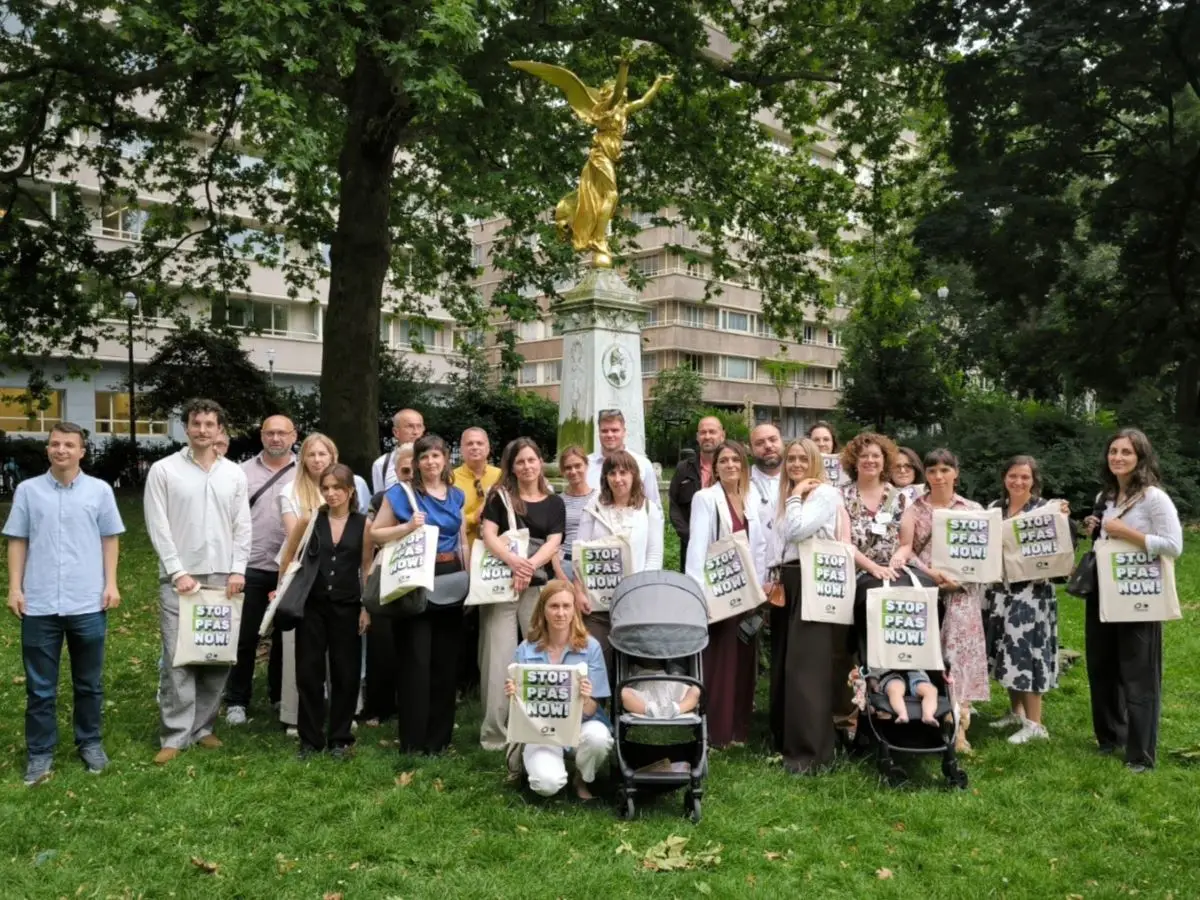
Cover: some volunteers who took part in the sampling, with their family members