

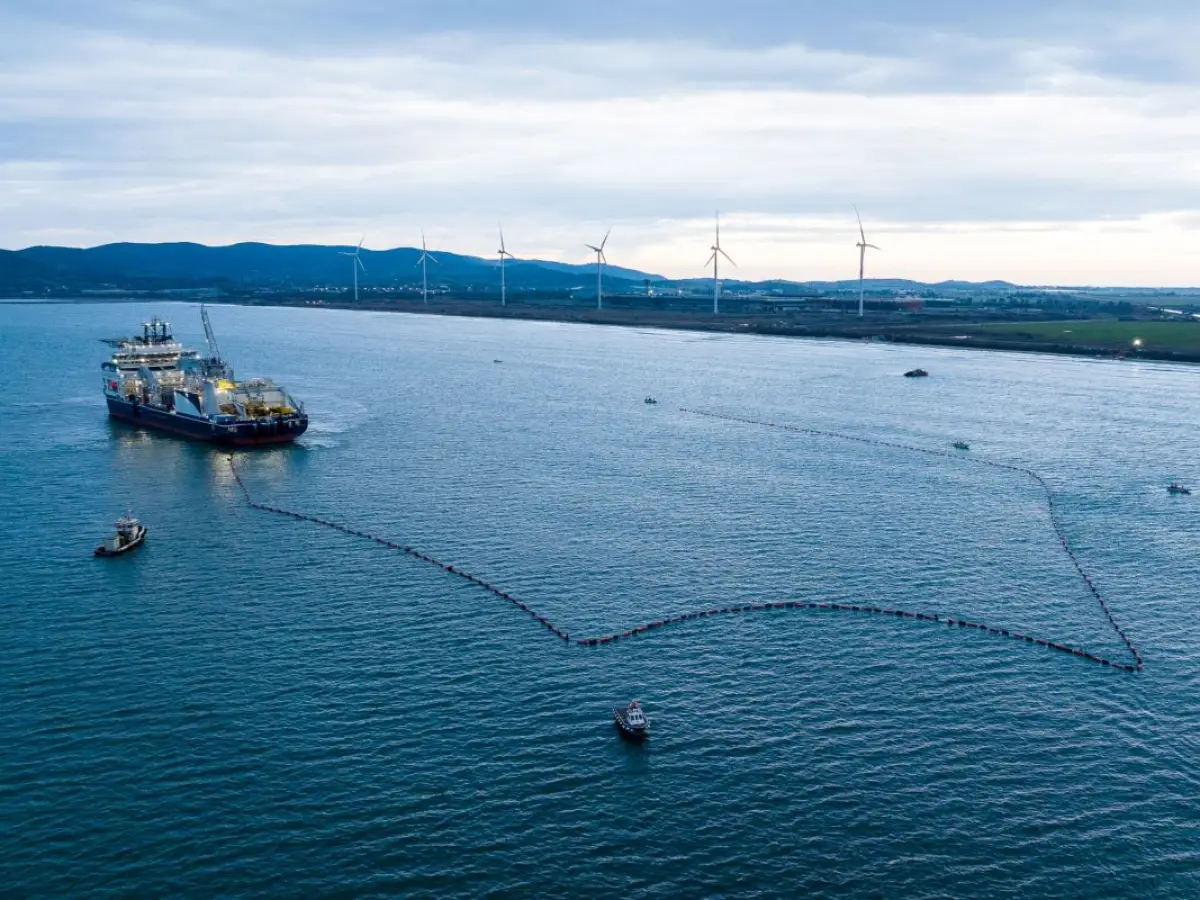

A crucial part of Italy's energy future is currently being built under the sea. An invisible network of cables connecting islands, regions and even continents, making the national electricity grid more secure, flexible and capable of accommodating the rise of renewable energy.
This is Terna's grand strategy for submarine electricity interconnections: thousands of kilometres of underwater infrastructure for several billion euros in investments, partly supported by the European Investment Bank (EIB), the National Recovery and Resilience Plan (NRRP), the REPowerEU plan and funds from the European Commission and the World Bank.
The record-breaking power line
There is a clear idea behind the numbers: connecting what was previously separate, integrating the most isolated areas, and transforming Italy into an energy hub in the heart of the Mediterranean.
The project that symbolises this vision is the Tyrrhenian Link, the power line that will connect Sardinia, Sicily and Campania with two branches totalling 970 kilometres and 1,000 MW of power for each section. With an investment of 3.7 billion euros, of which 1.9 billion euros is financed by the EIB and 500 million euros by the NRRP through REPowerEU, the Tyrrhenian Link will be the longest and deepest submarine electricity connection in the world.
In May 2025, the installation of the first of the two cables of the East Branch, between Sicily and Campania, was completed; in September, the installation of the first cable of the West Branch began, which will reach a depth of 2,150 metres, a world record. When it becomes operational in 2028, it will balance production from renewable sources in the south with demand in the centre, contributing to grid stability and reducing congestion. Above all, it will make it possible to virtually “move” energy from the sun and wind, making Italy more energy independent.
Adriatic and Tyrrhenian Seas
On the other side of the peninsula, the Adriatic Link will connect Abruzzo and Marche with a 250-kilometre direct current cable, over 200 kilometres of which will be submarine, with a capacity of 1,000 MW. The 1.3 billion euros project will link the power stations located in Cepagatti (Pescara) and Fano (Pesaro-Urbino) and will serve to increase the exchange capacity between central and southern Italy, integrating renewable production and improving grid resilience. Once again, Terna has opted for controlled horizontal drilling (TOC) techniques to minimise the impact on the coastline and seabed. The Adriatic Link is expected to come into operation in 2029, but its importance goes beyond the technical data: it means a more interconnected country, where energy does not stop at regional borders.
In the west, the group led by Giuseppina Di Foggia is renovating one of the most historic connections in the electricity system, between Sardinia, Corsica and Italy, through SA.CO.I.3. Approximately 400 kilometres long and with a capacity of 200 MW, it employs the latest generation of materials and more efficient conversion systems. Financed also within the framework of the European programmes for trans-European energy networks (TEN-E), the new SA.CO.I. will stabilise the electricity systems and improve the quality of service in the three connected areas, while at the same time reducing transmission losses.
The Euro-African corridor of renewable energy
Then there is the connection that reaches beyond the European horizon: Elmed, the power line that will link Italy and Tunisia: 220 kilometres of submarine cable with a capacity of 600 MW, capable of creating a Euro-African green corridor. Co-financed by the European Commission, the EIB and the World Bank, it will connect Partanna (Trapani) to Mlaabi, on the Tunisian coast. This will be the first electricity bridge between two continents built to exchange renewable energy: an infrastructure that puts the European Green Deal into practice and will make Italy the gateway for clean electricity from North Africa.
For Terna, investments in networks “are the key to the energy transition” because “they allow for the integration of renewables, rendering the network more resilient and strengthening Italy’s role as an energy hub in the Mediterranean.” This is also why large submarine cables are not just works of engineering: they narrate a vision of the country. An Italy that builds bridges, not barriers, and invests in what cannot be seen, yet makes everything else possible. Under the sea, between the Italian coasts, the grid of the future is coming to life, a network that connects territories, technologies and people in a single direction: that of energy independence.
This content is produced thanks to the support of sponsors
Cover: photo by Terna