

From an Earth-based workshop to an orbit around the planet. It is in this vein that Thales Alenia Space has built its role as a leading player in the space economy, an increasingly rich and important sector for the future, one that attracts economic and geopolitical interest and appetite. In Italy alone, the sector generates an annual turnover of over €2 billion and employs more than 7,000 people, and the figure is constantly growing. You cannot have influence if you are not in the room, and Thales Alenia Space, which has achieved great successes in its history, has the strength to link the Italian industrial supply chain to major European and international programmes.
The Thales Alenia Space system
In a field where public and private sectors collaborate and competition demands volume, quality, and reliability, Thales Alenia Space takes a pragmatic approach: it leads complex programmes as prime contractor, maintains long-term relationships with the European and Italian space agencies, and has a production base covering the entire cycle, from design to its new factory, with clean-room activities and operational applications on the ground.
A joint venture between the French company Thales and the Italian company Leonardo, with more than 8,000 employees across seven countries and over 3,000 in Italy, the company operates in telecommunications, navigation, Earth observation, exploration, and orbital infrastructure. Rome is the strategic heart, handling the integration of satellites, antennas, and equipment; in Turin, pressurised modules and scientific platforms are designed and built (a legacy of expertise that has produced more than half of the habitable volume of the International Space Station); Gorgonzola specialises in digital products and onboard computers; and, finally, L’Aquila manufactures electronic components for remote sensing and radar applications. It is an industrial presence capable of holding together the entire cycle, supported by a network of SMEs and research centres.
“Space is an increasingly privileged vantage point, and for a cutting-edge space industry capable of tackling the extreme challenges of a constantly evolving sector, innovation must necessarily be the key element in maintaining and strengthening competitiveness, not only by consolidating the network of current collaborators, but also by broadening relationships with research bodies, innovative startups, and SMEs in order to facilitate synergy between research, innovation, and industry,” says Giampiero Di Paolo, CEO of Thales Alenia Space Italia.
From satellites to the Moon
For Sentinel-1 NG, a programme under the EU’s Copernicus system whose resolution and “vision” capabilities it is improving, the European Space Agency has awarded the company the initial tranche of a €700 million contract. It will provide data for environmental protection, climate monitoring, and disaster assessment, as well as maritime surveillance and continuous, day-and-night monitoring of oceans, ice, land, and crops. Orbital observation is thus becoming civilian infrastructure.
At the national level, the company is one of the pillars of IRIDE, the constellation funded by the PNRR (National Recovery and Resilience Plan) and PNC (National Complementary Plan) and managed by ESA together with ASI, the Italian Space Agency. Thales Alenia Space will supply twelve small SAR satellites on the modular Nimbus platform along with one optical satellite, providing data for civil protection, public administration, and businesses, with extensive involvement of Italian SMEs.
The space economy is also about logistics and maintenance, after all. So, under ASI’s IOS programme (a €235 million contract as lead partner of a consortium with Leonardo, Telespazio, Avio, and D-Orbit), Thales Alenia Space is developing a demonstrator for in-orbit services: inspection, repositioning, upgrades, and refuelling, aimed at extending satellites’ operational life and reducing both costs and space debris, bringing together robotics, artificial intelligence, and re-entry technologies.
Attention remains on the Moon. Drawing on experience gained through the ISS, the company is providing pressurised modules for Axiom’s commercial space station, preparing ASI’s Multi-Purpose Habitat, and contributing habitation and logistics systems to the Artemis programme. With the Lunar Descent Element for the European Argonaut mission, it is working on the lander for the lunar south pole. At the same time, it is the prime contractor for ExoMars 2028, covering everything from atmospheric entry to landing, including the radar altimeter and integration of the rover’s analytical laboratory.
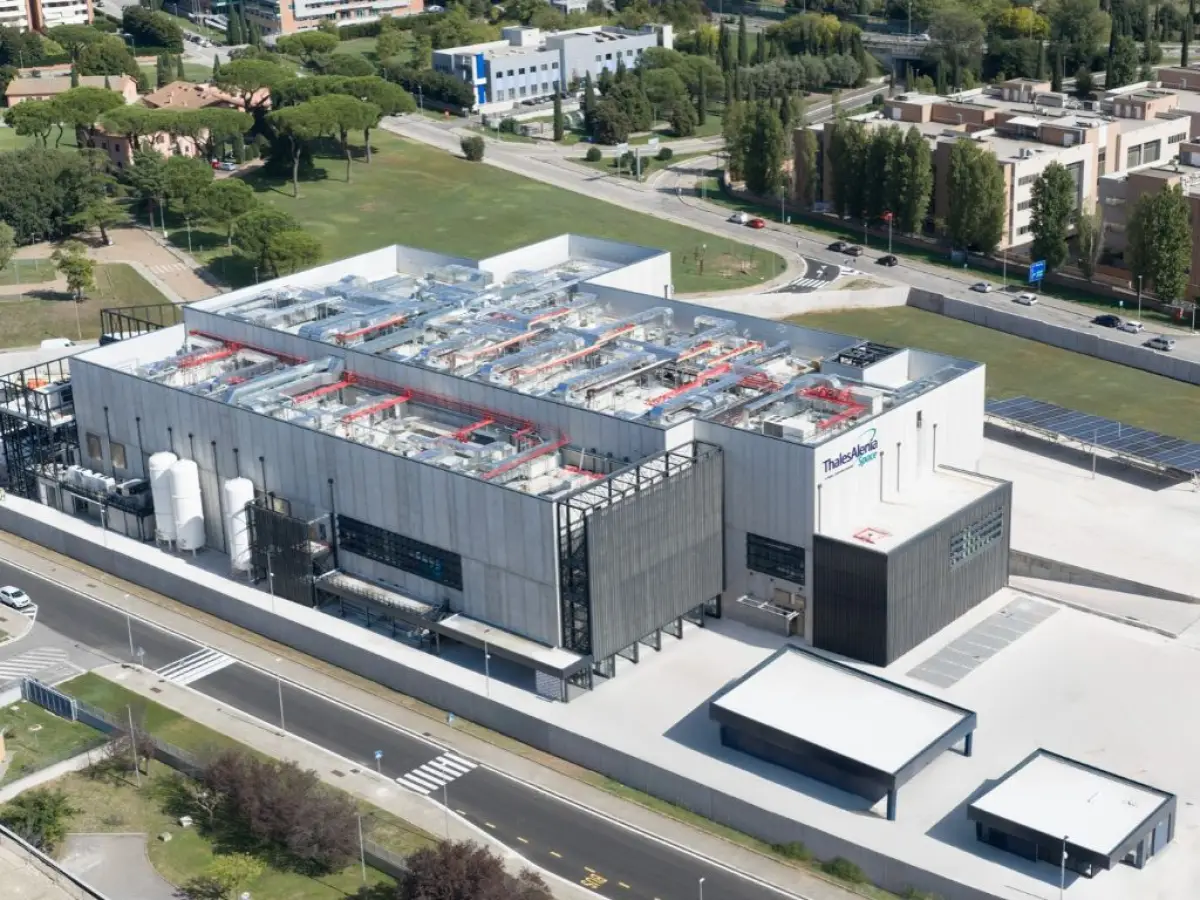
This capability has a new home: the Space Smart Factory, inaugurated in Rome on 7 October 2025 at the Tecnopolo Tiburtino, in the presence of President Sergio Mattarella. A 21,000-square-metre facility (5,000 of which are dedicated to modular clean rooms), representing an investment of over €100 million drawn from PNRR/ASI funds and resources from Thales and Leonardo. It is designed to manufacture over 100 satellites per year using digital twins, augmented reality, and robotics. The factory is open to research through the Space JointLab, and the first integrated satellite will be Sicral 3 for the Ministry of Defence.
Cover: Space Smart Factory - Thales Alenia Space