

This article is part of the thematic channel The Water Observer: subscribe to our newsletter and receive exclusive contents from the world of water
More than 5,000 registrations, 700 speakers and over 100 panel discussions and workshops: the first Euro-Mediterranean Water Forum wrapped up on Friday 2 October at the La Nuvola Convention Centre. Four days of discussions brought together institutions, international organisations, businesses, water utilities, the research community and civil society to address the major challenges facing water and water security across the Mediterranean. Organised by the Italian One Water Committee with the Union for the Mediterranean and the Mediterranean Water Institute of Marseille, the event was supported, among others, by the Ministry of Foreign Affairs and International Cooperation through CIHEAM Bari, with the Arab Water Council as a partner.
“From La Nuvola, there is a strong drive to make the Mediterranean the leading hub for water resilience,” said Maria Spena, president of the Italian One Water Committee. “The common thread running through the many discussions over these days has been a clear call for a water action programme involving all sectors across the board and giving space to every voice, with particular attention to local communities and populations most exposed to the effects of water scarcity and ecosystem degradation.”
Beyond the emergency: governance and the focus on water in the economy
More than a series of technical discussions, the first edition of the Forum - preceded by the adoption of the Union for the Mediterranean’s Ministerial Declaration on Water in the Mediterranean - painted a picture of a Mare Nostrum in search of a water policy worthy of its vulnerabilities. Around the world, after all, cities, river basin authorities, institutions and economic operators share problems that do not stop at administrative borders: drought, water quality, ecosystems under pressure and essential services that need to become more reliable.
Against this backdrop the run-up to the 42nd IAHR World Congress, scheduled to take place in Bari from 28 June to 2 July 2027, is taking place. Through the Road to Bari programme, the International Association for Hydro-Environment Engineering and Research (IAHR) is gathering the experiences and priorities of cities, river basin authorities and other stakeholders involved in water management. At the Forum, the association contributed to discussions on water governance, linking local needs to a broader basin-level perspective and international cooperation.
In Rome on 29 September, as part of the 39th General Assembly of WAREG, the association of European water regulators, WAREG and the International Network of Basin Organisations (INBO) signed a memorandum of understanding aimed at bringing together two levels of water governance that are often treated separately: on the one hand, the authorities responsible for the economic regulation of water services − tariffs, quality, investment and accessibility − and, on the other, the organisations responsible for planning and protecting water resources at river basin level.
The CEO Water Summit, opened by Retno Marsudi, the first UN Special Water Envoy, brought businesses and institutions together around commitments to protecting the water cycle and Mediterranean resilience. Underpinning the discussions was the question of financial resources. Infrastructure, networks, treatment and reuse facilities, nature-based solutions and information systems all require substantial, sustained investment.
“Every billion invested in the water sector generates 1.3 billion in GDP and 32,000 new jobs globally, with an impact greater than that of other infrastructure sectors such as energy, technology and transport,” Marco Pastorello, ACEA’s Chief Transformation Officer, pointed out from the stage, citing the World Economic Forum report Bridging the €6.5 Trillion Water Infrastructure Gap: A Playbook, produced with ACEA and the University of Cambridge. The document estimates the global investment gap for water infrastructure, to be closed by 2040, at 6,500 billion euros.
Italy at the Euro-Mediterranean Forum
Running alongside the Forum, the Water Festival, organised by Utilitalia, shifted the focus to Italy’s water system. The event opened with the presentation of the Water Resilience Pact, signed by 64 water service companies operating across the country. Together, the participating companies serve almost 42 million people, equivalent to 71% of Italy’s population. The Pact gives a concrete dimension to the word resilience: preparing services and infrastructure for a context in which extreme events and declining water availability can no longer be treated as exceptions.
On the sidelines of the 2026 Euro-Mediterranean Water Forum, ANBI (the National Association of Land Reclamation and Irrigation Consortia) and Schneider Electric signed a memorandum of understanding to support the technological innovation of Italy’s land reclamation consortia. The agreement aims to make water infrastructure more efficient, resilient and sustainable by drawing on tools and solutions for more advanced resource management. During the Festival, the results of IT-WATER, a project coordinated by the CIMA Research Foundation to develop high-resolution national scenarios for water resources through to 2070, were also presented for the first time.
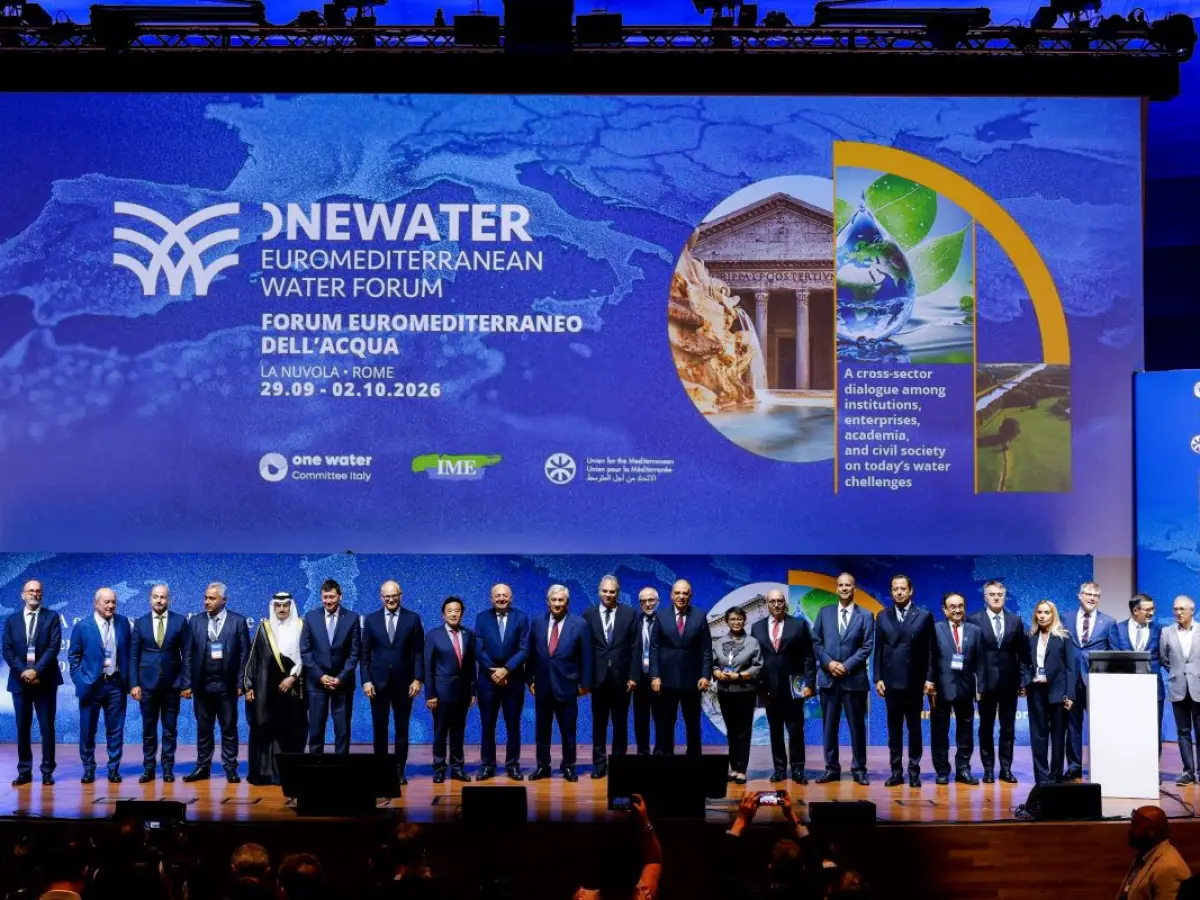
Cover: a group photo of the opening ceremony of the Euro-Mediterranean Water Forum by Giuseppe Carotenuto © FAO