

According to Aristotle, human beings are the only political species. Aristotle, however, lived 23 centuries ago. And despite the influence of his thinking on Western culture, the moral, rational and therefore political supremacy of humans over all other living beings is now finally being challenged.
Despite there still being a long way to go, non-human animals are starting to be regarded as political actors in various areas, as bearers of individual and collective demands, and as holders of fundamental rights such as the right not to be killed, exploited, imprisoned or mistreated. But also of the ability to express their needs and desires, and to be heard. For it is not true that they cannot speak, that they have no voice: “they make themselves heard, and constantly,” claims Dutch philosopher Eva Meijer, “you just have to pay attention.”
Writer, artist and researcher at the University of Amsterdam, Meijer is one of the most original voices in the field of new critical studies and political philosophy on animals. They have written several books on this topic, such as Animal Languages and When Animals Speak: Toward an Interspecies Democracy. “At the moment,” they write, “we live in a society built by our species, in which animals pay the price for exclusively human decisions”. But new forms of coexistence are possible, indeed necessary. Because a fair society today can only take the form of a multi-species democracy.
Let's start with words. Drawing on Jacques Derrida and his studies on language and power, you invite us to radically reconsider the distinction between “human” and “animal” that underlies the vast majority of cultures. Why is this distinction wrong?
For most people, this is a neutral state, but the way we humans think about other animals is actually shaped by various power relations. This can be seen everywhere in society, starting with language itself. As Derrida writes, using the word “animal” for all other animals is problematic in the first place because humans are also animals. And secondly, because all other animals are not an indistinct group, but are very different species, some of which are rather close to humans, while others are very different. However, using this word has a specific function: it creates a distance between humans and other animals, making it much easier to oppress them. It is important to highlight these aspects, which we take for granted, as they shape our world-view and render the oppression of other species so ingrained in so many practices of our culture that we do not even notice it.
In this regard, it is interesting to draw a parallel with other forms of discrimination within the human community, such as sexism, racism and ableism. In all these cases, we have started to change the language we use. What are the similarities with speciesism?
This is an important issue. When I first became involved in animal rights at the age of 15, in the mid-1990s, not much attention was paid to the subject. But now, within the field of critical animal studies and political philosophy, many scholars are addressing the issue from different angles. For example, Aph and Syl Ko have written a very important book, Aphro-ism, in which they reflect on the construction of animality in parallel with anti-black racism. Certain groups of humans are “animalised”, and this is part of the oppression. Women, for example, are often seen as “closer” to nature and animals. Aph and Syl Ko write that victims of animalisation are certain human groups, but also animals themselves, as they are used as a term of inferior comparison. Dinesh Joseph Wadiwel, in his latest book, Animals and Capital, spoke of “hierarchical anthropocentrism”: a hierarchy in which human white males are at the top and all other groups, human and non-human, are below. In essence, the power structure is centred on the degree of “humanity”: who is the most human of all? The problem is that when we fight this system by arguing that “we are also human”, we are merely reinforcing a structure in which being an animal is stigmatised. We therefore need to find alternative ways to challenge this status quo. Sunaura Taylor, author of the book Beasts of Burden about disabled humans and animals and the ways in which animals are disabled by humans in intensive agriculture, points out that it is not a question of developing a new set of standards to adhere to, but rather of accepting vulnerability and difference, and developing better systems that banish these violent hierarchies. People with disabilities are sometimes simply forgotten because they do not have the voice or the means to promote their cause. This situation is very similar to that of non-human animals, locked up in stables or cages, who cannot make themselves heard or go out and protest in the streets.
Hearing the voices of animals is at the heart of your research. However, you note that sometimes even activists fail to recognise animals' capability to speak out. Instead, we should learn to communicate with other animals, rather than just speaking for them. Why is this so crucial?
First of all, because as humans, we often simply don't know what they want. I believe that many activists still work with stereotypical views of animals' inner lives. But other animals have their own first-person perspective on their lives, and we need to reflect on the kind of society they want to form together with us. I'm not saying that we shouldn't use the language of rights and liberation as tools developed in the human sphere. Of course, we must use all the tools at our disposal. But beyond that, we must also ask other animals what it is they want. And clearly, we cannot ask them in the way that you and I are talking right now. I have written extensively on the subject of deliberation with animals and on multispecies assemblies as a means of knowledge and even as a form of government. Animals have the right to have a say in our common decisions: we should not only talk about them, but also talk to them. And this requires a different understanding of language. There are already many practices for discovering what other animals want, and there is a lot of research in ethology. A good example are “sanctuaries”, where non-human animals can live freely and their agency is promoted and supported, allowing them to speak for themselves. So, on the one hand, we as humans must criticise the way we treat animals. But at the same time, we must interact with them differently in order to form new societies and develop a different attitude towards them. And this is not only for their sake, but also for ours: we have a lot to learn from other animals about how to live sustainably on the planet.
Of course, today's relationship between humans and animals is full of contradictions: some we love, some we eat or use in laboratories, and others we fear. How can we steer our relationship with other animals in a healthier and more equitable direction? Perhaps by following the principle that Donna Haraway defines as “respect and regard”?
Yes, I think attention is a key point. A lot of people talk about using AI to finally understand what other animals are saying, but I'm pretty sceptical about that. The problem isn't that we don't understand what they're saying, it's that we don't listen to them. We really need to learn to pay attention; sometimes it's just a matter of observing them for a long time. I adopted 25 laboratory mice to save them, and by observing them, I learned a lot about them, about how they are completely different creatures from what we believe. Many people have similar experiences in their lives, but as a society, we don't act accordingly. Respect and consideration are something we can and must learn as individuals. But then we also have to translate this concept to the social level, to the community.
Speaking of communities, coexistence with other animals, especially wild ones, can sometimes turn problematic and lead to conflicts. As in the case of bears in Northern Italy…
In the Netherlands, we have a similar problem with wolves. The point is that humans think that the land belongs to them, but this is an entitlement we have given ourselves: no animal has ever signed a document saying “this is your land”. For example, when you want to build something and you say, “there's a vacant lot here”... Well, that land is not “vacant”, it is not “empty”: animals are living there, there are plants and trees. The first point to understand is that the land does not automatically belong to us and we share the planet with many other beings who may have more rights than us to certain places, because they may depend on them or may have arrived there before us. And then there's the issue of conflict. Humans aren't doing so well with each other these days, but we've still come up with some principles of democracy and fairness that might work well when dealing with other animals. The problem is that when humans don't like other animals around, they usually react with violence, simply trying to kill them or get rid of them. In an era of climate crisis, however, ecosystems are changing, and as a result, we will find ourselves managing more and more conflicts with different species. We will have to find ways to communicate. And by “communicate” I don't mean going up to the bear and asking “please don't attack us”. Landscape interventions can be used, for instance. Elephants are afraid of bees, so in order to prevent them from approaching a dangerous place, loudspeakers can be placed there to reproduce the buzzing sound of bees: they will learn that the place is to be avoided.
So, do we need interpreters and translators?
Yes, we need interpreters and diplomacy too. For example, there are bears in North America that “write” on trees, leaving “letters” to each other with scents and imagery. But these multispecies translations require biologists and ethologists who know how to interpret the signs. It is also essential to learn to accept that we share the world with other beings. My colleague Krithika Srinivasan, who researches dogs in the United Kingdom and India, has observed that in India there is greater tolerance and acceptance if a person is killed or bitten by an animal. I believe that cultural context plays a great role in how conflicts are addressed and resolved. And ultimately, there is no reason why animals should pay the full price of coexistence; it is a matter of give and take. Australian philosopher Val Plumwood recounts the time she was attacked by a crocodile in her canoe and nearly died. After this experience, she was not angry and did not want to kill the crocodile, as many other humans would have done. On the contrary, she felt deeply part of a larger living reality in which we are all connected. Being prey – as the text is titled – is something that we, as humans, have forgotten. But it is important to realise that we are vulnerable beings and that we too are part of the cycle of life.
Regarding coexistence with wild animals, you and other researchers are proposing an interesting solution: a new form of land rights that gives animals ownership of the land they live on. This could represent a real revolution in the field of habitat conservation. How would it work?
I am convinced that at some point we should get rid of the concept of “property”, step outside the capitalist structure and think about land rights based on community and cohabitation with the earth. Meanwhile, in the transition towards a fairer situation, many are reflecting on the rights of nature: natural entities should no longer be owned by humans, but only by themselves. For non-human animals, this could be very promising, not only from a justice perspective, but also from a conservation point of view. Today, in the Netherlands, as in many other places with a strong agricultural tradition, we do not have many wilderness areas. Every government or new landowner wants to do something different with the land and therefore simply destroys what has been done before, without worrying about the trees and animals that have settled there in the meantime. Non-human ownership of land would instead rely more on the wisdom and practices of these living beings. It would be really interesting if landowners started experimenting with these systems. It would work in two ways: against capitalism, but also against the annihilation of spaces for wild animals.
All these suggestions and ideas point towards a multispecies society and democracy. The question is: how should we build this kind of society in practice?
Recently, I have been working on the idea of a multispecies assembly. Take the climate crisis, for example. What we are seeing today in decision-making and legislation proves that our parliamentary democracies are not suited to dealing with this type of problem, as they are based on four-year election cycles: politicians do not think about the future, but only about what they can promise their voters in this short period of time. There is also a perceived gap between what politicians do in parliament and what people on the street experience and think. We therefore need to develop new forms of politics. One example is citizens' assemblies.
Like those proposed by Extinction Rebellion?
Exactly. The idea is to bring together people from different levels of society to form a representative group. These people learn about the topics to be discussed, debate them and formulate recommendations for the government. This is actually an ancient model of government, both in Western societies with the ancient Greeks, but also in many other non-Western societies. One of the problems with these assemblies, however, is that other living beings are not taken into account. And even when they are mentioned, for example, when discussing the environmental crisis, animals (or plants) do not sit at the table. So, I have developed a site-specific model where humans and other living beings can come together and deliberate on issues that affect everyone. It is easier with domestic animals because they are quite good at expressing their preferences. But wild animals, which are more distant from us, may need to be represented, and representation must be based on actual interaction with them. Now we would need this kind of local political experiment to gain knowledge about how to communicate politically with other animals, and then develop a system together. There are, however, already many suggestions for working towards a multi-species policy. For example, in the Netherlands, we have a Party for the Animals (Partij voor de Dieren), and in other parts of the world there are experiments with non-human representation in legal structures. We should then take various paths. First of all, we should use the system we have and try to change it from within, as the Party for the Animals does. Then we need to change the knowledge structures connected to it, and here the role of philosophy and science is fundamental. Finally, we need to think about new experiments, new forms of government suitable for interaction with other animals. On one hand, we need to reconsider how other animals fit into the structures we have; on the other, we need to fundamentally rethink the concepts and structures that determine our interaction with them. Democracy will have a different meaning in a multispecies society.
One last question. You live with many animals: dogs, cats, and mice. What have they taught you?
They taught me everything. Olli, the stray dog I adopted, taught me a lot about how a society is formed. We lived in a neighbourhood with many humans from different cultures, and some were afraid of him. But he was really diplomatic, much more than me, friendly to everyone, always giving everyone the benefit of the doubt. In a society focused on conflict, like the one we live in, I truly learned how important it is to be kind to others from him.
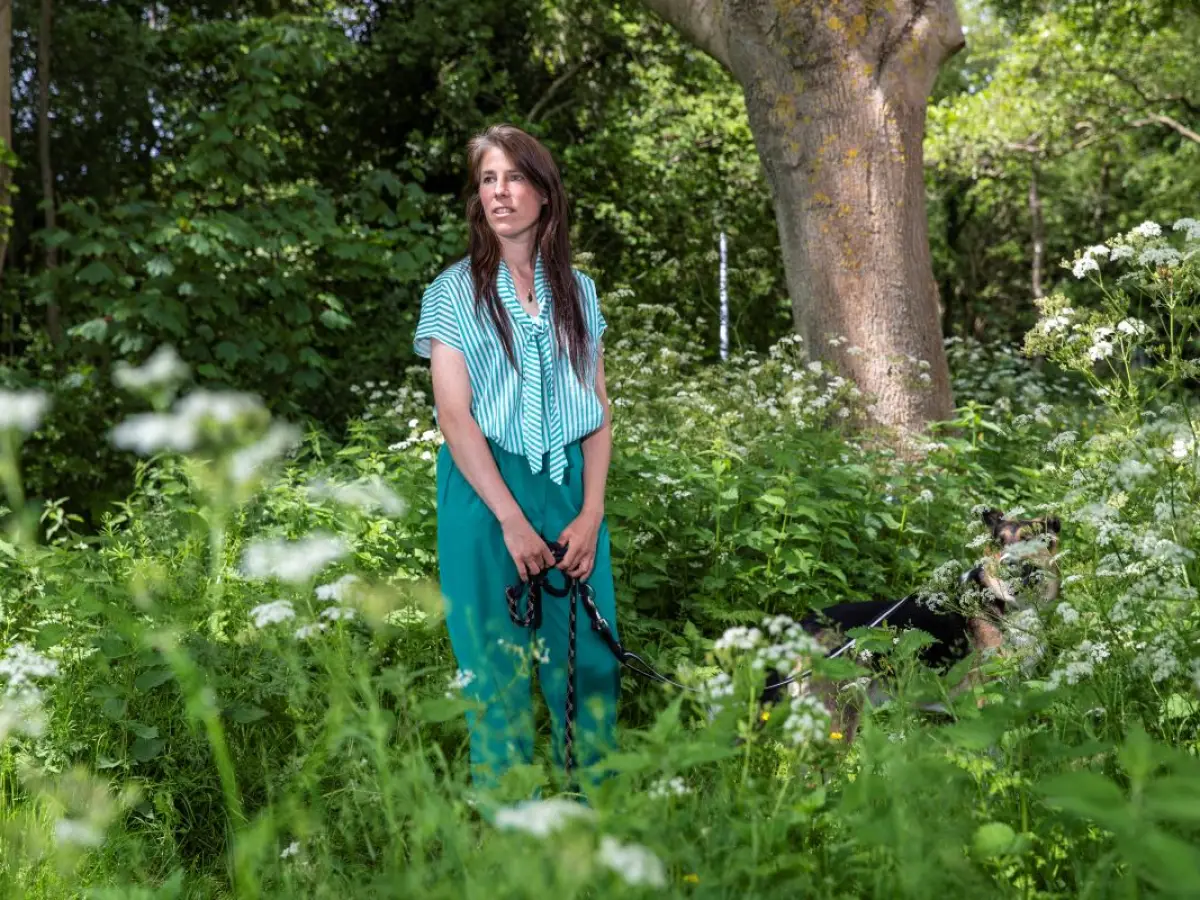
Cover: Eva Meijer