


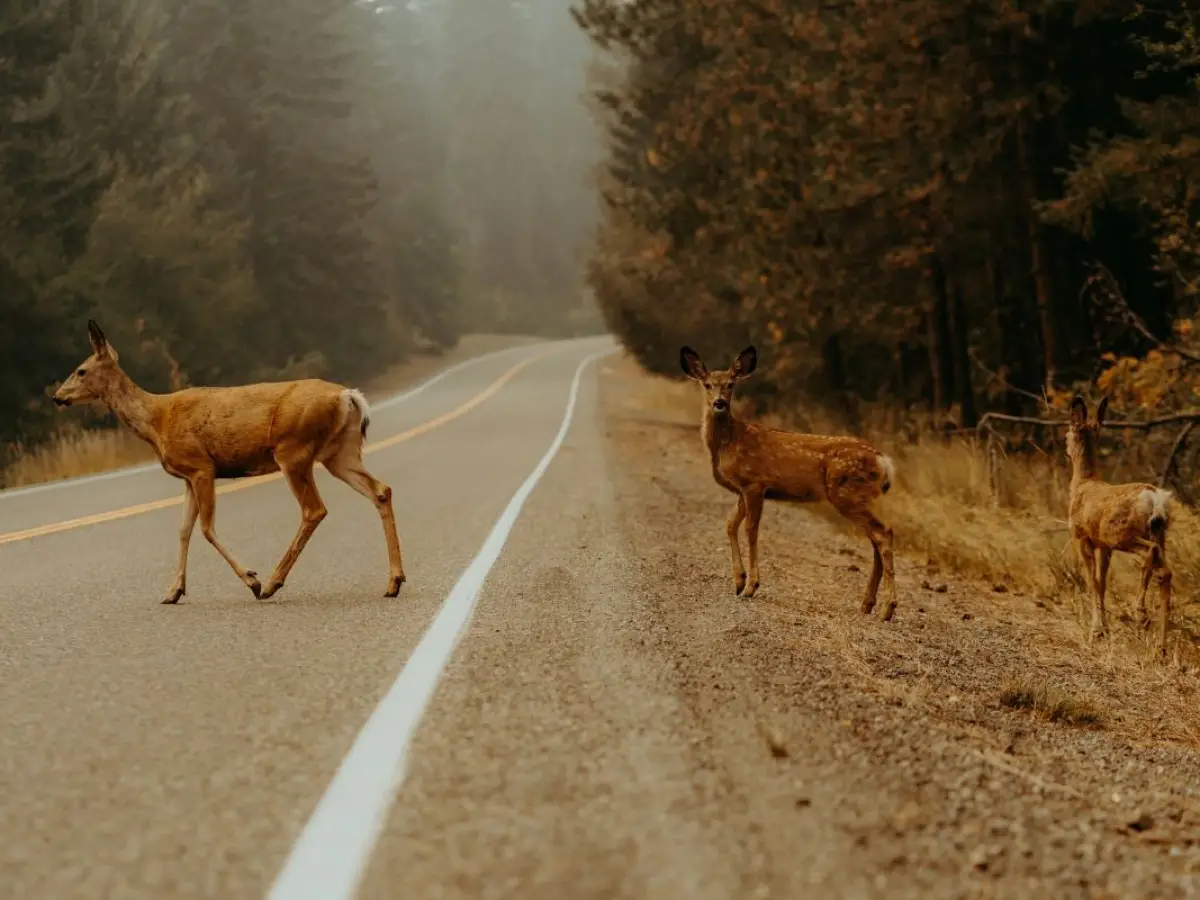

Journalistic coverage on the climate crisis and its environmental consequences has often overlooked the change in land use and its effects on wildlife movement. This is the focus of Roam: wild animals and the race to repair our fractured world (Patagonia, 2025), written by science journalist Hillary Rosner, an environmental reporter for US and international media and Environmental Journalism professor at the University of Colorado.
The author travelled across the United States as well as Central America, Europe, and East Africa to document how habitat fragmentation and human infrastructure interfere with the roaming patterns of wild animals, movements that underpin crucial ecological processes. The book challenges human-centric ways of seeing the world and invites the reader to embrace different perspectives, focusing on creatures whose existence is in peril due to a shrinking possibility to roam.
Wild animals need to move – for daily foraging, seasonal migration, and dispersal – but they are increasingly confined within a human-modified world. Roughly 40% of the planet’s land has been converted to agriculture, while cities continue to expand, with urban areas up by nearly 80% over the past three decades. Human infrastructure has also developed in parallel. According to the website Energy Monitor, an estimated $3.5 trillion was invested in road construction projects underway in 2023 alone, slicing landscapes into smaller fragments. Roads directly affect wildlife, with scientific studies estimating that approximately 100 million large mammals are struck and killed by vehicles each year. This number excludes all other species, emphasising that roads frequently become lethal barriers in natural landscapes.
The remarkable expansion of human infrastructure has led to a widespread loss of connectivity, a concept that lies at the heart of the book. “I define connectivity as the movement of species and the flow of natural processes that sustain life on Earth,” Rosner explains to Renewable Matter. “Connectivity takes several forms. Linear connectivity refers to the need to create new links between isolated landscapes, allowing animals to roam. Functional connectivity focuses on how to mend ecosystems so that essential processes continue to function and natural systems can evolve.” Together, these ideas make up the concept of ecological connectivity, which the International Union for Conservation of Nature (IUCN) defines as “the unimpeded movement of species and the flow of natural processes that sustain life on Earth.”
During her travels, Rosner also chose Italy to report on the efforts seeking to restore ecological connectivity and allowing wildlife movement. She visited the Abruzzo region, where the organisation Rewilding Apennines operates. Here, the NGO promotes a rewilding approach based on three key elements: large core protected areas, ecological corridors that connect them, and the presence of predators such as wolves and bears that help regulate the entire ecosystem. Abruzzo is also home to the Marsican brown bear, a rare subspecies with only about 60 individuals remaining.
“In Abruzzo, Rewilding Apennines is committed to safeguarding endangered species and restoring ecosystems,” Rosner continues. “I joined young volunteers to locate and cover open wells in the ground and to remove old fences. These may seem like small actions, but together they can make a real difference. With such a low number in the bear population, every single intervention matters. In Abruzzo, where villages are scattered and the population is declining, there are instances of local hostility to wildlife. That’s why cultural and social initiatives are also important to raise awareness among residents to coexist with the presence of wild animals.”
Conflicts between local communities and wildlife are present in other parts of Italy, particularly in Trentino, where brown bears were reintroduced more than twenty years ago. “In Trentino, I met Professor Francesca Cagnacci, who, together with other researchers, is leading a study on bear movements in relation to human presence,” Rosner explains. “They are combining data from GPS radio collars fitted on the animals with Strava app data tracking people who go trekking, biking, and other activities along trails. The goal is to study what is known as functional human disturbance, namely how the presence of people influences bear behaviour. Researchers have found that bears tend to prefer steep terrain and dense forests, while avoiding areas with a high density of human traffic. Understanding these movement patterns is crucial, as connectivity is not limited to physical barriers: even frequent human presence on trails can act as a barrier to wildlife movement.”
Animal movements across different landscapes are affected by human presence, which may lead to stress and conflict. At first glance, natural parks and protected areas might seem like ideal safe havens for wildlife. Protected areas cover about 15% of the Earth’s land surface; however, less than half of these areas are ecologically connected to one another, and many are too small to support the species that inhabit them. “Animals need to move beyond protected areas: this is a pattern I have observed in all my reporting, from Costa Rica to Kenya to Italy,” the author points out. “Many researchers have shown a direct link between the size of a reserve and the long-term stability of the species living there, highlighting the importance of connections between protected areas and their surrounding landscapes. Increasing fragmentation creates more ‘edges’ and breaks apart ecosystems, altering their biodiversity.”
“In protected areas too small to meet the needs of certain species, processes of defaunation may occur,” the author adds. “We tend to focus on extinction, when a species disappears entirely, but defaunation is just as important. It describes the gradual decline of animal populations when conditions can no longer sustain them, to the point where they shrink or are no longer able to perform their ecological functions.”
A key concept is the matrix, defined by scientists as the landscape outside protected areas that animals must traverse to move from one reserve to another. The matrix can include farmland, villages and highways, and it plays a crucial role in the movement and survival of wildlife living within protected areas.
“I visited Corcovado National Park in Costa Rica, one of the most biodiverse places in the world,” Rosner recounts. “However, the park is too small to fully meet the needs of the species living there. To ensure their survival, the land outside the park must be made more wildlife friendly. Park rangers are involving local communities in the creation of wildlife corridors and in planting native trees, having understood that effective conservation can only work if it is carried out together with communities.”
Engaging local communities is essential to developing initiatives that foster coexistence between wildlife and people, generating ecological benefits in the process. At the same time, prioritising connectivity can reshape our broader understanding of conservation itself. “Gary Tabor, founder of the US-based Centre for Large Landscape Conservation, explained connectivity to me through a metaphor: it is the circulatory system of nature, and we have done a poor job of conserving it,” Rosner concludes. “We have concentrated on the heart and lungs, the areas set aside around the world as off-limits to development. But those places cannot survive unless we also protect the circulatory system.”
Also read: Rewilding: Meaning and Benefits of Active Ecological Restoration
Cover: photo by Emmanuel Munoz, Unsplash