

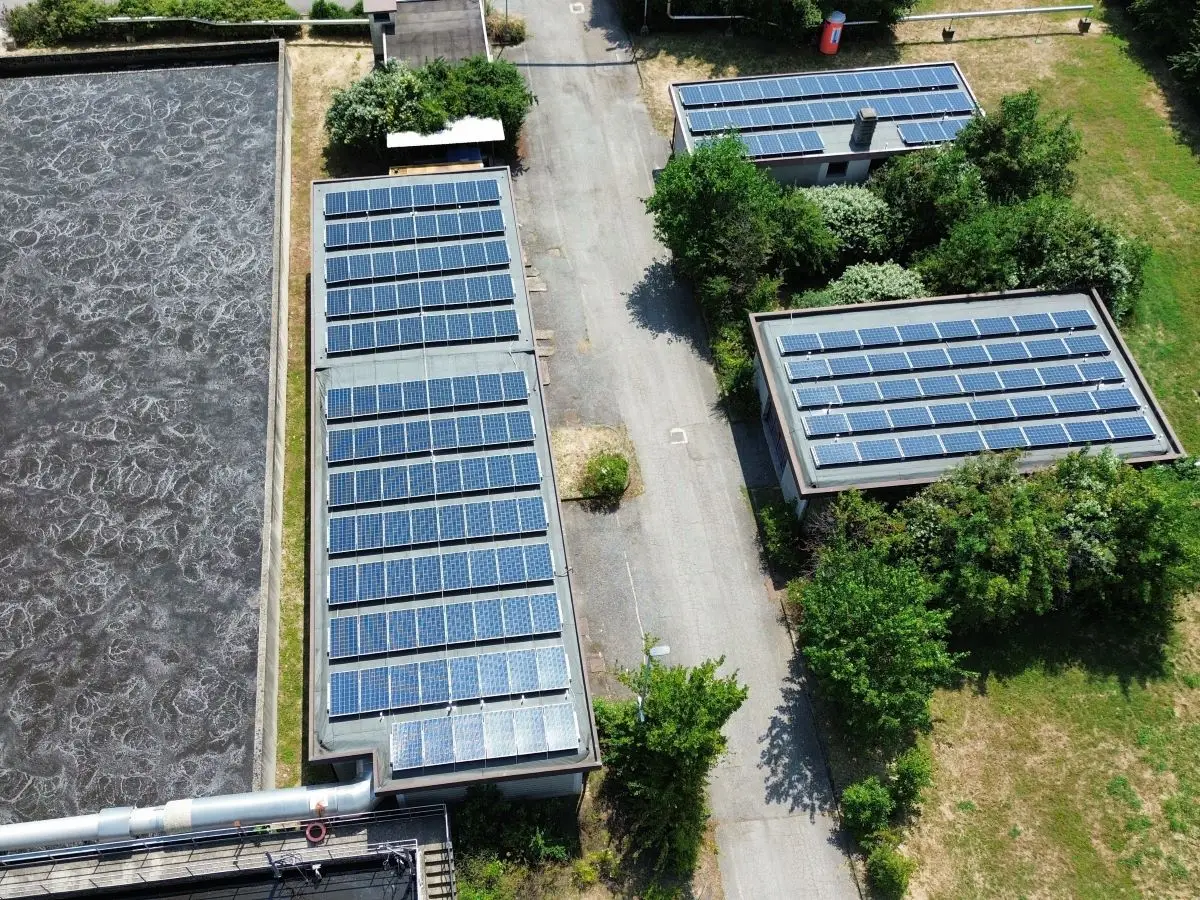

To combine energy production, consumption reduction, and citizen engagement by transforming wastewater treatment plants into more resilient and energy self-sufficient infrastructures. This is the goal of the Solar Power Masterplan devised by Gruppo CAP, the green utility that manages water services for the Metropolitan City of Milan.
The project, which sits at the core of the 2025-2029 Industrial Plan, involves the installation of over 30,000 kWp of solar panels on existing sites, with estimated savings of 11,159 tonnes of CO₂ per year. The plan is worth over 50 million euros, 13 of which are covered by income from bill payments, 10 by the group's own capital, and 27 by industrial partners. In addition to using the impermeable areas of the plants, the group is trialling solutions that simultaneously enable solar energy production and support agricultural activities in the surrounding areas, developing self-consumption and energy sharing projects through Renewable Energy Communities (REC).
These actions are a response to a complex regulatory context. Directive (EU) 2024/3019 on energy neutrality requires wastewater treatment plants to carry out energy audits every four years and to gradually increase the share of energy produced from renewable sources, reaching 100% of consumption by 2045. The first deadlines are close: 31 December 2028 for plants serving over 100,000 population equivalent, and 31 December 2032 for those between 10,000 and 100,000.
Robecco sul Naviglio: when the sun meets agriculture
The path toward decarbonisation, energy self-production, and local area enhancement is being led by CAP Evolution, the group's subsidiary that specialises in Waste, Wastewater, and Energy. One example is the photo-agrivoltaic plant in Robecco sul Naviglio. An investment of 850,000 euros has led to the creation of a solar power plant on the impermeable surfaces of the wastewater treatment plant and an agrivoltaic system on the surrounding farmland.
"Adjustable, biaxial panels protect crops from temperature peaks and modulate light based on the needs of plants, reducing water stress and improving agricultural yield. The energy produced exceeds 1.1 GWh per year, covering approximately 14% of the treatment plant's demand and reducing dependence on fossil fuels," CAP Evolution General Director Alessandro Reginato tells Renewable Matter.
Shared energy for the community along the Naviglio Grande canal
Renewable Energy Communities are another strategic pillar of the energy transition. These associations can bring together local authorities, SMEs, private individuals, and businesses, creating a virtuous system in which local administrations and companies collaborate as producers or "prosumers", that is, entities that produce and consume energy.
The "Naviglio Grande" REC, arising in March 2025 from a collaboration between CAP Evolution and the municipalities of Buccinasco and Trezzano sul Naviglio, involves the installation of a 657.20 kWp solar power plant that will produce energy for local consumption: part of it will power the Trezzano wastewater treatment plant, reducing costs and emissions linked to acquiring energy, while approximately 83% will be distributed to the local population and businesses, generating environmental and economic benefits for the entire community.
Energy efficiency and new experiments: the future of CAP plants
On a larger scale, CAP Evolution and A2A Calore e Servizi have joined forces to design ten new solar power plants, some installed on CAP balancing tanks (thus preserving land), capable of producing over 7 GWh annually. Part of the energy, 14%, will directly power the plants, while the remainder will be fed into the grid or shared through remote self-consumption and energy communities. The initiative will save approximately 2,100 tonnes of CO₂ per year, stabilise energy costs and increase the overall efficiency of the infrastructure.
Finally, these initiatives are complemented by the agreement to interconnect the Rozzano wastewater treatment plant to the district heating plant operated by Atmos, a company that is part of the GETEC group and manages the municipal grid. The treatment plant will be connected both thermally and electrically, creating an integrated system capable of exchanging electricity and heat.
The heat energy supplied by the heating plant will cover the energy demand of the water treatment plant and stabilise the temperature of the digesters. This will improve the efficiency of anaerobic digestion and biogas production. At the same time, the heat derived from biogas fed into the municipal district heating grid will provide renewable energy for the community. This project stands out for its highly experimental value.
With this interconnection, says Marcoandrea Muzzatti, Head of the Technical Area – Energy Sector at CAP Evolution, “we are not only maximising the energy efficiency of our plants, but also transforming renewable heat generated by wastewater treatment into concrete value for the community, in line with circular economy principles".
This content is produced thanks to the support of sponsors
Cover: Cassano D’Adda, Gruppo CAP