


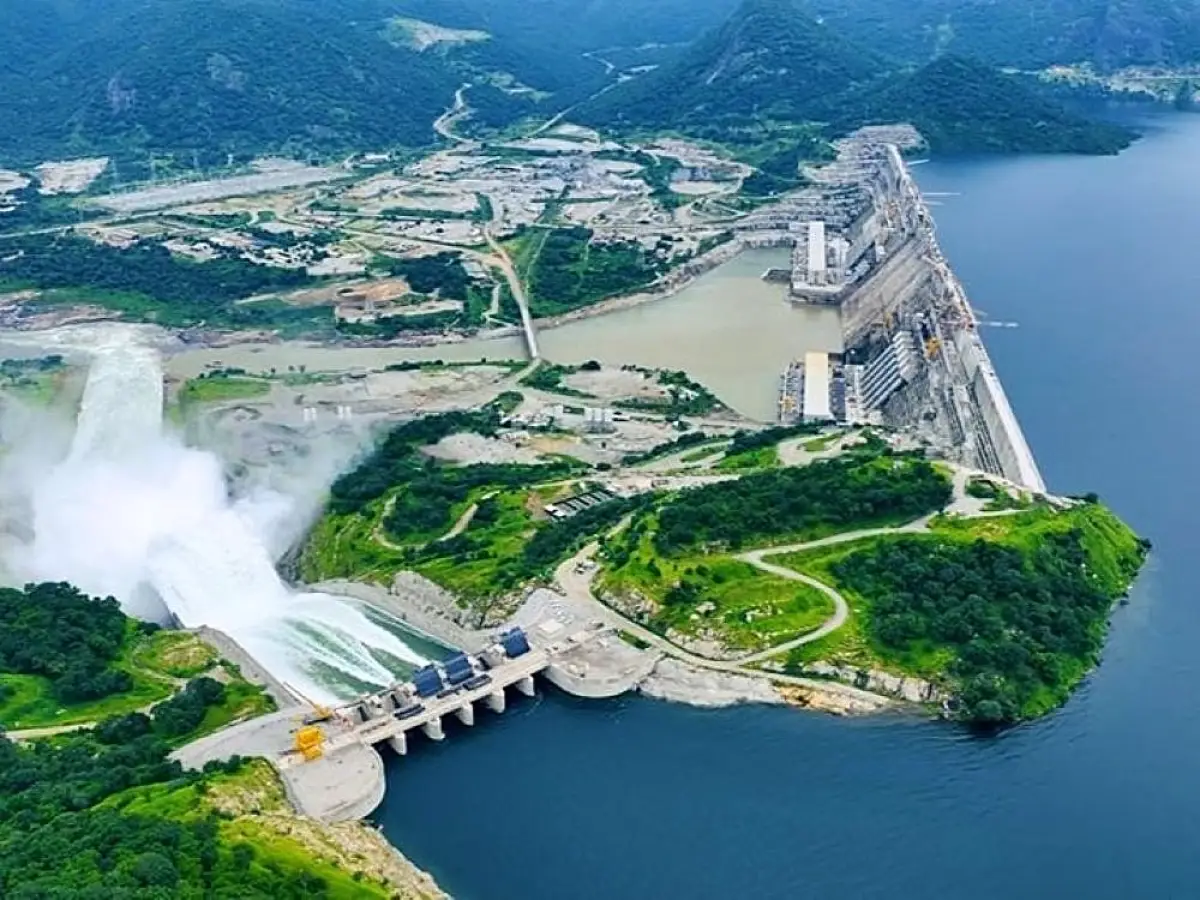

In September, Ethiopia unveiled the Grand Ethiopian Renaissance Dam (GERD), hailing it as a “generational victory”. Standing before the dam's cascading waters, Prime Minister Abiy Ahmed declared an end to the era of Ethiopia’s energy dependency. As Africa’s largest hydroelectric project, the GERD is a monumental feat of engineering. Its reservoir holds 74 billion cubic metres of water, and its turbines are designed to produce over 5,000 megawatts of electricity, an output comparable to five nuclear power plants.
However, the celebratory atmosphere was marked by the glaring absence of representatives from Sudan and Egypt. For these downstream nations, the dam fundamentally alters their access to the Nile’s vital waters. Beyond its tangible significance, the GERD’s inauguration serves as a moment of reckoning for international water law. The dam stands as a direct challenge – and some argue an outright violation – of the three foundational principles that have governed the world’s shared rivers for decades: equitable utilisation, no significant harm, and prior notification.
These three principles form the bedrock of the 1997 UN Watercourses Convention, which codified modern international water law. They were established to replace the archaic Harmon Doctrine, a principle of absolute territorial sovereignty that allowed a state to exploit any water flowing within its borders, regardless of the impact on downstream countries. While long dismissed as legally and morally untenable, the Harmon Doctrine appears to be quietly resurfacing in practice.
Consider first the principle of equitable and reasonable utilisation, which mandates that riparian states share transboundary waters fairly. The GERD was built without substantive consultation on what equity would mean for the Nile nations. Ethiopia proceeded with construction unilaterally, and the dam now physically controls the Nile’s flow. This creates a fait accompli that renders the principle of equity almost meaningless, as neighbouring countries cannot retroactively negotiate fairness from infrastructure that is already built.
The obligation of prior notification – i.e., informing fellow riparian states of planned projects with enough time to discuss them – was technically observed but effectively emptied of meaning. Ethiopia did notify Egypt and Sudan, yet construction began in 2011 while Egypt was destabilised by the Arab Spring, and the project advanced despite Cairo’s objections. Notifications came as the dam was already under construction not before critical decisions were made. The requirement was thus reduced to a formal gesture rather than a mechanism for genuine collective deliberation, a procedure that assumed it could shape outcomes but, in this case, was powerless to do so.
The principle of no significant harm is the one most clearly strained. The GERD gives Ethiopia physical control over the Nile, creating the potential for profound harm if that power is exercised unilaterally. Egypt’s entire political economy depends on the river; its agriculture, water supply and industry all rely on predictable flows that Ethiopia can now modulate. The no‑significant‑harm principle traditionally assumes that damage is accidental or an unintended side‑effect of legitimate development. The GERD is different: it was built explicitly to control water, and the capacity for deliberate, strategically timed harm now exists without any binding agreement to constrain how that control will be used. In this context, the problem is not only the risk of harm, but that the principle itself has lost its practical meaning.
Ultimately, whether the dam delivers benefits Ethiopia is not the central issue of this argument. What matters is that Ethiopia unilaterally decided to build the largest dam in Africa and succeeded in doing so despite sustained opposition from its neighbours. This choice reveals a stark reality in transboundary water politics: international law functions only when and where states choose to respect it. In the absence of robust enforcement mechanisms – and in the presence of deep power asymmetries – law migrates from the centre of decision‑making to its margins, advocated for in speeches but rarely decisive on the ground.
Let there be no mistake: this phenomenon is not confined to Eastern Africa. Across the globe, similar scenarios are unfolding: India restricts the flow of the Teesta River, Turkey controls the Tigris and Euphrates, and Laos built the Xayaburi dam despite objections from downstream nations. These instances are not failures of international law, but rather a clear demonstration of its growing irrelevance as a constraint on states determined to use water to advance national goals.
Cover: Prime Minister Office Ethiopia, Public domain, via Wikimedia Commons