


Every time you open a bottle of fruit juice or water, or a can of beer, or a bottle of wine, there’s an invisible ally at work, preserving the quality and shelf life of the drink: nitrogen. It is odourless, colourless, and makes up 78% of the air we breathe. In industrial beverage production, it is an essential ingredient.
“Nitrogen acts as a filler to displace oxygen, which would otherwise react with the bottled product and cause its initial organoleptic qualities to deteriorate,” explains Francesco Camerlingo, Marketing and Sales Development Leader for Food & Beverage at Nippon Sanso Industrial. “It is also very often useful for bottling water and soft drinks.” The premise is simple, but the applications are numerous and vary considerably depending on what’s inside the bottle.
The drop that saves plastic
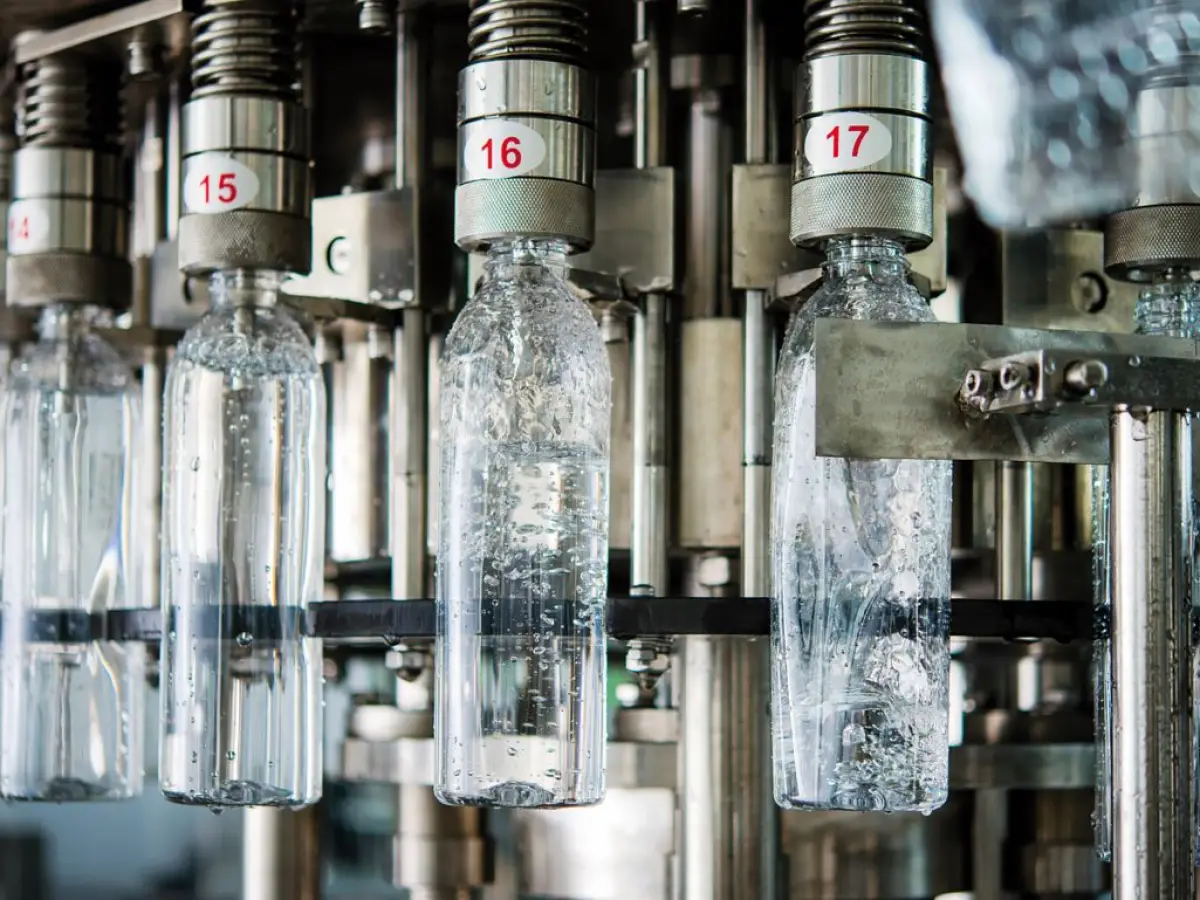
The best-known case is that of PET bottles, which have progressively become lighter over the years, in line with the principles of the circular economy: less plastic, lower cost, lower environmental impact. There is, however, a problem: a container so light and thin cannot bear the weight of pallets during transportation. The solution is the Lin Dropper, Nippon Sanso’s liquid nitrogen dosing device.
“One litre of liquid nitrogen expands to around 700 litres of gas,” explains Camerlingo. “A tiny droplet of just a few grams, added into an already-filled mineral water bottle before capping, is all it takes. As it expands inside the sealed bottle, the nitrogen instantly pressurises it.” The bottle, soft until a moment before, becomes as rigid as if it were carbonated. “Sparkling water doesn’t have this problem, because CO₂ pressurises the container on its own. It’s to still water that a drop of nitrogen needs to be added.”
With fruit juices, iced tea, and functional beverages, however, things become more complicated. These products are bottled using aseptic machinery (the entire system must be sterile), and non-sterile nitrogen would contaminate the line. Nippon Sanso has therefore developed a dual-source system: the nitrogen gas is first sterilised at 140 degrees, then liquefied through a coil cooled by liquid nitrogen in a separate circuit. The result is sterile nitrogen, ready to be used with juice. “This is required to prevent deterioration of the area in contact with the headspace,” Camerlingo clarifies. “With juices, a dark film can form between the surface of the liquid and the cap. Sterile nitrogen eliminates the problem.”
Wine: nitrogen from grape to cork
In wine, and particularly white wine, nitrogen accompanies the entire production cycle. “It is used from start to finish during the bottling phase,” says Camerlingo. “To make primary storage vessels inert, to push and transfer wine from one tank to another, as well as for the headspace. All white wines need nitrogen to remain clear and clean.” In some applications, argon is also used. This heavier molecule better blocks the ingress of oxygen, but at a significantly higher cost.
The latest frontier of Nippon Sanso’s systems is canned wine, currently showing strong growth in the United States, where the single-serve market is expanding rapidly. A can has a very wide opening, and the wine foams considerably before sealing,” explains Camerlingo. “A larger drop of liquid nitrogen is applied to the top of the foam to stop it forming and allow the can to be sealed.”
Finally, for dealcoholised wines – a technology still under development – Nippon Sanso uses supercritical CO₂ to extract the alcohol: “We are carrying out tests trying to reintroduce at least the aromatic compounds, which give wine its scents and flavours, and are usually destroyed by traditional methods.”
The nitrogen supply chain
Unlike other industrial gases, nitrogen has an intrinsically secure supply chain: it is obtained by fractional distillation of air, an inexhaustible source. Nippon Sanso operates in Italy with six Air Separation Units (plants that compress and cool air to cryogenic temperatures to separate its components) and fifteen cylinder-filling centres distributed from Piedmont to Sicily. For high-volume production, the company also offers on-site solutions with plug-and-play generators installed directly at the customer’s facility, eliminating dependence on external logistics.
“We guarantee continuity of supply through back-up tanks and handle all aspects of management and maintenance,” says Luca Moseneder Frajria, Industrial Marketing & Technologies Coordinator at Nippon Sanso. The cryogenic tanks are also monitored in real time: pressure, liquid level, and delivery parameters, all tracked remotely, with automatic resupply optimisation. An invisible drop, then, but with a very tangible infrastructure behind it.
This content is produced thanks to the support of sponsors
Cover: Nippon Sanso