

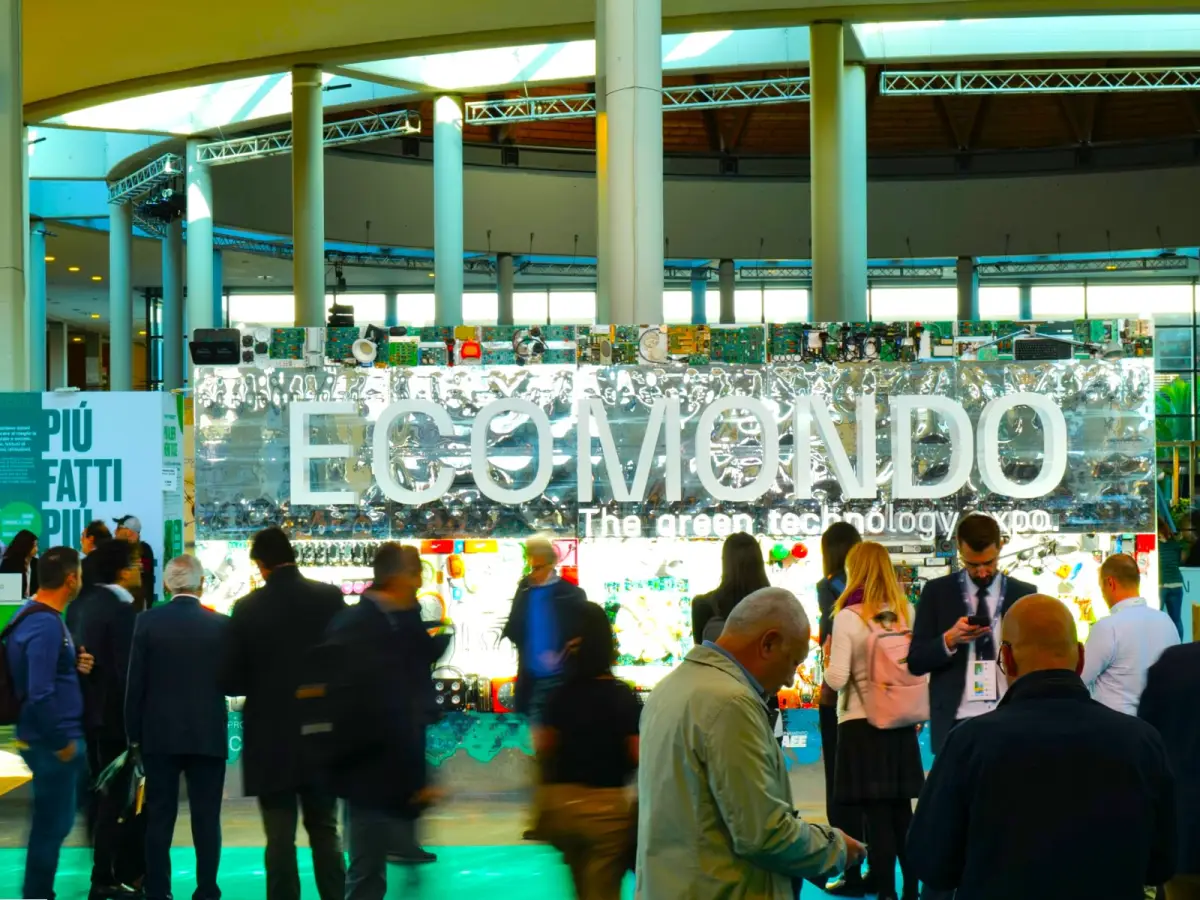

From 3 to 6 November, Ecomondo will return to the Rimini Expo Centre for its 29th edition, bringing together companies, researchers, institutions and organisations working across the circular and regenerative economy. Italian Exhibition Group’s international event will host more than 70 conferences, workshops and other sessions coordinated by its International Technical Scientific Committee with European and international partners. Further events will be organised by exhibitors and industry associations, with a substantial number of sessions in English aimed at strengthening the event’s international reach.
The programme reflects a transition increasingly shaped by resource constraints, climate risks and industrial competitiveness. Rather than treating environmental action as a cost to be managed, the discussions will examine how circularity, decarbonisation and innovation can reduce dependence on primary materials, improve efficiency and support more resilient economies.
Materials, manufacturing and circular cities
Resource efficiency will be a major thread, from electronic waste and batteries to plastics, buildings and packaging. A session organised with ERION will look at European approaches to recovering critical raw materials from waste electrical and electronic equipment and batteries, considering how recycling could help reduce Europe’s reliance on imported resources. Other discussions will address the challenges of plastic circularity and the implications of the forthcoming European Circular Economy Act for packaging and waste management.
Construction will be examined through the lens of urban mining: recovering and reusing materials already present in buildings and infrastructure. Meetings organised with Green Building Council Italy, the Polytechnic University of Marche and sector associations will explore the regulatory context, available technologies and practical ways to expand circular approaches across the built environment. A workshop with Sant’Anna School of Advanced Studies, ENEA and UN Global Compact Network Italy will return to the question of how circularity can be measured across entire value chains.
Critical raw materials will also be addressed through a dedicated session on strategic cooperation between Europe and Africa, organised with the University of Turin, the European Commission’s Joint Research Centre and Italian ministries responsible for the environment and industry. The discussion will consider how cooperation can create mutual benefits while supporting access to materials needed for the transition. In parallel, a workshop on circularity metrics will examine how businesses can assess performance across supply chains rather than relying on isolated indicators. These discussions point to a broader challenge for policymakers and industry: translating circular-economy ambitions into comparable measures, workable rules and investment decisions across Europe.
Textiles will receive particular attention as European rules on product design, transparency and producer responsibility evolve. Sessions will cover reuse, repair and ecodesign, the harmonisation of extended producer responsibility systems, and the Digital Product Passport under the Ecodesign for Sustainable Products Regulation. Ecomondo’s Textile Working Group will also develop a dedicated programme for the sector.
The urban agenda will connect circularity with public health and climate resilience. In sessions organised with the National Research Council, the UNESCO Chair on Urban Health, the National Association of Italian Municipalities and universities, participants will discuss how digital tools, sustainable infrastructure and new governance models can help cities become more circular, resilient and climate-neutral. The paper industry will also be in focus, including cooperation between paper manufacturers and large-scale retailers and an assessment of the environmental and economic benefits of National Recovery and Resilience Plan projects supporting paper recycling.
Soil, bioeconomy and water security
Regenerative agriculture and the bioeconomy will feature prominently. The programme includes discussions on farms as biorefineries, the role of biodegradable and compostable bioplastics in protecting soils, and how start-ups, artificial intelligence and new investment models can support innovation in agri-food systems. The fifth States General for Soil Health will explore links between soil conditions, urban development and the resilience of food systems, while the 28th National Conference on Composting and Anaerobic Digestion will examine organic waste treatment.
Forest resources, woody crops, biodiversity and carbon farming will be considered alongside land remediation and developments in environmental regulation. Another session, organised with Sapienza University of Rome, UNEM and Legambiente, will address remediation in Italy during a period of regulatory change. Geotechnical engineering and the design of sustainable, resilient interventions for environmental protection will also be on the agenda.
Water will be another central focus, spanning marine ecosystem restoration, efficient use of freshwater and the security of infrastructure. Sessions with organisations including ARERA, the Po River Basin Authority, CNR-IRSA and several universities will look at emerging contaminants, circular water use, nature-based solutions, pollution prevention and basin-level governance. Other discussions will address water efficiency in industry and agriculture, as well as smart networks, digitalisation and infrastructure security.
These themes will extend beyond Italy. International sessions will consider Euro-Mediterranean cooperation on water resilience, resource recovery from end-of-life products, oil pollution in the Mediterranean and the development of sustainable materials through the region’s bioeconomy. A further discussion will explore how cooperation from source to sea can support water resilience and the goals of the Ocean Pact.
International partnerships, investment and policy
Ecomondo will continue its focus on cooperation with Africa through the sixth Africa Green Growth Forum. Organised with partners involved in the implementation of the Mattei Plan, the forum will examine how institutions and the private sector can support sustainable development, with particular attention to water, agriculture and inclusive, resilient value chains.
Finance and governance will cut across the programme. A conference organised with the Italian Sustainable Investment Forum will examine how corporate climate transition plans can help companies and investors manage ESG risks while strengthening competitiveness. Other sessions will address bankability and investment models for innovation, including in water services and the bioeconomy.
Two established events will return. The fifth Forum on Responsible Communication will discuss how to communicate the sustainability transition while balancing environmental urgency and social cohesion. The third ESG CEO Summit, organised with TEHA – The European House Ambrosetti and IPSOS-DOXA, will consider the relationship between compliance, competitiveness, reporting and industrial transformation. The States General of the Green Economy will take place on 3 and 4 November, organised by the Foundation for Sustainable Development with the Ministry of the Environment and Energy Security and promoted by the National Council for the Green Economy.
Regulation will also feature in sessions on water-service governance, waste-management rules, traceability, end-of-waste criteria, landfill best available techniques and implementation of the revised Industrial Emissions Directive. Alongside these policy discussions, calls for papers will bring technical research, case studies and practical examples on waste prevention, circular resource management, industrial symbiosis and circular eco-districts. A session developed with Imperial College London, the European Innovation Council and ART-ER will focus on how cleantech businesses can scale up, attract investment and accelerate industrial change.
Taken together, the programme positions Ecomondo as a meeting point between research, regulation and implementation. Its breadth reflects the interconnected nature of the ecological transition: progress on materials, soil, water, energy and finance will depend not on isolated solutions, but on the ability to connect technologies, businesses and public policy. The event’s programme, which is being updated, is available on the official Ecomondo website.
Cover: photo by Ecomondo