

Rimini - The 29th edition of Ecomondo was, as always, a success. The Rimini exhibition centre was packed to bursting point, exhibitors were satisfied, and there was an ever-increasing range of content and events. We spoke about this with Alessandra Astolfi, Global Exhibition Director of the Green & Technology division at Italian Exhibition Group, who was a guest on our pop-up podcast MATERIAxGARC Ambiente: Women in the Circular Economy, produced in collaboration with Blab Italia.
Let's start with the numbers. Why is Ecomondo becoming more and more international?
The venue is practically full, which surprised even me. We have 1,850 exhibiting companies, with 19% more foreign exhibitors than at the previous edition, and 1,280 international buyers from 77 countries, twice as many as last year. Ecomondo is a global hub for the circular economy: we showcase technologies that make the ecological transition possible to international markets, including those that are further behind us.
Yet Italy doesn't tell its own story much abroad.
This is something we work on with Italian embassies, the Italian Trade Agency and the Ministry of Foreign Affairs (MAECI). In this sector, fewer than 50% of companies export, and we want to take the more reluctant ones abroad too. Italy is a major manufacturing country, with material recovery deeply rooted in its industrial tradition: it has turned a constraint into an opportunity. Our circular material use rate is 21%, compared with the European average of 12%. That is an excellence we should also put to work by exporting technologies.
What are the key themes for 2026?
Three supply chains: textiles, water and the bioeconomy. At the entrance, there is a textile installation created in collaboration with Scart and the Hera Group a rainbow of fabrics that invites us to rethink our approach to materials whose recycling rates are still far from European targets. In Hall D2 a whole area is devoted to textiles, from materials analysis to recycling, with the Prato district. We are looking ahead to the introduction of extended producer responsibility schemes for textiles: they will better organise collection, reuse and recycling. Then there is water, a resource whose scarcity leaves us vulnerable: entire halls are devoted to recovering rainwater and wastewater for industrial and agricultural uses. Finally, there is the bioeconomy, spanning everything from organic waste and sustainable biomethane production to new materials and fertilisers: a bridge between agriculture and energy. And there are start-ups, because we want to make room for young people and new ideas.
One event not to miss?
There are more than 200 conferences, organised by sector. I'll name one: the States General of the Green Economy, with Minister Pichetto Fratin, Edo Ronchi and Professor De Romanis, to understand where the circular economy is heading.
In 2027 Ecomondo turns thirty. How will you celebrate?
We're already working on it. Over these years we have built an environmental culture and a community: we want to celebrate its strength with events that I can't reveal just yet, but which will surprise people.
IEG has also launched new trade fairs. Which ones?
The division has seven brands. Three years ago, we separated the energy sector from Ecomondo by launching KEY – The Energy Transition Expo, which has since become a major exhibition. In a few weeks, we will be launching IBE Intermobility Future Ways, a new exhibition dedicated to mobility, where citizens take centre stage. Then there is BEX, dedicated to the convergence of space and industry: the space sector is an example of circular economy principles in action, as everything needs to be reused. And finally Ecomondo Mexico, which is why Mexico is the partner country of this edition.
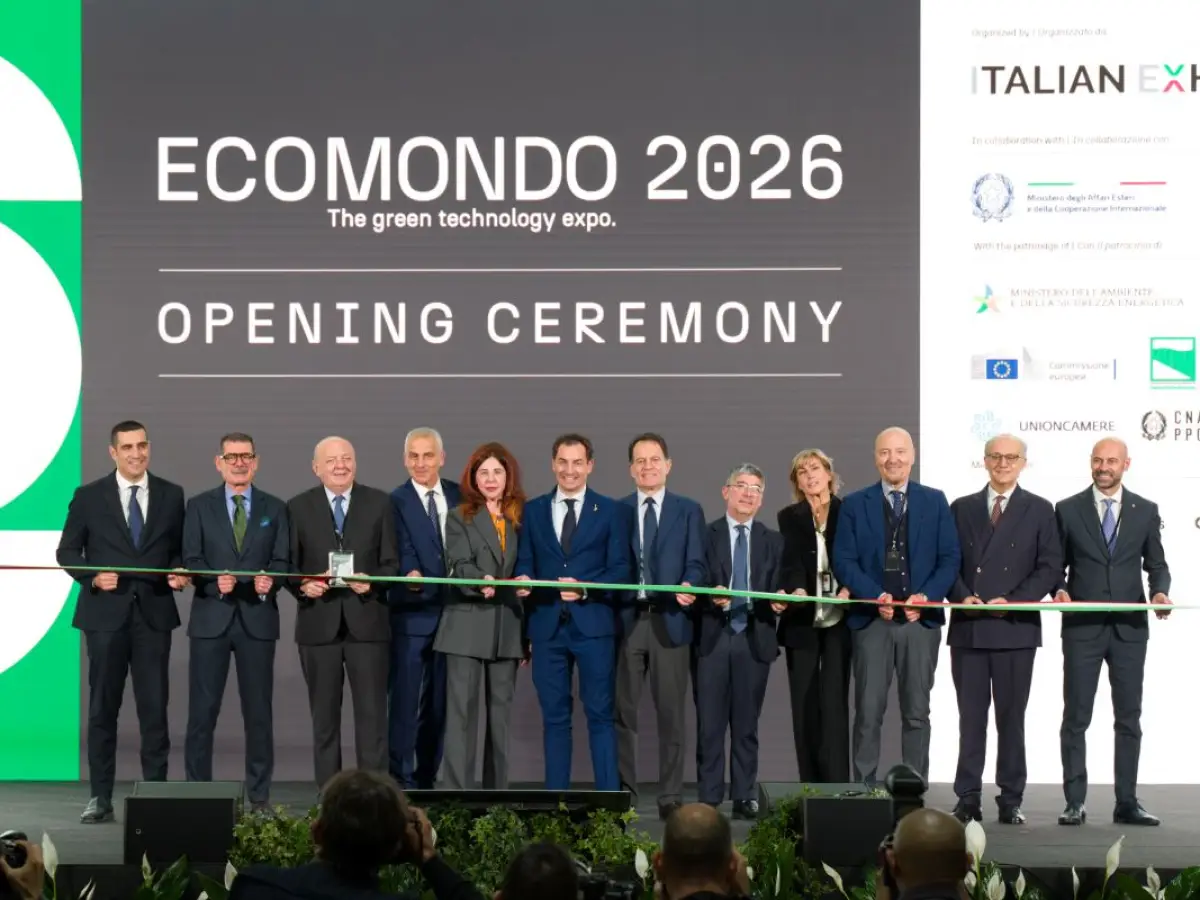
Cover: the ribbon-cutting at the opening ceremony. Photo by Ecomondo