


Helsinki – Electrification is an existing competitive advantage for Europe, yet without integrated models for investment, grid development and industrial policy, it is at risk of slowing down just as the expansion of artificial intelligence and data centres is driving up demand for electricity. That was the message conveyed at the Power Summit 2026 held by Eurelectric, the association representing the European electricity sector, held in Helsinki on 3 and 4 June. Estimates revealed during the event suggest that data centres could account for around 28% of the growth in European electricity consumption by 2030.
At the Summit, media partnered with Renewable Matter, Eurelectric has launched two complementary initiatives. The study Power Couples – Enhancing Industrial Competitiveness through Electrification analyses electrification's contribution to the competitiveness of European industry and a joint commitment between players in the electricity and digital sectors to support the growth of data centres in a sustainable manner.
“Turning fragmented decisions into coordinated, system-level delivery is the key to solve the full electrification deployment challenge,” said Markus Rauramo, Eurelectric President and CEO of Fortum. “Europe now needs investment predictability, faster grid build-out and integrated delivery models that can scale quickly. This will unlock a more resilient, competitive and investment-ready industrial economy.”
Power Couples: electrification as a competitiveness lever
“Grid connectivity can no longer be treated as an afterthought,” explains Ralf Blumenthal, Senior Vice President Europe at Siemens Grid Software, to Renewable Matter. “In the past, connecting new consumers to the network was a relatively straightforward process, but the rapid growth of renewable generation, large-scale load centres and increasingly variable demand patterns has fundamentally changed the picture. Avoiding new bottlenecks requires early coordination between grid operators, regulators and those seeking capacity, as well as greater transparency on actual connection needs.”
According to Eurelectric’s Power Barometer 2025, in an already 72% decarbonised European electricity system, industrial electrification had only advanced by one percentage point by 2024. While Brussels is attempting to resolve this issue with the AccelerateEU package, intended to make electricity cheaper and more accessible, the report on Power Couples presented by Eurelectric demonstrates, through 61 companies and 30 projects, that electrification only truly becomes scalable when the market, infrastructure and policies are aligned within integrated partnership models that jointly optimise demand, low-carbon supply, the grid and flexibility.
The report identifies five replicable models that function as “power couples”: from the Silvertown ECTOgrid project in the UK, which electrifies heating on an urban scale using large heat pumps, storage and smart grid control; to Microsoft’s data centre in Dublin, which acts as a system resource by providing rapid response services for the grid; to Stockholm Data Parks, where waste heat from over 30 data centres is sold to the city’s district heating network, turning a cooling cost into a new revenue stream and reducing the use of natural gas.
Twin Transition: AI, data centres and infrastructure under pressure
During the Power Summit, participants also tried to work out how to ensure that new large-scale load centres – from industrial estates to data centres and electric vehicle charging hubs – would not transform already strained grids into bottlenecks that restrict access to energy. According to Blumenthal, three priorities have emerged. “First, grid planning and load growth must be developed together rather than sequentially,” he explains “Second, both network operators and large consumers need to provide clearer information on real capacity requirements to avoid unrealistic connection queues and inefficient planning. Third, flexibility should become a standard requirement for large loads, including data centres. As power systems become more complex, the ability of major consumers to adjust demand and provide flexibility services will be essential for maintaining system stability and making better use of existing infrastructure.”
On the one hand, AI is driving up demand for electricity, with data centres expected to account for a significant share of the growth in European consumption. On the other, AI itself has now become a tool for managing this complexity, thanks to applications that optimise the grid, forecasting and asset performance. It is in this context, and in the wake of the European Commission’s launch of the new European Technological Sovereignty Package – which includes the Chips Act 2.0, the Cloud and AI Development Act, a strategy for open source and a roadmap for digitalisation and AI in the energy sector – that the Twin Transition Commitments initiative promoted by Eurelectric comes into play.
The goal is to tackle both aspects of the issue together: firstly, assessing how much energy demand from data centres will grow and what level of flexibility will be required in the coming years; and secondly, verifying the capacity of the European electricity system to support this growth. All of this will be achieved by fostering more structured collaboration between utilities and hyperscalers and through the widespread use of AI across the entire energy value chain. The results, reported Eurelectric in a press release, will be incorporated into an in-depth study to be published in 2027, providing recommendations to support the sustainable development of artificial intelligence and data centres in Europe. In short, for Europe, the real test will not merely be ensuring enough clean electricity for AI. It will be to develop governance models in which large digital consumers actively contribute to the stability of the system, rather than simply drawing on its capacity.
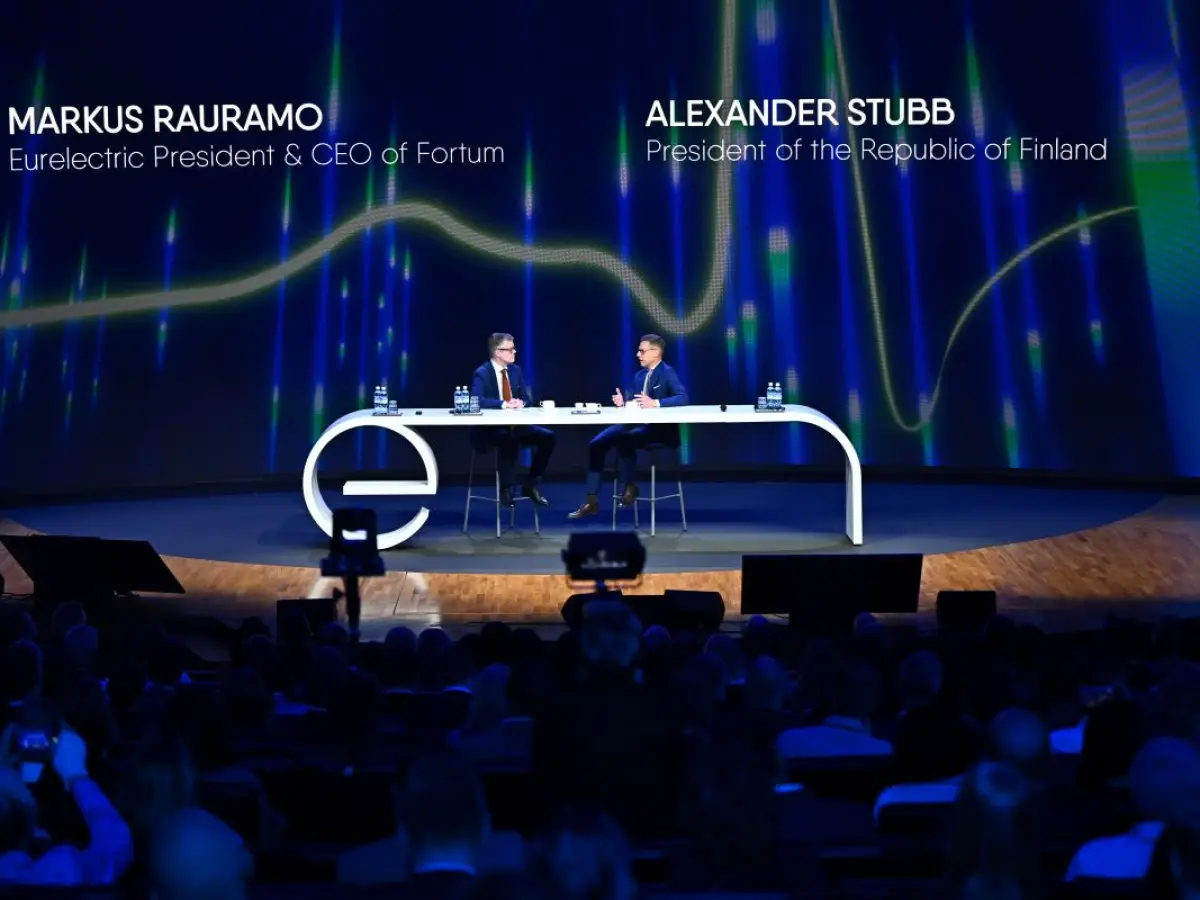
Cover: Markus Rauramo and Alexander Stubb, Power Summit 2026