


A wind farm that supplies electricity equivalent to the consumption of around 10,600 households while channelling part of its revenues into electric bicycles, home renovations and measures against energy poverty. This is the case of Andilly-Les-Marais, in western France, winner of the first Fast & Fair Renewables Award, with Renewable Matter as media partner. Presented at WindEurope’s Annual Event by its CEO Tinne Van der Straeten, the recognition went to a project seeking to reconcile the speed of the energy transition with environmental stewardship and local support.
Yet the most significant figure is not electricity generation alone. Nearly 200 residents invested around 1.2 million euros in the project; the local cooperative COOPEC holds 31% of the overall capital, while project developer Valorem owns 51% and regional investment fund Terra Energies 18%. In an area historically marked by opposition to wind power, the Andilly-Les-Marais project offers a model in which participation is not confined to an information phase after decisions have already been made, but becomes part of governance and of the distribution of economic value. Through its actions, it represents well the five principles of the cross-sector Fast & Fair Renewables & Grids Initiative, which is coordinated by ICLEI Europe.
The project
“The initiative was launched in 2017 by the municipality of Andilly-Les-Marais, within the ‘Positive Energy Territory’ ambitions supported by the Aunis Atlantique community of municipalities. From the outset, the municipality, the association ‘A nous l’énergie renouvelable et solidaire 17’ (ANE!rs17), and Aunis Atlantique itself worked together through public meetings, thematic working groups and a Monitoring Committee”, Bertrand Cardinal, volunteer president of COOPEC, tells Renewable Matter.
During the development phase, the Committee met twice a year, bringing together representatives of the State, the Department, the Chamber of Agriculture, the Marais Poitevin Regional Natural Park, farmers, residents and a group of opponents. “Open to the public, the Committee ensures transparency regarding the project and it provides perspective that the municipality of Andilly-les-Marais may or may not consider. This multi-stakeholder Monitoring Committee is intended to evolve in its composition and will exist throughout the lifespan of the wind farm”, adds Cardinal.
The project therefore does not present meaningful participation as an automatic guarantee of support. Rather, it shows how important it is to bring together different perspectives in a sector where the faster rollout of renewables often encounters local resistance over landscape, biodiversity, noise and the allocation of benefits.
Participatory fundraising
At Andilly-Les-Marais, the promise is that a share of control and of financial returns will remain in the area, rather than flowing exclusively to external investors. COOPEC organised the participatory fundraising through public presentations in municipalities across the Aunis Atlantique area. Members were offered three types of shareholder current accounts, comparable to loans made by members to the cooperative: with terms of six, 12 and 20 years, and respective returns of 3%, 4% and 5%. “Members receive annual interest payments, and at the end of the term, their invested capital is repaid. The interest rate offered is higher than that of the French government-regulated savings account”, adds Cardinal.
Trust, however, does not rest on remuneration alone. COOPEC keeps its members informed through group visits, monthly electricity-production updates and the option to follow the wind farm’s output data in real time on its website. The cooperative currently has 500 members: 12 local authorities, six companies, four associations and 478 citizens. Membership begins with the purchase of at least one 50 euros share, a threshold intended to combine local roots with accessibility.
Votes and redistribution of benefits
The cooperative structure rests on a principle that challenges the traditional link between capital and power: “1 member = 1 vote, not 1 euro = 1 vote”. According to COOPEC, four elements should guide the governance of similar projects: local roots, shared decision-making, environmental commitment and a non-speculative approach. The redistribution of benefits adds a further layer. The company’s revenues and profits are allocated among Valorem, COOPEC and Terra Energies according to their shareholdings: 51%, 31% and 18%, respectively. But COOPEC has chosen to receive the development bonus linked to the project’s success annually over 20 years and has committed to directing it to the local area.
“This is how COOPEC will dedicate 62,000 euros per year for 25 years to energy-saving actions and the fight against energy poverty in the territory. The first actions already deployed concern mobility assistance by financing the purchase of electric-assist bicycles, based on 500 euros per bicycle, and home renovation work”, adds Cardinal.
Which lessons for other EU countries?
The Andilly-Les-Marais wind farm offers no ready-made template for Europe. “This project cannot be directly duplicated through a simple copy-paste. However, we can draw inspiration from the key strengths that contributed to its acceptance and success. These include transparency, education, consultation and co-development”, adds Cardinal.
As Arthur Hinsch, Senior Expert Sustainable Energy Systems at ICLEI Europe and Coordinator of the Fast & Fair Renewables & Grids Initiative, explains to Renewable Matter, the Andilly les Marais wind farm is truly inspiring and valuable. “The Fast & Fair Renewables & Grids Initiative represents an agreement between the renewables industry, environmental organisations, energy communities, local governments and civil society based on five principles which steer the development of projects in an accelerated way, but also in a way which is considered as fair for all.”
This matters because public support for renewables does not automatically translate into local acceptance. “The Fast & Fair principles reflect a European-level consensus, carefully negotiated between the sectors, to provide a common reference and baseline which can be used to mediate between competing interests at the local level,” Hinsch says.
For other EU countries, the policy implication also concerns market access. Tenders, auctions and public procurement can also reserve space – or provide suitable remuneration – for renewable energy communities, helping them compete with larger players. An option referenced in Articles 22d and 15a of the Renewable Energy Directive (RED III). As Hinsch notes, Article 15a states that “where deemed relevant, Member States may promote cooperation between local authorities and renewable energy communities in the building sector, particularly through the use of public procurement”.
In practice, while some local authorities are already tailoring procurement practices to the specific characteristics of renewable energy communities, this remains far from commonplace. “It requires careful consideration of how to best introduce community-focused bidding and selection criteria while respecting national and European requirements for public procurement processes. This can be done in several ways, including by direct reference to EU Renewable Energy Communities (RECs) definitions and/or national transposition definitions,” Hinsch concludes. “With the reiteration of this opportunity in the Fast & Fair principles, we jointly reiterate that using tenders, auctions and public procurement to support renewable energy communities in reaching a level playing field is supported by market stakeholders across both the for-profit and non-profit space.”
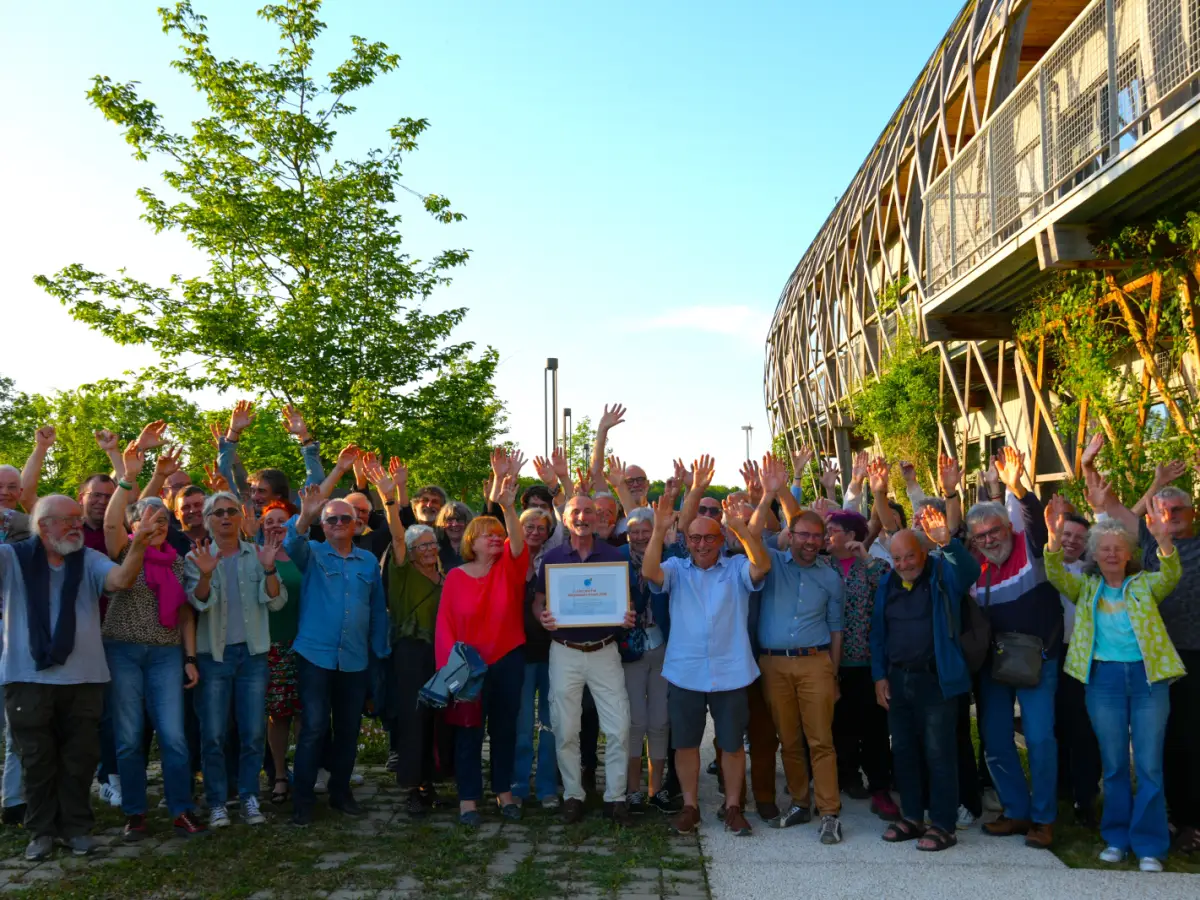
Cover: the Andilly-Les-Marais community