


This article is part of the thematic channel The Water Observer: subscribe to our newsletter and receive exclusive contents from the world of water
“If there’s water, everything is possible. Everything depends on water.” That is what Birsen Şarlak, a female farmer in Soğukpınar, a village in Kahramanmaraş at the epicentre of the earthquakes that devastated Turkey three years ago, tells me. It’s a hot July afternoon. A group of villagers and I watch as Edwin Clarke, a regenerative agriculture consultant, sets up a rainfall simulation.
In front of us are three samples of soil, each treated differently. White basins overhead stand in for clouds. The villagers around us watch in near silence, following every movement of Clarke’s hands. In a few minutes, Clarke will release water from them and we will watch which soil holds onto the most.
“It rained quite a bit this year,” muhtar Nazmi Kuru, an elected local official, offers before the demonstration begins. Clarke warns that Turkey is on track to become a water-scarce country by the end of the decade, and rainfall totals alone don't tell the story. Turkey is already classified as a water-stressed country, with annual per capita water availability of about 1,300 cubic metres. According to the Turkish Ministry of Agriculture and Forestry, unless stronger conservation measures are taken, Turkey is expected to become one of the countries experiencing water scarcity from 2030 onwards.
“Looking at how much rain fell and thinking That will be enough for us is not really possible anymore,” he says. It is a worry most of them already carry quietly.
The demonstration is not a one-off. It’s part of a Community-Led Disaster Risk Management Program run by Support to Life (Hayata Destek), a Turkish humanitarian organisation that has worked in the country since 2005. The program operates in 17 high-risk villages across Hatay, Adıyaman and Kahramanmaraş, the three provinces hit hardest by the February 2023 earthquakes, which killed more than 53,000 people nationwide.
The program’s premise is that communities in places like these should be active implementers of their own risk plans. Soğukpınar and neighbouring Kaleköy are two of those 17 villages. Rainwater harvesting, alongside renewable energy, first aid, early warning and disaster preparedness training, is one of the solutions the program is trying to turn into routine. For many here, simply having someone show up to talk about water already feels like its own small relief.

What the soil isn’t holding onto
The critical point, Clarke says, is that not every drop of rainfall is actually absorbed by the soil. He notes that even a small increase in organic matter in the soil can significantly boost its capacity to hold usable water. Healthy soil should sit around 3% organic matter. In Turkey, 70% of soils fall below 2% instead, and the more a field is ploughed and tilled, the faster that number drops.
Edwin Clarke goes deeper into why soil health matters so much. Tillage breaks apart the small clusters of sand, clay and silt that make up healthy soil structure. Every time a field is tilled, that structure is torn apart and exposed to air. Oxygen-loving bacteria then burn through the organic matter inside, and the soil grows poorer, less able to hold water, less productive. Clarke is careful to acknowledge that tillage has its uses too, but reducing how often and how intensively they till is a start.
He traces the problem back to the Green Revolution of the 1970s. Cheap fertiliser, better tractors, cheap oil, and new dams all arrived at once, and farming got more productive, for a while. What got missed was the damage to soil health, especially erosion. The U.S. faced the same problem and built programs to help farmers switch methods.
That scepticism about outside fixes extends to the village’s favourite solution to its water problems: a reservoir. Before investing in a structure that collects rainwater, Clarke argues, other, cheaper interventions can already keep 30 to 40% more water in the ground where it falls. Skipping straight to storing more water without fixing the underlying practices, he warns, risks doing more harm than good.

After the quake: a new water map
The February 2023 earthquakes did not just damage houses here. They reshaped the ground itself. In Soğukpınar, 95 homes were destroyed and five people were killed, according to Hayata Destek’s community risk assessment. A moderate landslide caused further property damage, and a subsequent avalanche damaged seven more homes. In neighbouring Kaleköy, the quake affected roughly 80% of the village and destroyed property, though fortunately no lives were lost. In both villages, the quake shifted underground water sources. Some disappeared entirely, others simply moved, leaving communities to relocate wells and pipelines around a map of water that no longer matches the one they grew up with.
Soğukpınar itself is known for its apples, cherries and peppers, but Birsen Şarlak’s words echo again: None of that matters without water. Rainwater harvesting means collecting water during periods of surface run-off and heavy rain so it is available during the dry season, when it is actually needed.
Some of that work is already underway. Before the current disaster-risk program even began, Hayata Destek had piped a distant water source into Soğukpınar using solar panels and pumps, under an earlier initiative called “Locally-Led Empowerment”. Since then, the village has received a solar-powered water-heating panel, and four members of the village committee have been trained in first aid and search-and-rescue, alongside broader community sessions on flood and fire risk run jointly with two local facilitators and two forest rangers.
From risk assessment to action
None of it came easily. Villages were either difficult or impossible to reach by road in winter. A large elderly population made outreach even harder. Participation, however, grew over time, and so did the requests. Residents began pushing the district municipality more directly for support, grew more willing to consider changing what they plant and started showing up more consistently for search-and-rescue trainings.
Both villages’ risk assessments flag the same underlying vulnerability: ageing populations, thin livelihoods and young people who have already left for work elsewhere. The roadmap Clarke proposes has five parts: protect and strengthen the systems that still work, build simple, distributed water structures, redesign fields to use water efficiently, gradually expand perennial crops and managed livestock grazing and strengthen cooperation within the community.
That roadmap is being tested against very different conditions. In Kaleköy, frost has since become a bigger threat than drought in some years. In 2025, an unusually severe frost wiped out nearly the entire fruit harvest. Fifteen to twenty years ago, Soğukpınar’s own fields grew wheat, chickpeas and beans. As water grew scarcer, families there switched to walnuts, which need less irrigation, only to watch that harvest falter too as the drought deepened.

The youth is leaving farming behind
Nazmi Kuru, the muhtar, listens attentively to the pitch for rainwater harvesting but is not quick to embrace it himself. When I ask whether the generation coming after him will carry the method forward, his answer is blunt: “There’s nothing after us”. It is no secret that young people are leaving farming for the cities. Finding anyone to work the land is getting harder.
I asked three young relatives, Sinan, Ümit and Ercan Gökburun, about the effects of the drought on their daily lives. All three worry openly about what another dry summer could mean for the little land they still work. “I have twelve acres of walnut trees. I water them with a tanker truck, and it’s still not enough,” one says. Another has three acres planted with dry beans: “There isn’t enough water.” Last year, the village paid to lay its own pipeline and haul water down from the mountain by hand, proof, as much as anything, of how badly the area’s infrastructure has fallen behind, and how little state support they feel they have received before now.
Water scarcity has pushed most of Soğukpınar’s residents into seasonal farm labour nearly 100 kilometres away, in the Narlı district of Kahramanmaraş, because they can no longer make a living from their own land. Migration out of the village has climbed. Some families have sold their cars, even their fields, just to get by.
For Edwin Clarke, fighting drought is, above all, a social problem: “When there’s no next generation left, families stop wanting to invest.” Reversing it means giving people a reason to believe there is still a future here worth staying for.
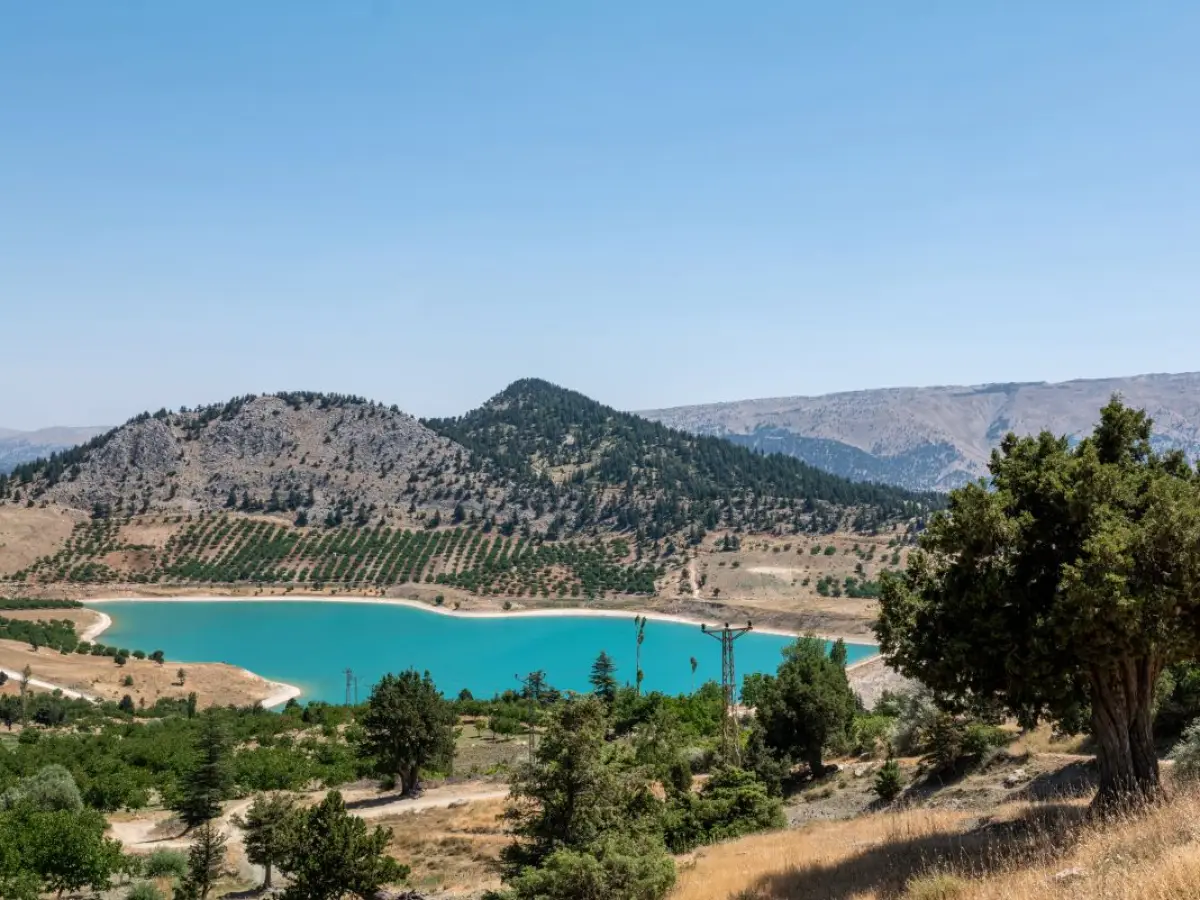
Cover: © Kerem Uzel