

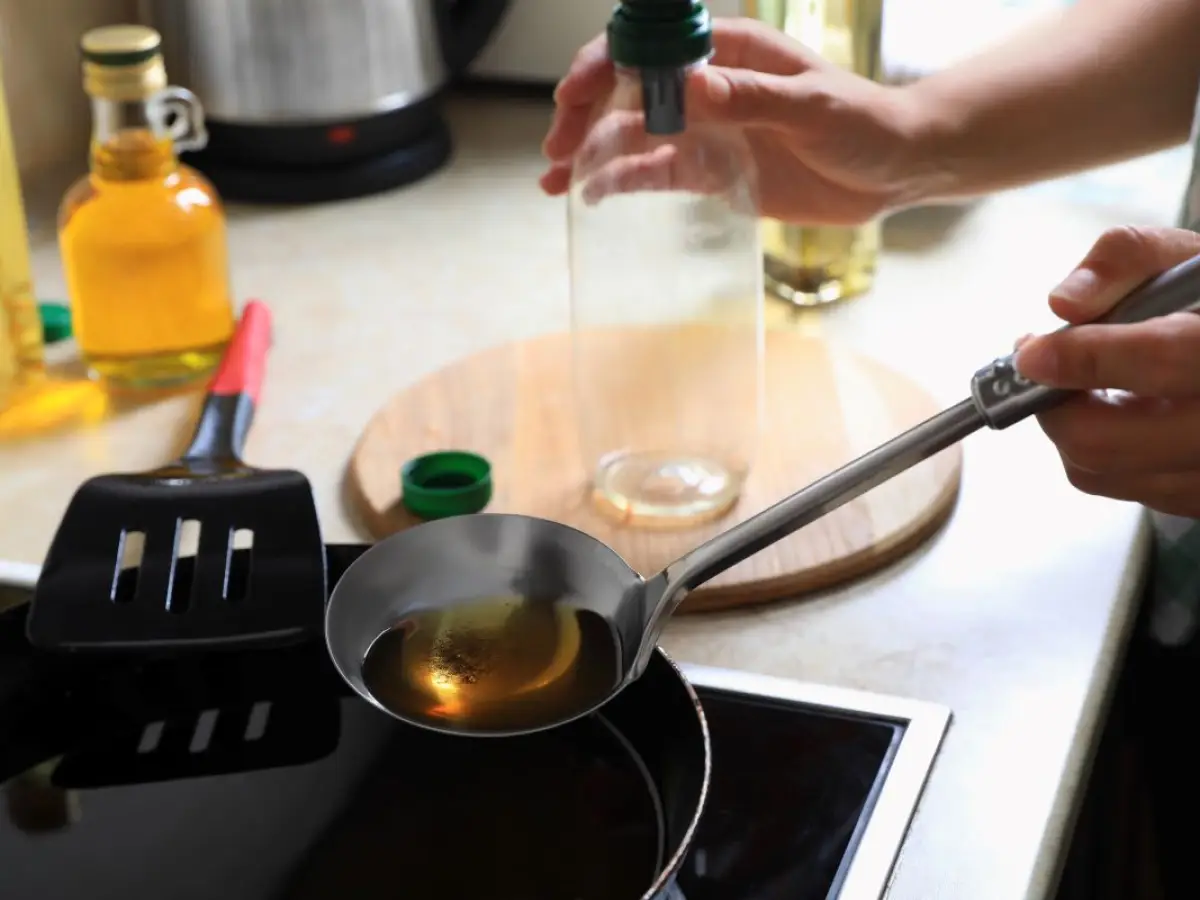

Olive oil, seed oil, corn oil. We use it for cooking, for frying, for preserving tuna or mushrooms, and then we tip it down the kitchen sink, as if it were water. It rarely even occurs to us that food oil released into the environment can not only cause serious harm, but also represents an unforgivable waste of a valuable resource.
CONOE, the Italian national consortium for the collection and treatment of used vegetable and animal oils and fats, was set up more than twenty-five years ago with the twin aims of preventing both this harm and this waste. While collection, grown year-on-year, is now focused on improving results by capturing the flows of this particular waste stream that are still untapped, today CONOE is ready for a further step up, positioning itself as an organisation capable of supplying the market with regenerated organic raw materials for a series of products, such as biofuels, biolubricants, dyes, and biopolymers. General Director Francesco Mancini and Operations Director Barbara Gatto told us more.
All the used oil collected in Italy (and what has yet to be collected)
Let’s start with CONOE’s figures. Data up to 2025 shows a growth trend, with over 82,000 tonnes of used cooking oils (UCO) collected, mainly from food-service businesses and food sector companies. “To this, we have to add collection that falls outside the Consortium’s remit, namely household waste managed directly by municipalities, currently amounting to approximately 15,000 tonnes of used oil,” says Barbara Gatto. “Altogether, the whole supply chain collects more than 120,000 tonnes of waste, up from 110,000 in 2024.”
There is, however, still considerable room for improvement, since, according to the Consortium’s estimates, the total volume of used cooking oil produced in Italy each year is around 300,000 tonnes. “Doing some simple math,” Gatto continues, “around 180,000 tonnes are not captured, almost all of which originates from domestic kitchens. Unfortunately, this used oil is still most often poured down household sinks, with an environmental impact that remains highly underestimated compared to other types of waste.”
Alongside a lack of public awareness and knowledge, there is often also a shortage of the widespread collection points that municipalities should be putting in place to make it easier for people to dispose of this waste. “CONOE has been working on this for several years, with projects developed jointly with local authorities to improve both public communication and the collection network.”
Recycling supply chains
But where does the used oil actually end up, once it has been recovered from kitchens and food industry facilities? “The reuse of vegetable oil bases already relies on at least two well-developed supply chains,” says Francesco Mancini. “First and foremost are biofuels, which absorb more than 90% of the 120,000 tonnes collected in Italy. Between 6 and 7% of the used oil collected is deployed as a base for producing biolubricants, and the remainder feeds into green chemistry sectors, such as the dye supply chain for the tanning industry, where it becomes a base for dyes. There is then a residual fraction that is used for more traditional purposes, such as the production of waxes and soaps. Finally, a still-emerging use is the production of biopolymers for plant-based microplastics destined for the cosmetics industry.”
New frontiers for the Consortium
With all these reuse supply chains, both new or already well-established, demand for regenerated vegetable bases is therefore growing, and with it, Mancini explains, grows the interest in strengthening collection services and seeking out vegetable oil sources beyond the kitchen. “Our collectors are no longer content simply recovering used oil from food-service businesses; they are now exploring which other types of waste might yield fatty-acid bases that could be regenerated.”
Several projects have therefore been launched to recover such bases from spent biolubricants (which are themselves produced from regenerated used vegetable oils) or to capture fatty acids that end up in urban wastewater treatment plants.
“Until now,” Mancini notes, “these activities were not of direct interest to the Consortium, which was originally set up specifically to capture used oils from food-service kitchens. But today that scope is widening, since the Consortium’s collectors and regeneration plants face growing demand for these materials and so are no longer looking for them solely as an output of food-service activities.”
Not only upstream (through collection), but also downstream (through recycling), the role of CONOE, and, more broadly, that of all consortium-based systems, appears ready for an evolution. “Whereas EPR systems, until now, were conceived mainly with the aim of preventing waste from being dispersed and ensuring its recovery, we are trying to take a further step towards effective recycling,” Mancini explains. “Recovery is the ‘bare minimum’. Today, EPR systems should also be concerned with securing markets for the regenerated waste they output under their remit, ensuring that those uses are genuinely sustainable, both economically and environmentally. Therefore, we can say that the time is ripe for the role of the Consortium, and of consortia in general, to be interpreted more broadly in the framework of the regenerative bioeconomy.”
This content is produced thanks to the support of sponsors
Cover: image by Envato