


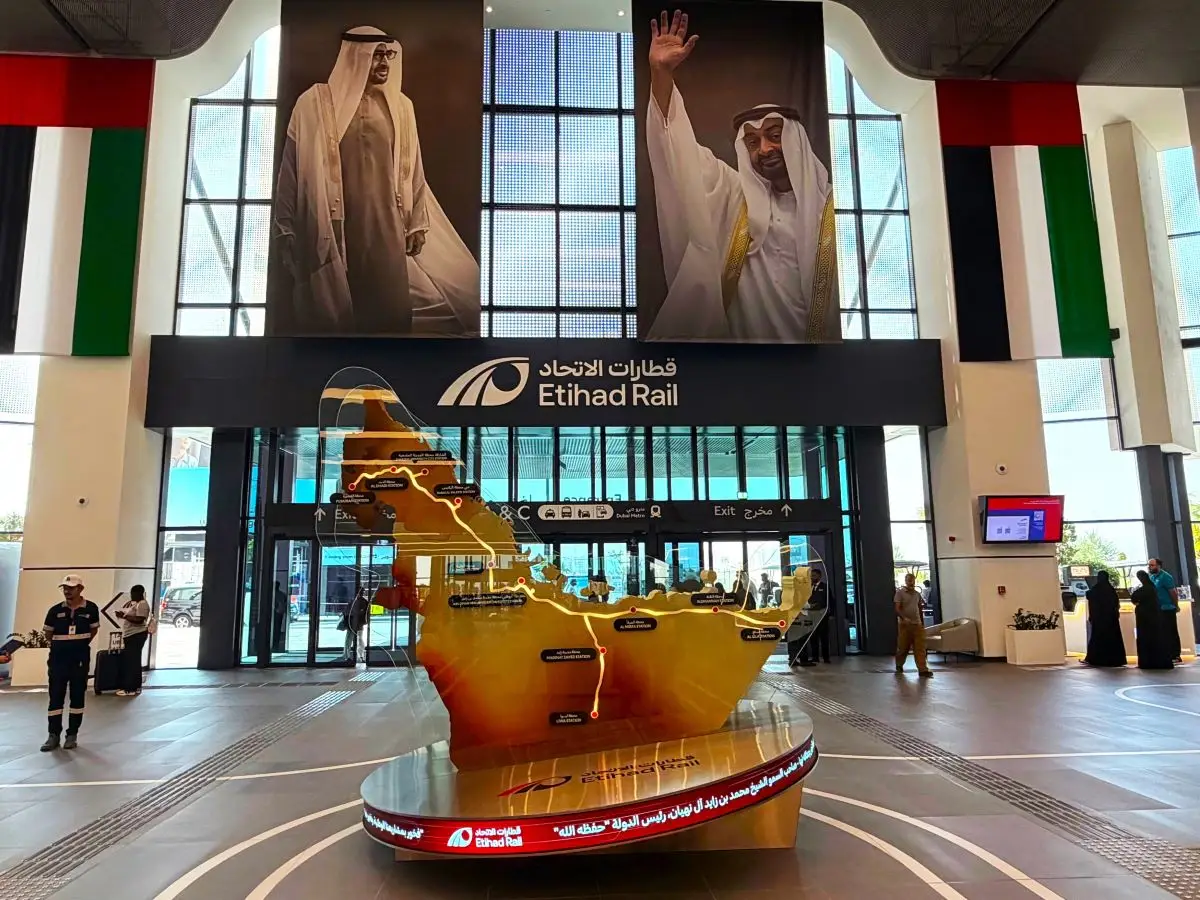

Dubai – The first train to cross the desert arrived in Dubai at the end of September, sparking a sense of wonder and evoking memories of days gone by – were it not for the ultra-modern design, the immaculate Al Yalayis station and the city’s skyline in the background. Travel times flash across the digital displays with precision: Dubai-Abu Dhabi 57 minutes; Dubai–Fujairah 69. Some people even travel on the train just to take a few selfies. The network forms part of a rail programme worth over $13 billion (covering both freight and passengers) which, with the war against Iran and the closure of the Strait of Hormuz, has taken on a new strategic significance: to offer the country a land-based alternative to a maritime bottleneck now deemed too vulnerable.
Bypassing the strait, one of the world’s most important arteries through which gas, oil and goods transit to Europe and Asia, is a matter of survival here. It is not just a matter of geopolitics: according to the National Association of Freight and Logistics, overall shipping costs in the Gulf have risen by 300–500% compared with before the outbreak of the conflict. Driving up rates are war risk insurance, fuel costs and expenses associated with alternative routes. At the height of the crisis, operators in the Emirates reported costs of close to $10,000 per container, compared with around $1,500 before the war.
Yet the cost of this conflict is not measured solely in dollars or in extra days at sea. In the Gulf states, investment priorities are shifting: energy security, defence and new infrastructure to bypass the Strait of Hormuz have become top priorities. “The main change is that Gulf states are no longer thinking only about efficiency; they are thinking about redundancy,” Ebtesam Al Ketbi, president of the Emirates Policy Center, independent think tank in Abu Dhabi, explains to us. “Hormuz has reminded everyone how dangerous it is to depend too heavily on one maritime chokepoint. In simple terms, the Gulf is moving from maximum efficiency to strategic resilience.”
Meanwhile, the resources needed to protect existing infrastructure or build new infrastructure risk competing with those required for economic diversification and the energy transition, which have been at the top of the political agenda here for years now. It is a paradox: hydrocarbon revenues finance the diversification of Saudi Arabia and the UAE, but they are also, as we have seen in recent months, among the most vulnerable to geopolitical upheavals. In short, the post-oil era in this part of the world continues to depend on the stability of the oil system.
Priority for energy security
At the record pace that characterises the Gulf states – made possible by the availability of cheap labour from South-East Asia and Africa, employed in round-the-clock shifts – investments in the oil sector and logistics are multiplying, particularly in the Emirates, Saudi Arabia, but also in Iraq: railways, oil pipelines, ports and roads for road transport.
The various “visions” of the Petro-states for the post-hydrocarbon era and their net-zero targets, which have become a cause championed by the sheikhs in recent years, are faltering as state budgets come under pressure from defence costs. The breakdown of expenditure is changing: in the first quarter of 2026, Saudi Arabia ran up a fiscal deficit of around $33.5 billion; public spending has risen, and military requirements are weighing heavily on the accounts (Patriot missiles alone cost several million dollars each). In the Emirates, too, defence now absorbs tens of billions of dollars a year, while the protection of energy infrastructure, after the attacks and serious damage suffered during the conflict, has become a national priority.
Another factor is the sharp economic slowdown caused by the Hormuz crisis. Oxford Economics has progressively revised downwards its forecasts for the Gulf Cooperation Council countries: in its latest update, it forecasts a record contraction of 6.4% for 2026. Even the International Monetary Fund speaks of a regional recession, caused by the collapse in hydrocarbon production and the slowdown in the non-oil economy.
This pressure could also be felt at the upcoming COP31 in Antalya, where Saudi Arabia and the UAE traditionally play an important role within the Global South bloc and in the debate on the “just transition” – further intensifying the dispute over the timing and costs of decarbonisation.
A setback for the transition?
Early figures show that this shift in priorities is already having an impact. The Gulf monarchies are not abandoning the transition, but the war is slowing down its pace and reducing investment. Here in Dubai, tourism has not yet recovered: hotels and restaurants are waiting for the winter high season to see how much of the previous normality will actually return. In Saudi Arabia, the review of the major Vision 2030 projects, already begun before the war, has become a pressing priority.
“Defence, energy security and protection of critical infrastructure have become more urgent. That means some expensive or long-term green projects may face greater scrutiny,” notes Al Ketbi. The data from the Norwegian research institute Rystad Energy points in the same direction and, first and foremost, shows a significant slowdown. Due to the logistical disruption in the Strait of Hormuz and the Red Sea, solar panels and components continue to arrive slowly. In March, monthly imports of photovoltaic modules into the Emirates plummeted to 160 MW, compared with an average of 767 MW in 2025.
“The crisis is expected to result in a net delay of between three and 12 months across the active renewable energy pipeline in the Middle East, while simultaneously strengthening the medium to long-term strategic commitment to the energy transition. The overall effect is a short-term delay followed by a sharper medium-term acceleration in Saudi Arabia and the UAE,” writes Rystad. The slowdown, the institute points out, would therefore be logistical and financial, not strategic.
A post shared by Al Ketbi: “I do not see the Gulf abandoning the energy transition. Solar, nuclear, batteries and grid investment still make strategic sense because they reduce domestic dependence on hydrocarbons and strengthen energy security. The transition is becoming more pragmatic. Governments will increasingly favour projects that deliver both economic value and strategic resilience, not simply environmental credentials.” The line is a fine one, however: if energy security and financial returns become the criteria for selecting investments, there is a real risk that decarbonisation will take a back seat.
The new logistics landscape of the Gulf
“The UAE has to protect its economy against the immediate risk of disruption in Hormuz,” continues Al Ketbi. “Infrastructure such as ADCOP [Abu Dhabi’s pipeline, ed.] is about strategic resilience: ensuring that the country can continue exporting energy if a major maritime route is threatened. That is a national-security requirement, not a reversal of climate policy.”
One glance at a map is enough to see why the exodus from Hormuz is heading inland and towards the ports on the Arabian Sea and the Red Sea. The striking sight here is no longer the oil tankers stranded in Hormuz, but the queues of lorries outside the ports and the prefabricated warehouses hastily erected along the coast. In Fujairah, ships are loading containers, while a little further north, at Khor Fakkan, thousands of lorries enter and leave every day from a terminal that, until a few months ago, functioned primarily as a maritime transhipment hub.
The most ambitious project is the Development Road: a $17 billion project involving 1,200 kilometres of roads and railways from Grand Faw Port, in southern Iraq, to Turkey and from there to Europe. Launched before the war but now of strategic importance, it involves Iraq, Turkey, the UAE and Qatar.
For hydrocarbons, however, the alternative lies in pipelines. The Saudi East-West Pipeline runs for around 1,200 kilometres from the eastern fields to Yanbu, on the Red Sea, and can transport up to 7 million barrels a day. In the UAE, the Adcop Habshan-Fujairah pipeline carries crude oil from Abu Dhabi directly to the Gulf of Oman; ADNOC, the national oil company, is expanding its export capacity, expected to double by 2027 to reach 4 million barrels a day.
Escape to the West
But the most visible transformation is taking place in the ports. For decades, Dubai’s massive Jebel Ali port, covering an entire district of the city, has been one of the Middle East’s main hubs. However, it is located within the Persian Gulf. The UAE’s logistics giant, DP World, has therefore signed a 50-year concession to develop new terminals in Fujairah, capable of handling up to 2.5 million containers a year. In Dibba, a popular weekend and day-trip destination for Dubai’s expats, it will add 3.6 million tonnes of annual capacity. A little further north, at Khor Fakkan, Gulftainer is increasing capacity from 3.5 to over 10 million containers.
The same shift westwards is affecting Saudi Arabia, where convoys of lorries cross the desert. Containers unloaded on the Red Sea now travel mainly by road to Riyadh and Dammam, or take the reverse route for exports. The Saudi Landbridge project also includes 945 kilometres of railway between Riyadh and Jeddah, connecting to the existing line to Dammam to create a corridor from the Persian Gulf to the Red Sea. This project, too, predates the war, but the closure of the Strait of Hormuz has given it a new sense of urgency.
Solutions developed or accelerated in response to the emergency are becoming permanent infrastructure. “What is changing is that these projects are no longer seen simply as infrastructure projects. They are increasingly viewed as national security assets,” Al Ketbi concludes, citing the train passing through Dubai, the pipelines and the new links between the region’s ports as examples. These infrastructures have the potential to attract investments worth billions and to reshape a trade landscape that has, for decades, centred on the Persian Gulf and the Strait of Hormuz. The end of conflict and instability, however, with its futile military interventions and deadlocked diplomacy, is still nowhere in sight.
Cover: Dubai’s new railway station, photo by Elisabetta Norzi