

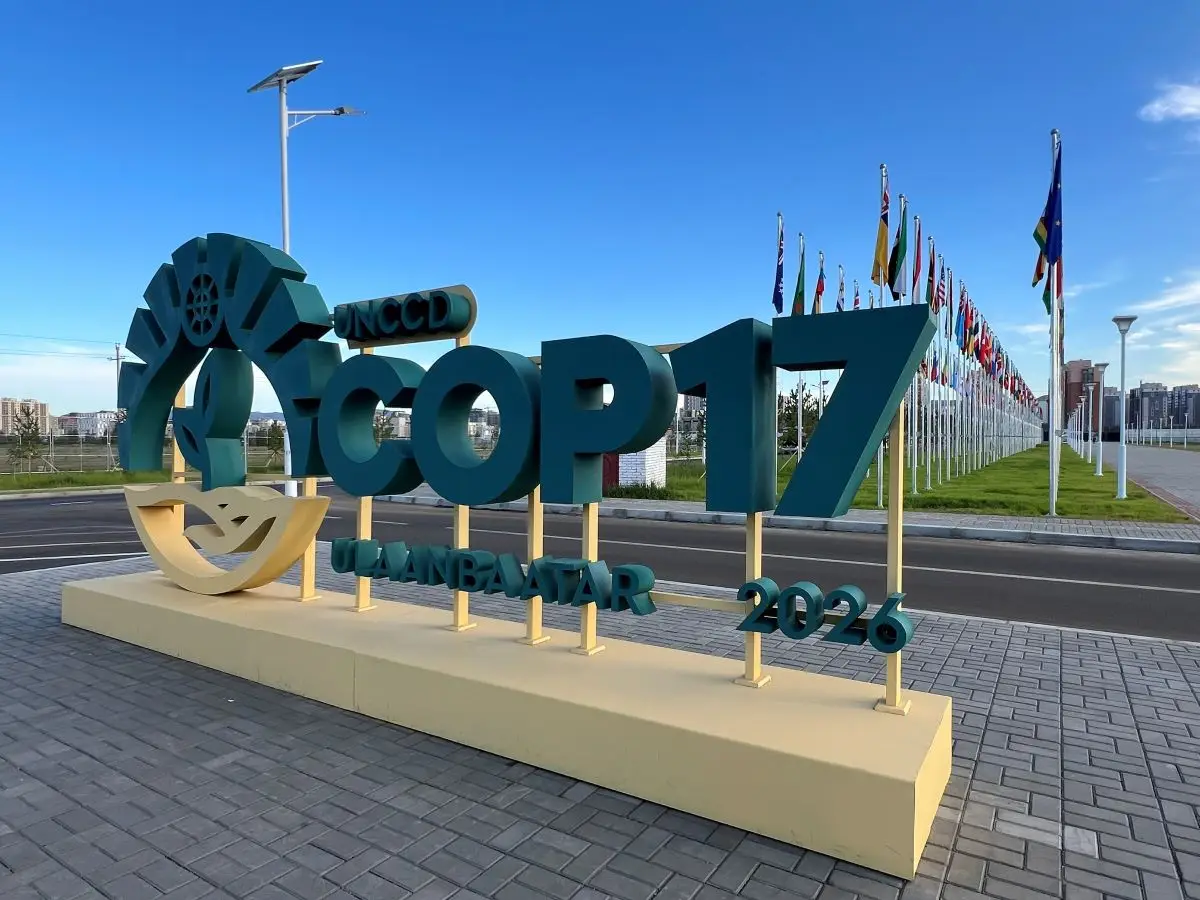

Twelve days of negotiations, 196 Parties, and more than 110,000 people attending across the Blue Zone and Green Zone. In the end, COP17 on combating desertification, held in Ulaanbaatar, one of the three major environmental treaties to emerge from the 1992 Rio Earth Summit alongside those on climate and biodiversity, leaves behind two very different legacies: on the one hand, 1.3 billion dollars and the largest initiative ever launched for the world’s rangelands; on the other, a second consecutive failure to reach a global agreement on drought. Between these two extremes, an entire strand of the negotiations simply evaporated: the discussion on the rights of communities affected by desertification, Indigenous peoples, women and civil society. It was not rejected in plenary. It was taken off the table in the first days of the conference, and never fully returned.
The National Garden Park, where the COP was held, stands at a precise point in Ulaanbaatar, where the city stops being a forest of glass skyscrapers and begins to give way to the mountains. From the entrance to the Blue Zone, all it takes is a glance upwards to simultaneously see the two Mongolias that this conference tried – without entirely succeeding – to hold together: the cranes continuing to raise new towers on the edge of the national park, and the green ridgelines where a third of the country’s population still makes a living from pastoralism, across a territory in which 77% of the land has been degraded. It is no coincidence that Mongolia chose this setting to host the conference. Here, the tension between urban development, land protection and pastoralism is visible within a few metres. For twelve days, it was also the setting for the negotiations.
A COP between rangelands and drought
COP17, held from 17 to 28 August under the title Restoring Land. Restoring Hope, had been presented by the Mongolian presidency as the COP of implementation: no more promises, but projects getting under way. Three objectives had been set out: finally building resilience to drought, closing the financing gap between real needs and the resources currently being mobilised and putting rangelands at the centre of the global agenda.
On drought, the COP confirmed everything that was feared on the way there. The dossier had been deadlocked since COP16 in Riyadh, and three text options reached the negotiating table in Ulaanbaatar. The most ambitious, backed by the African Group, proposed a genuine international instrument; the minimalist option, pushed by the United States, reduced the issue to voluntary national action; in between was a bridging proposal from Chile, dismissed by the Africans as work that had already been done in the past.
The text emerged only on the second-to-last day of the COP, after a night of negotiations that continued until 4 am, and contained no new instrument: only a commitment to continue discussing the issue at COP18, in Egypt in 2028. “It’s not what we expected, but it ensures that the discussions remain open,” one delegate said immediately after the announcement. Others, after days spent going round in circles over the same issues, did not attempt to hide their exasperation: “We’ve been talking about it for years... I mean, for days.” Outside the official negotiating rooms, the sharpest verdict came from WWF. Christine Colvin, the organisation’s global head of freshwater policy, put it bluntly: “It is deeply disappointing that ambition on drought dried up.”
On finance, something did genuinely move: 1.3 billion dollars was put on the table, the first tangible step towards closing the gap between real needs and the resources currently being mobilised. Much of that sum, however, flowed into a single channel: rangelands. The Rangelands Flagship Initiative is the largest mobilisation ever undertaken by the Convention on this front. At a press conference, UNCCD Executive Secretary Yasmine Fouad described it as the political heart of this COP: “When I say that this is a COP of implementation, this is exactly what I mean: we listened, and rangelands have been put at the centre alongside finance.”
And then there is the fourth front, the one that did not appear in the official statements but ran through every day of the negotiations: the genuine inclusion of the communities that experience desertification first-hand. Here, the outcome is not disappointing. It is a step backwards.
Who was left out
From the very first day, the United States and Russia opposed the inclusion of four items on the agenda: the post-2030 strategic framework, references to gender, the participation of civil society and Indigenous peoples, and synergies with the other two Rio Conventions on climate and biodiversity. In the language of diplomacy, these points were “suspended pending consultations”. In practice, for much of the conference, they remained outside the room. A joint statement from civil society, Indigenous peoples, local communities, pastoralists, women and young people responded immediately: postponing something does not mean cancelling it, but nor does it amount to inclusion.
In the end, the four thematic caucuses (Indigenous peoples, local communities, gender and youth) met for the first time in the Convention’s history and were able to submit their formal statements to the presidency. But representatives of pastoralists and civil society organisations present in Ulaanbaatar describe a different experience: that participation remained more symbolic than substantive in the texts that really matter, the ones where decisions are made.
Patrice Burger of CARI, one of the long-standing civil society organisations within the Convention, offers a broader reading of what happened. “I have never seen a COP like this; it’s unprecedented,” he says, but adds that he is not surprised. On 7 January, the United States withdrew from 66 international organisations, cutting their funding: a way of saying, Burger explains, that such forums no longer serve Washington’s interests. Yet the United States has been a party to and has ratified this Convention for thirty years, having also endorsed the principles that are now being contested (gender, civil society, synergies between the Conventions).
For Burger, it is literally “a form of blackmail”: a country that behaves as though it is part of the system for decades, then stops paying its contributions and says no to everything. According to civil society, this dynamic translated into days of intermittent negotiations in the contact groups: whenever a paragraph on gender, Indigenous peoples or synergies returned to the table, an objection from Washington or Moscow could send it back into discussion. The US delegation left Ulaanbaatar a day before the meeting closed, warning that nothing would be negotiable after a certain time. For Burger, this is not an isolated episode, but a sign of how difficult it is to keep a Convention founded on participation and voluntary contributions functioning when an important Party changes its position.
The problem, in fact, is not only political. The UNCCD does not provide for any mechanisms to deal with a Party that ceases to comply with the principles it has signed up to, let alone to exclude it. And this is where Burger sees the future risk: that the system will end up adapting to the conditions imposed by those who wield the most influence and decide to challenge it. This is also why he stresses Article 3 of the Convention, which establishes that decisions should be taken with the participation of civil society, local authorities, young people and women. This is not a procedural detail, but the treaty’s most visionary principle. And it is precisely that principle that Ulaanbaatar has put to the test.
The issues still unresolved
The drought text approved in Ulaanbaatar sends the dossier on to COP18, in Egypt in 2028. In the meantime, the Drought Resilience Investment Facility will have to prove that it can mobilise private capital for concrete projects, while the common fund for vulnerable countries launched in Riyadh will have to move from commitments to resources that are actually available. Work on synergies between climate, biodiversity and desertification will also have to take a more clearly defined form ahead of COP31 on climate in Antalya, in November.
But one question remains that goes beyond this COP. If the system cannot find a way to deal with a country that, after joining and contributing to the Convention, decides it no longer recognises some of its rules, there is a risk that the same pattern could be repeated with other countries and in other negotiations.
That is the precedent Ulaanbaatar leaves for COP18: not only an unresolved drought dossier, but the need to work out how to prevent a Convention founded on cooperation from being repeatedly shaped by those who choose to challenge its rules.
Cover: photo by Marta Abbà