


This article is part of the thematic channel The Water Observer: subscribe to our newsletter and receive exclusive contents from the world of water
For a decade, Junker has built its relationship with the public around an important everyday practice: recycling and managing urban waste. Today, the Italian platform, used by 3,500 local authorities and over 3.2 million households, is expanding its scope to include water services, evolving from a guide to urban hygiene into an integrated platform for the circular economy.
At the heart of this strategic decision lies the desire to strengthen the relationship with consumers and foster greater environmental awareness, as Noemi De Santis, co-founder of Junker, explains: “Making it easier to access information can lead to greater efficiency for service providers and, above all, to greater awareness amongst people regarding their consumption of an increasingly precious resource.”
Junker began and developed in the world of separate waste collection. Why the move into the water sector?
This is a natural progression for us: after all, across the country, waste management and water services have historically and industrially been integrated within numerous multi-utility companies. Moreover, in recent years, growing regulatory pressure, primarily from ARERA, and the urgent need to align with the UN Sustainable Development Goals [SDGs 6 and 12, ed.] have prompted operators themselves to urgently seek digital channels for rapid and efficient communication. This is compounded by strong demand from the public: 82% of users, according to our survey of over ten thousand participants, expressed a desire to manage these two aspects within a single app.
What does the platform offer?
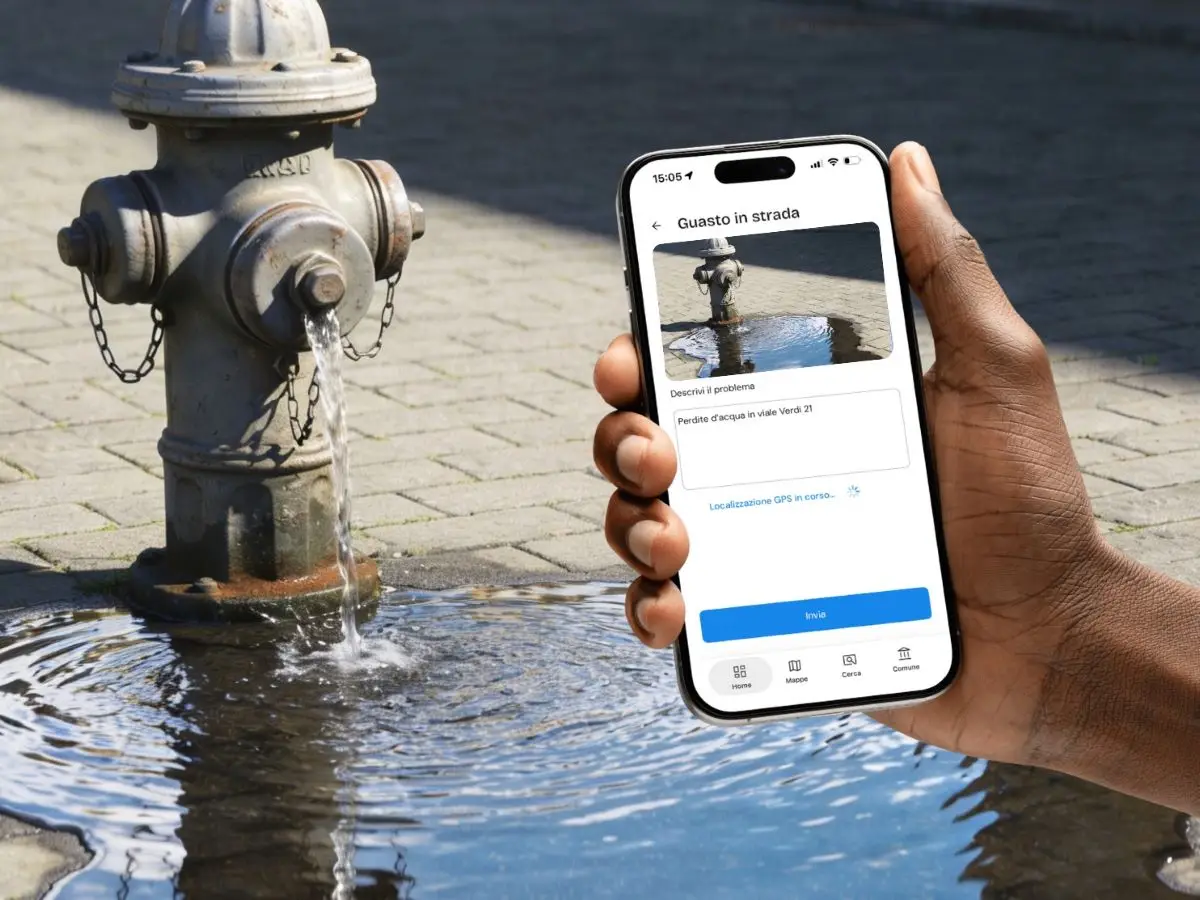
It presents itself to the user as a genuine “multi-utility app”. Citizens select the “water service” channel and can monitor their consumption and bills, receive real-time push notifications about faults, outages or rationing, view the chemical and physical parameters of the water in their local authority area, consult the map of “water kiosks”, submit photographic meter readings and report geolocated network leaks via GPS.
In practical terms, what changes when using the app?
The citizen enters the information area from the first page. If they then wish to access their personal services, they can log in, including via systems such as SPID or CIE: from that moment on, they find themselves in a personalised environment. They are no longer “at Junker’s”, but can tell, even visually, that they are on their service provider’s site. The service can be structured flexibly. The first level is information: communications, data and emergency alerts. The second is interactive and concerns citizen-to-operator information, such as meter readings and reports. In this case, thanks to geolocation, a report sent via Junker already contains the coordinates of the location from which it was made. For example, if the water supply is cut off in a particular area and several users report the problem, the utility provider can view a real-time geographical cluster of these reports in its back office. It is a way of turning citizens into active sentinels within the local area. Of course, this also entails a responsibility to respond to and provide feedback for users.
What are the benefits for service providers?
Developing a proprietary app from scratch involves enormous IT risks and substantial marketing costs to persuade citizens to download it. Junker, on the other hand, provides utility companies with an active and loyal user base, with a user acquisition cost of virtually zero. Furthermore, we offer a technological edge that benefits both citizens and service providers. In 2025, the platform underwent a major technological overhaul, transitioning to a highly configurable multi-tenant and multi-channel architecture. We can manage co-branding and the harmonious coexistence of different brands, native segregation of data flows without overlaps or confusion, and geolocalised navigation: a multi-tiered mapping system dynamically activates water services solely on the basis of the user’s GPS location and specific profile, accepted and declared at the time of app installation, as required by the GDPR.
Your strategic rationale links the launch of the water module to regulatory pressure from ARERA and to the fact that around 24% of the investment requirements beyond the PNRR remain unfunded. Is Junker more of a low-cost compliance tool for operators, or a service designed primarily for the public?
There is no need to choose between the two options. Our commercial offering for the water service does, indeed, address the economic and regulatory needs of operators, but compliance and service to citizens in Junker have always been two sides of the same coin. Our model is B2G2C, i.e., Business to Government to Citizen: we work with the operator so that it can offer a better service to citizens. It is undeniable that pressure from ARERA acts as an extraordinary catalyst: the macro-indicators MC1 (contract start-up and termination) and MC2 (quality of customer relations and accessibility) subject utilities to extremely severe penalties, which in the two-year period 2022–2023 exceeded 680,000 euros for individual companies. In addition to this, there are the post-PNRR infrastructure investments that will remain unfunded. However, as is already evident in the waste sector, the operator can only achieve compliance if it puts the citizen at the centre.
An example?
Take self-meter reading, for example: to reduce estimated billing, the utility provider needs residents to report their consumption regularly. This is easier to achieve if the smartphone offers a highly simplified, inclusive interface (available in 14 languages) accessible to older people, the blind and the visually impaired. The same applies to tackling water wastage and service disruptions: to respond more quickly, having residents who can report issues in real time and with geolocation is a tangible advantage. And then there is transparency: if a person receives a prompt notification when the water supply is cut off, they can make alternative arrangements; if they can access water quality data, they have additional tools to understand the service they are using. ARERA Resolution 655/2015 itself imposes strict obligations in terms of transparency, telephone accessibility and user empowerment. In short, Junker helps resolve the operator’s compliance issues precisely because it is a service designed to be adopted and appreciated first and foremost by the public. When the user’s life is made easier, the utility’s internal efficiency automatically benefits.
The survey shows that users are more interested in finding out about water quality and receiving information on faults and disruptions than in paying their bills via the app. Is this influencing the development of the platform?
In fact, it confirms the philosophy on which Junker was founded: to be, first and foremost, a tool for communication and transparency, as well as a means of enabling responsible and proactive behaviour. In the survey, information on water quality scored 2.9 out of 3, real-time alerts on faults and disruptions reached 2.78, while bill payment scored just 2.13. Thanks to our flexible, modular and progressive service, a utility provider can start with a lighter version, focused on information functions, and subsequently integrate transactional services for bill payments.
Will the app also become a tool to help people understand how much water they are using?
Yes, and this opens up a world of possibilities. If the utility provider makes consumption data available, we can display it but also use it for ongoing awareness campaigns. Citizens could, for example, compare their own consumption against a benchmark to see where they stand in relation to the average. This information could also be linked to gamification mechanisms, with recognition or reward schemes for the most responsible behaviour. In this way, a seemingly neutral piece of data – how many litres of water we consume – becomes a tool for raising awareness. We can provide the technology and the opportunities for interaction, but naturally it is the water supplier that decides how far it wants to take user engagement.
The platform interfaces with the utilities’ IT systems: how do you manage data security and processing?
Junker receives data from the service provider, which decides what information to make available and uses it only to the extent necessary to provide the service. It is important to make it clear to users that we do not have unrestricted access to their personal data. If a member of the public uses the app to view public information, they do not necessarily need to log in. When they log into their personal account, however, they are accessing the provider’s system via our interface. This is an important aspect for us because, as we work with the public sector, we are subject to very stringent requirements. The technology must facilitate the relationship between the citizen and the provider, not create a further layer of opacity.
The partnership with BEESELF and Terranova introduces artificial intelligence algorithms to identify anomalous consumption patterns and suspected hidden leaks in homes. How far along is this predictive component?
The industrial partnership and technological integration with Terranova’s BEESELF portal are currently the most innovative and fully operational solutions available on the market. The application of predictive AI algorithms is at a stage of “on-demand” and customised implementation, rather than standardised, mass-scale operation. The application depends heavily on the technological infrastructure of the individual utility provider and, in particular, on the availability and quality of data from smart meters. For this reason, the approach is currently personalised and “tailor-made” for each individual utility provider, working with them to assess which tools can actually be activated based on the available data.
This content is produced thanks to the support of sponsors
Cover: image by Junker