


A coastal factory can tell you almost everything about the water leaving its premises: volumes, water-quality parameters, permits and monitoring results. Ask it about the sea that water flows into, and it has very little to say. This is exactly where corporate responsibility for water ends today: at the site boundary, not at the sea.
The UN Biodiversity Conference (COP17) in Yerevan, the first global review of the commitments made under the 2022 Kunming-Montreal Global Biodiversity Framework, was preceded by a UN report concluding that none of the framework’s 23 targets has yet shown wholly positive progress. Two of them bear directly on business and water. Target 7 calls for pollution from all sources to be cut and for excess nutrients lost to the environment, such as the nitrogen and phosphorus that rivers carry down to the sea, to be halved. Target 15 calls on large companies to disclose their impacts on nature.
Two recent developments in Europe show just how hard it is to turn those targets into rules. Under the new European Sustainability Reporting Standards (ESRS), published on 21 September, standard E3 is no longer titled “Water and marine resources”, but simply “Water”. Marine topics have been parcelled out to other standards, and the requirement to disclose financial effects has been dropped because, in EFRAG’s view, no mature methodology existed. Shortly before, on 3 September, Advocate General Juliane Kokott advised the Court of Justice of the EU to annul the provision of the Urban Wastewater Treatment Directive that requires the pharmaceutical and cosmetics industries to cover at least 80% of the cost of removing micropollutants. That provision tried to do the opposite, extending responsibility beyond the factory gate. It rests on a Commission estimate that medicines and cosmetics account for 92% of the toxic load of micropollutants in wastewater. In the Advocate General’s view, the estimate lacks a sufficient scientific basis to allocate such a large share of the costs to those two sectors. Kokott does not question the polluter-pays principle; she simply asks for proof of who is polluting, and by how much. The Court has yet to rule.
Two rules with opposite aims, then, have run into the same wall. A company’s responsibility for water stops where measurability stops. This is not a matter of political will or corporate bad faith; it is a structural limit. International water stewardship standards, such as that of the Alliance for Water Stewardship, have already pushed more forward-looking companies to think at catchment scale rather than site by site. What is still missing is the last stretch, from river to sea.
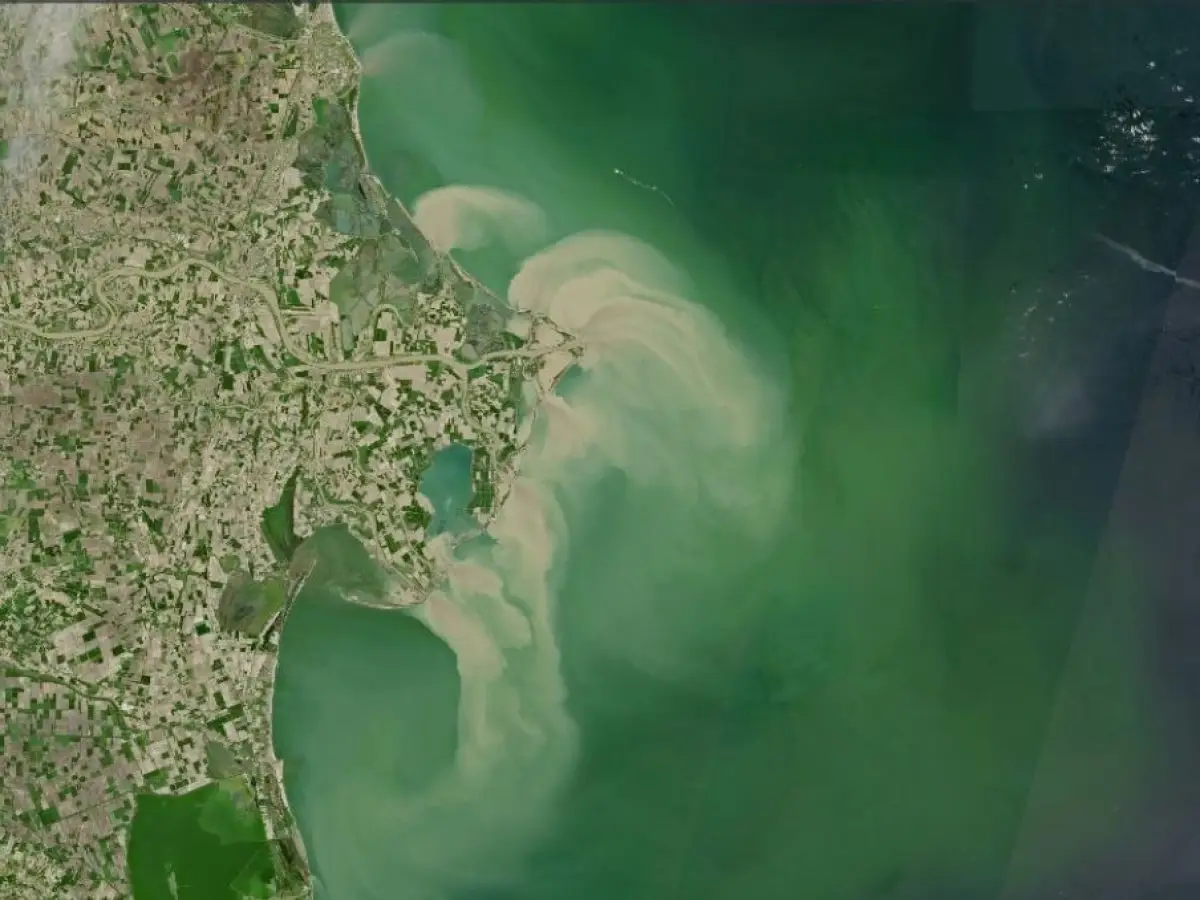
Nor is this only a coastal problem. A food manufacturer in the Po Valley does not think about the sea, which may seem a world away. Yet that is where its water ends up: the Po discharges an average of some 1,500 cubic metres per second and delivers more than half of the nutrients entering the northern Adriatic. In a tanning district, by contrast, many firms discharge into the same river, often through a single treatment plant, and even the most diligent cannot distinguish its own contribution from that of other companies. In each case the chain of evidence breaks at a different link: the state of the sea, the path the water takes, the share attributable to any single company.
Outsiders have already started looking. Since August, Ocean Sensitive Areas, a tool developed by GIST Impact and HUB Ocean, has let investors check how close the facilities of some 10,000 companies are to sensitive marine areas, without requiring any information from the companies themselves. It is a screening tool, not a measure of impact. But it means that a company’s exposure to the sea becomes visible before the company itself has the means to explain it.
Can the problem be solved? Not entirely, but more than we tend to assume. I see three ways forward, and each builds on something that already exists. The first is to widen the boundary of responsibility from the individual site to the catchment. Where an impact cannot be pinned on a single site, responsibility is shared among those discharging into the same river, with shared costs and shared targets. In Germany’s Ruhr region, this has been standard practice since the late nineteenth century: river associations split costs between municipalities and industry partly according to pollution load. In Italy, consortium-run treatment plants, such as those serving the Tuscan tanning district, already point the same way. The next step is to carry that logic all the way to the sea.
The second is to shift from attribution to contribution. When it comes to climate, companies report emissions across their value chains even though they do not control them: they use estimates and disclose the uncertainty. On water, we stopped the moment measurement became uncertain. The same approach could work here, with transparent estimates of each site’s contribution to pressures on the sea and explicit margins of error. That is the logic behind the wastewater directive, and it needs strengthening, not abandoning.
The third is to push back the frontier of what we can measure. Continuous monitoring of effluent, chemical fingerprinting that traces a substance back to its source, satellite data on coastal waters: much of what was invisible a few years ago can now be observed. Europe’s public datasets, from WISE to EMODnet and Copernicus, are already available. What nobody has yet done is join them up, from site to sea.
All of this matters more in the Mediterranean than elsewhere. It is a semi-enclosed sea, where water exchange is slow and whatever enters from land tends to stay: an estimated 80% of its pollution originates on land. It is home to more than 17,000 marine species, 20 to 30% of which live nowhere else. Italy is the natural place to start. Many of its industrial districts, from leather tanning to agri-food, sit along rivers such as the Po and the Arno, and the Po basin alone generates over 40% of national GDP. We know where the companies are, we know where their water goes, and we have the consortia and the data. What is missing is the thread that connects them.
Companies that look beyond their operational boundaries will not do so out of obligation, at least not at first, but because others will soon be asking them to: banks, investors, insurers, coastal communities. Those that move first will be able to use their own data to tell the story of their relationship with the sea., rather than have it told for them. The Kunming-Montreal Framework asks companies to account for their impacts on nature. In Europe, when it comes to water, they currently do so only as far as the factory gate. The water, of course, does not stop there. It keeps flowing, all the way to the sea.
Cover: The Po Delta, 22 April 2025 © European Union, contains modified Copernicus Sentinel data 2026, processed with Copernicus Browser