


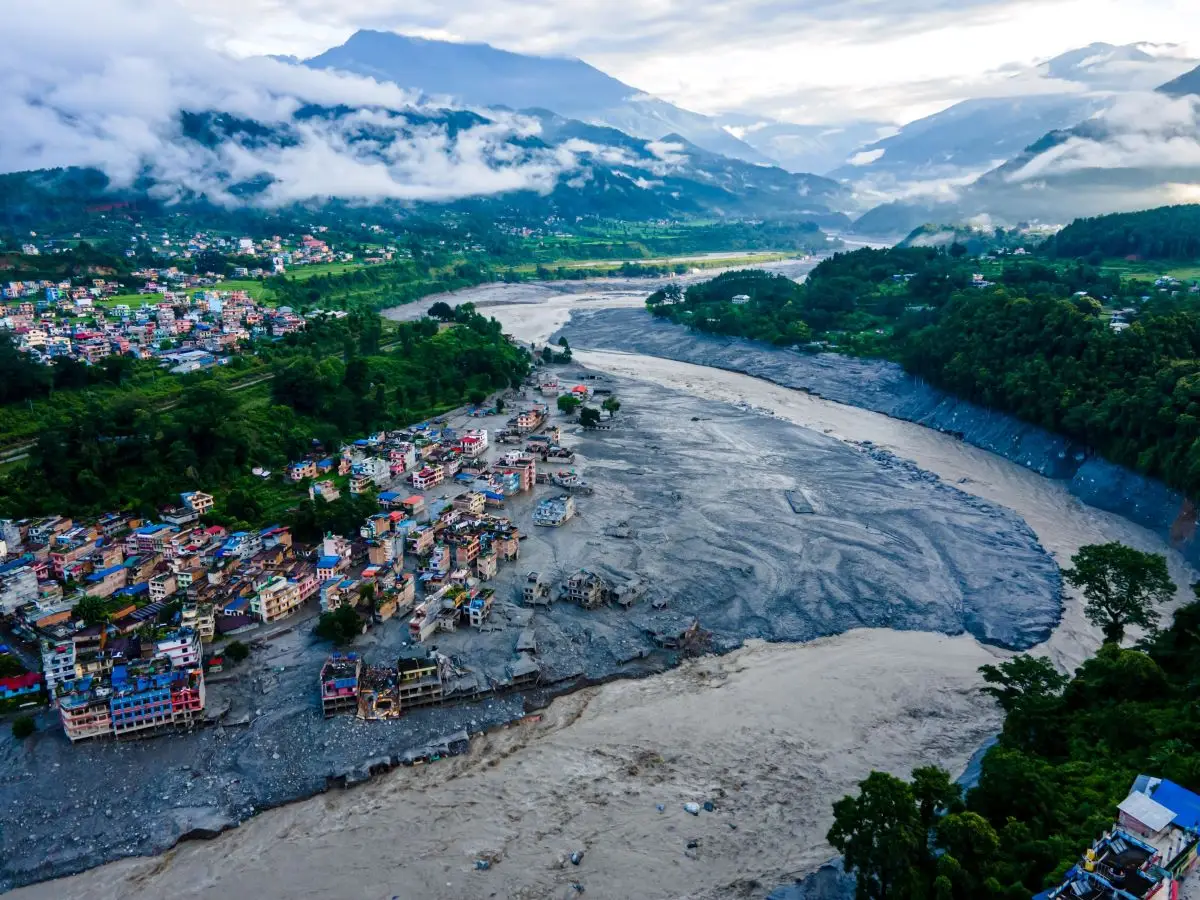

There is one word that Nepal’s Foreign Minister Shisir Khanal has stopped using, replaced by a different one. The first is aid. The second is compensation. The speech refers to the disaster on the Bhote Koshi River, the “Himalayan tsunami” of 26 August that destroyed villages and killed thousands of people, causing over 5 billion euros’ worth of damage, just over a tenth of the country’s GDP. And, for the first time, a government is not asking for aid but for the compensation owed by the countries most responsible for the climate crisis.
A week after the disaster, Balendra Shah’s government sent a formal request for climate compensation to China, the United States and India, the world’s three largest emitters of greenhouse gases. According to the Kathmandu Post, Nepal’s Minister of Finance, Swarnim Wagle, sent a letter of request to international partners; at the same time, Kathmandu has submitted an urgent request to the Fund for Responding to Loss and Damage (FRLD, also known as the Loss and Damage Fund), the climate finance mechanism established by the United Nations to deal with situations such as this.
According to the Nepalese authorities, the official toll has risen to nearly a thousand bodies recovered and around 4,500 people missing across Nepal and Tibet. Ten municipalities in the districts of Nuwakot, Rasuwa and Dhading have been severely affected, with further damage downstream in Gorkha and Chitwan: tens of thousands of homes destroyed, schools damaged, and hydroelectric power stations worth billions of rupees swept away.
Minister Khanal’s remarks, as reported by Kantipur TV and various international media outlets, are well worth reading at length: “Nepal’s greenhouse gas emissions are virtually negligible. Yet, we are paying the ultimate price for a global crisis we did not create.” And he goes on: “The rapid melting of glaciers and these catastrophic mountain tsunamis are direct consequences of global climate change.” The minister asserted that China, the United States and India have a “historical responsibility to compensate vulnerable nations like Nepal”, a phrase that international climate law has, for at least a decade, been using in an attempt to translate the principle of equity between those who caused the crisis and those who bear the cost into concrete obligations.
From a scientific perspective, the prevailing theory remains that the disaster was triggered by a collapse of ice and rock. This is a detail that matters from a diplomatic standpoint: the strength of Nepal’s claim for compensation rests precisely on the scientific attribution of the phenomenon to global warming, not merely on a perception of injustice.
The fund expected to pay out, and its structural limitations
The Loss and Damage Fund is not a new initiative: its institutional history began in 2013 with the Warsaw Mechanism, then further developed through the decision made at COP27 in Sharm el-Sheikh (2022) to establish a dedicated fund, and was operationally launched at COP28 in Dubai (2023), with the World Bank acting as temporary trustee for the first four years. This decision was contested by many NGOs precisely because of the risk of a pro-Western bias in its governance.
The figures, updated as of March 2026, show a fund still in its start-up phase: $822 million pledged by 27 partners, of whom 24 have already signed contribution agreements and begun transferring funds. The fund aims to disburse an initial tranche of $250 million in 2025–2026. These figures should be set against the estimated funding requirements: at least $100 billion a year according to the most conservative estimates, rising to $580 billion by 2030 and $1.8 trillion by 2050 according to the most ambitious projections. In other words, the fund currently covers well under 1% of the actual need – a shortfall that makes Nepal’s request, however politically significant, difficult to translate into actual funding in the short term.
More at stake than Nepal
Khanal deliberately broadened the scope of his appeal beyond national borders: Nepal, he said, is a downstream community for China and an upstream community for India, and the Himalayan rivers affect the entire region. The loss of Himalayan glaciers threatens the water security of over two billion people in South Asia, who depend on river basins like the Ganges. This context transforms a national tragedy into what the minister describes in no uncertain terms as “a matter of civilisational survival”.
Whether this request will be heeded by the nations concerned, above all China, remains to be seen. COP31, which Turkey will host in Antalya in November, aims to present itself as “the COP of implementation”. If it truly is, Nepal’s request will be one of the first real tests of that promise.
Cover: an aerial view shows the aftermath of severe flooding along the Bhotekoshi River in Nuwakot, Nepal. The flooding affected low-lying areas and settlements near the riverbanks, causing widespread damage to homes, roads, bridges, a hydropower station and other infrastructure. Several people remain missing as authorities continue to assess the extent of the disaster. Rescue teams and security personnel are conducting search and rescue operations in the affected areas. Photo by Ambir Tolang / JNA Press, IPA Agency