

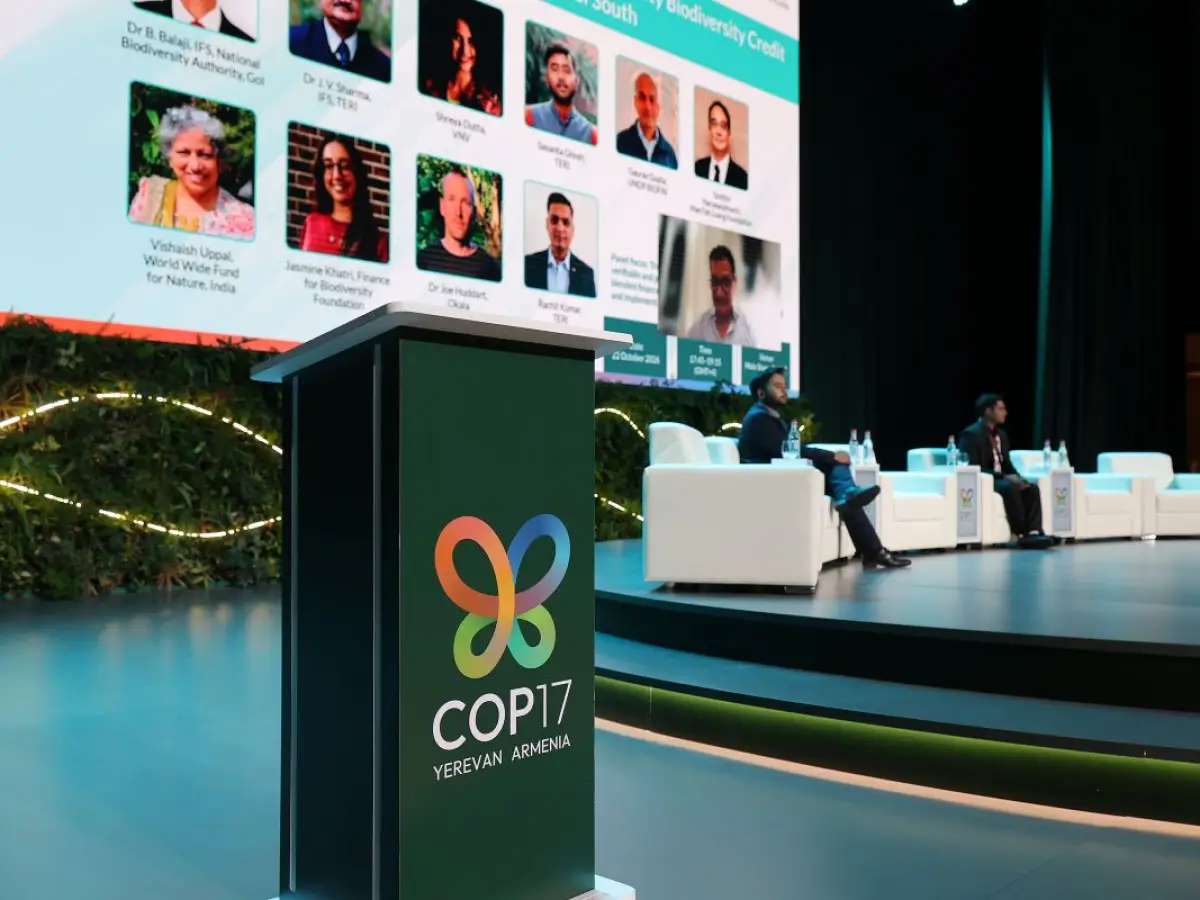

Yerevan - Monday, 26 October marked the start of the second week of COP17, the UN negotiations on biodiversity. The Meridian Expo in Yerevan, Armenia, is ready to welcome ministers from member countries, who will be evaluating the draft texts produced by the presidency and the negotiators. Many issues remain unresolved, and consensus will need to be reached on the final text that will mark the conclusion of the negotiations, aimed primarily at accelerating the achievement by 2030 of the 23 targets set out in the Kunming-Montreal Global Biodiversity Agreement. We have analysed some of the most important ones.
The first major global analysis of the goals: the Global Review
The need for a strategy to bridge the progress gap on the 23 targets of the Kunming-Montreal Framework was one of the key issues addressed. According to Guido Broekhoven, Head of Multilateral Policy at WWF International, “the first week highlighted the difficult choices, but did not fully resolve them”. Many civil society representatives urged ministers to translate the assessment into stronger national action. Despite this, the Executive Secretary of the Convention on Biological Diversity (CBD), Astrid Schomaker, reported significant progress but warned that the most complex issues still remain to be negotiated.
In a show of leadership, the Armenian presidency put forward the Yerevan Pathway, a document identifying measurable priorities to address the gaps in the implementation of global biodiversity targets over the next two years.
Unresolved issues relating to the global review of the targets concern soil biodiversity, harmful incentives, land-use planning, ecological connectivity, pollution and benefit-sharing. The actual Global Review, which will analyse unfulfilled commitments, is due to take place this week.
Business and finance: a structural problem, rather than a resource one
As expected, biodiversity finance was the most divisive issue of the first week. The list of donor countries dates back to 2006, and calls have been made for years to broaden the donor base. The European Union and France are demanding that the Gulf states and major emerging economies, including China and India, also contribute; for their part, developing countries argue that existing donors must first honour their own commitments. Saudi Arabia and Qatar are strongly opposed to broadening the donor base.
According to Target 19 of the Kunming–Montreal Agreement – which concerns the mobilisation of financial resources – the aim is to mobilise $200 billion a year for biodiversity from all sources by 2030, and $20 billion a year by 2025 (rising to $30 billion by 2030) for developing countries. Meanwhile, the 2025 interim target has, in all likelihood, been missed.
Also on the agenda is the issue of public subsidies for activities harmful to nature and biodiversity, with the aim of cutting them by at least $500 billion a year. Target 18, in fact, focuses specifically on the issue of subsidies, urging countries to identify incentives and subsidies harmful to biodiversity and to reduce them by at least $500 billion a year by 2030, “starting with the most harmful ones”.
According to the global report on which the Global Review is based, the 2025 milestone has not been met. Yet, in the draft negotiating text on resource mobilisation (dated 21 October), Target 18 appears only in the preamble. The Armenian presidency is, in fact, launching the Yerevan Call on Incentives Positive to Biodiversity, a Friends of Target 18 coalition and the Yerevan Biodiversity Finance Challenge, a platform coordinated by UNDP/BIOFIN with the OECD, IISD and the CBD Secretariat. The aim is to help ministries of finance, planning and the environment to redirect harmful spending and integrate biodiversity into national budgets. It is an important political signal, but it remains outside the scope of the negotiated decisions.
By contrast, the Cali Fund – established at the end of 2024 during COP16 on biodiversity in Cali, Colombia, to encourage companies that profit from nature’s genetic information to contribute – stands at $10,656, of which $7,085 has actually been paid in, against a target of $1 billion per year. The contributions specified (1% of profits or 0.1% of turnover) are voluntary.
On 16 October, at the COP17 Leaders’ Summit, nine private funders launched the Species Recovery Alliance, committing to invest over $500 million over five years towards the recovery of the world’s most endangered species. Members include the Bezos Earth Fund, Re:wild, the Rainforest Trust, the Critical Ecosystem Partnership Fund, the Colossal Foundation, the Fondation Segré, the Franklinia Foundation, the Ayers Wild Cat Conservation Trust and WildLives Earth: they will align their investments, share knowledge and work with local partners, measuring results against the IUCN’s Red List and Green Status of Species.
The alliance operates alongside, but separately from, CARES, a coalition of 17 governments led by Colombia and Armenia to advance Target 4 on halting extinctions. Cristián Samper of the Bezos Earth Fund argued that protected areas alone cannot save all endangered species and called on other funders and governments to join. A high-level dialogue on the GBFF was scheduled for 26 October, with the announcement of new commitments, during which some figures may have changed.
Synergies: climate, biodiversity and desertification are all part of the same crisis
On Wednesday 21 October, the Presidency hosted an event on the synergies between the three Rio Conventions (climate, biodiversity and desertification), alongside a side session on forests and the COP30 roadmap to combat deforestation.
At the same time, in the spectacular Armenian pavilion, Armenia also called for greater synergy between the three Conventions: biodiversity, climate and desertification. Guest speaker Tristan Tyrell, Programme Management Officer for Biodiversity, Climate Change and Dry & Subhumid Lands at the CBD, urged attendees to reflect on the fact that people in the field do not view these crises in isolation: climate, biodiversity and desertification are all part of a single crisis. Another guest at the presidential round table, Bethan Laughlin, Senior Policy Specialist at the Zoological Society of London, issued a call to action, stating that “there is currently no simple way to get the Conventions to cooperate, and the issue of synergies must be brought to the negotiating table, not just included on the action agenda.”
Hayro Hakobyan, facilitator of the NDC Partnership (a coalition for advancing the Paris Agreement), adopted a tougher stance, arguing that the transition towards synergies should be guided by individual countries’ priorities, not by the commitments under each Convention. The IUCN has also published joint statements for the three Rio Conventions, warning that synergies must strengthen biodiversity commitments, not dilute them.
Regarding synergies within the negotiations, however, a key issue is how to prevent forestry and agricultural carbon projects from harming species, habitats and local communities. Nigeria, for example, supports the inclusion of climate-related obligations in decisions on biodiversity, but Russia is opposed.
In the draft text on resource mobilisation, countries are primarily asked to ensure transparent accounting to avoid “double counting” – so that the same funds are not declared twice, once for climate and once for nature. Some countries also wish to avoid duplication of work between the secretariats of the Conventions. In short, when it comes to synergies, everyone agrees in principle. In practice, however, the dispute centres on who is obliged to do what and how to account for these commitments.
The voice of indigenous peoples
On the final day of the first week, indigenous representatives and environmental campaigners marched from the IUCN pavilion to the entrance of the exhibition centre, carrying placards bearing slogans such as “Time to Face the Justice Gap”, in a protest organised by Friends of the Earth International. Their demand is for what is known as FPIC (Free, Prior and Informed Consent). The protests led by indigenous peoples also expressed solidarity with the Armenian campaign My Heart Is in the Highlands, which aims to raise awareness of communities affected by mining activities, whose members have been intimidated.
Target 22 includes the “protection of defenders of environmental human rights”, but national plans do not appear to prioritise this. The wording on human rights and gender is still contested in the forest negotiations. Indigenous representatives want to be recognised as the leading experts on biodiversity conservation, the main contributors to its protection and those who make their living from it, not merely as stakeholders to be consulted. They are calling for resources, not just recognition. Local and indigenous communities are indeed frequently mentioned, but no mention is made of financial support for them.
The major issues discussed during the first week of COP are, in short, linked by a common thread: implementation and structure. The importance of working in synergy is recognised, but the structure of the three Conventions does not yet allow for smooth operation. A global analysis of the targets leads to negative and disappointing results, yet countries are not changing the way they operate. Financial support remains voluntary, while subsidies for activities harmful to biodiversity continue. Indigenous peoples continue to be mentioned in the texts and recognised, but effective support is lacking.
The hope is that by the end of this week, the common thread that will emerge will centre on acceleration and implementation, with tangible and measurable commitments to achieve targets that already exist. And that the newly elected Brazilian presidency will be able to uphold and support this development.
Cover: photo by CBD COP17 Yerevan official