


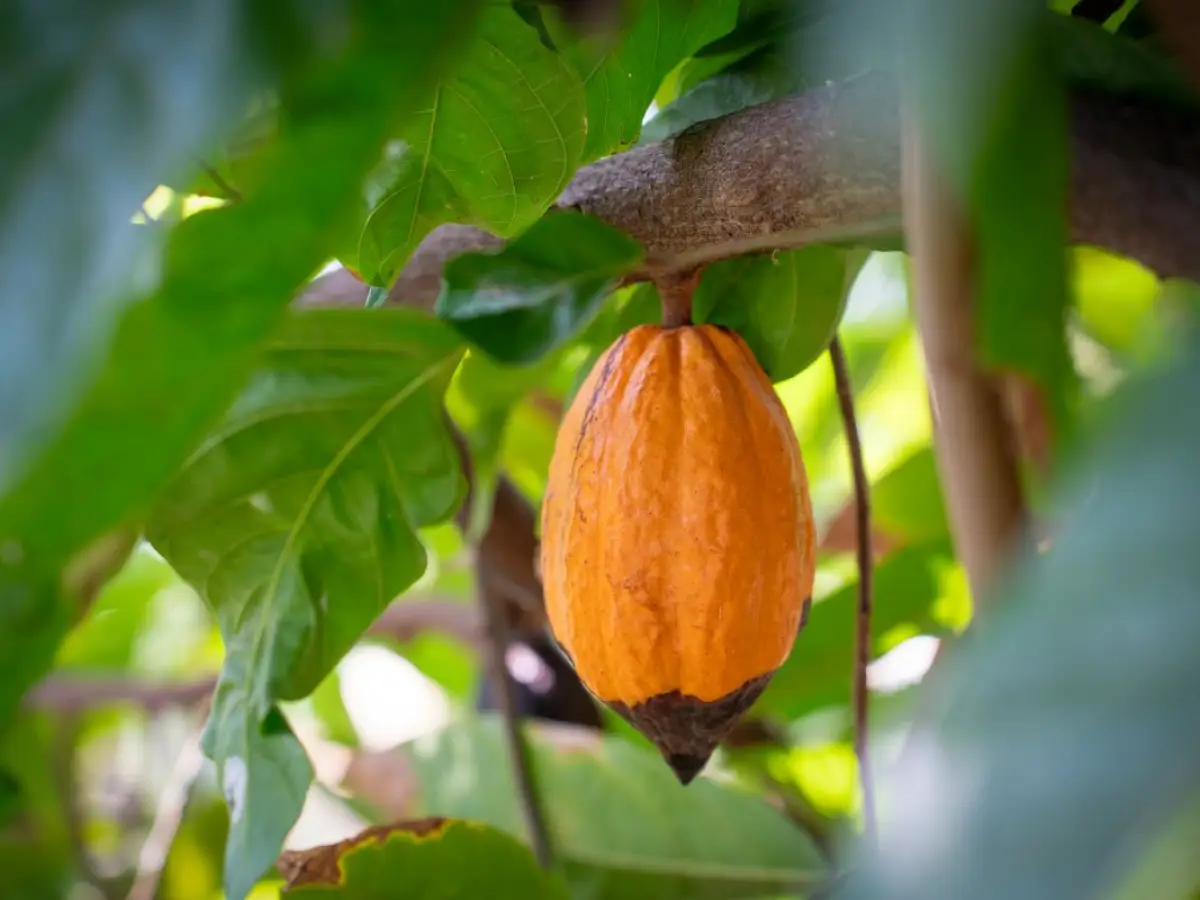

“We earn around $200 [€175, ed] a month, and every expense has to come out of that,” says Francis Tenor, president of the Boase Sibi cocoa cooperative in Ghana’s Eastern region. Around him, many cocoa farmers still live in modest homes without electricity. Over the past year, cocoa prices have fallen by 30%, even as production costs have continued to rise.
Historically, farmers with sufficient resources expanded their plantations, clearing primary forests to boost production and income. Today, they face stricter restrictions. Cocoa expansion has come at a high environmental cost in Ghana. According to the NGO Mighty Earth, Ghana has lost around 80% of its forest cover over the past six decades, with cocoa cultivation responsible for roughly one-third of that loss.
In an effort to curb deforestation, the European Union passed the EU Deforestation Regulation (EUDR) in 2023. The law is one of the world’s most ambitious environmental regulations. From 2027, companies will have to prove that cocoa sold in the EU was not grown on land deforested after 2020. Francis is already preparing for the new rules, but doubts farmers can survive unless their incomes improve. “If nothing is done about prices, it will be difficult to comply with the EUDR,” he says.
A few hours’ drive away in Accra, the mood is markedly different. Sitting in the spacious, air-conditioned headquarters of the state-owned Cocoa Marketing Company of Ghana, its managing director, Wisdom Kofi Dogbey, sees the regulation as an opportunity for the country's cocoa sector. “All farmers are registered in the system. I can trace every cocoa bean from the farm to the seaport,” he states proudly.

Nearly 790,000 farmers, almost every cocoa grower in Ghana, have been registered in the country’s new traceability system. Each has a QR-coded identification card linked to the geolocation of their farms, allowing authorities to verify that the cocoa was not grown on land deforested after the EUDR cut-off date.
Every company handling cocoa, from buyers to exporters, must also be registered. Before shipments leave for Europe, port officials will verify the documentation and block any cargo that fails to comply. Even in remote mountain villages, accessible only via rutted dirt roads cutting through primary forest, farmers have been trained to comply with the EUDR.
With about 60% of its cocoa destined for Europe, Ghana has had little choice but to adapt. The government has invested heavily, taking on debt to build a nationwide traceability system designed to keep access to its biggest export market.
Much of the cost of introducing the EUDR has been covered by the European Union, COCOBOD and major chocolate companies. But compliance still comes at a price for farmers.
Farmers producing cocoa from both EUDR-compliant farms and farms that do not meet the regulation’s requirements must keep the harvests separate, often selling them to different buyers. For growers earning little more than €175 a month, the additional expense and workload can be difficult to absorb. “Farmers have to buy separate drying mats for each batch of cocoa beans and carry out multiple fermentation processes because compliant and non-compliant cocoa cannot be fermented together. All of that costs money,” explains Obed Owusu-Addai, director of the environmental NGO ECOCARE and one of Ghana's best-known conservation advocates.

Some multinational chocolate companies are offering financial incentives to encourage compliance. Nestlé, for example, pays a premium to growers who can prove their cocoa is produced on land that meets the EUDR’s deforestation requirements and who adopt practices that improve productivity. For growers participating in such schemes, these premiums are among the few ways to increase income, which otherwise depends on prices set by COCOBOD in line with international market trends.
Yet many farmers argue that such incentives do not address the small share of the chocolate industry's profits that reaches cocoa producers. “It is Europeans who are cheating farmers by buying cocoa at lower prices, turning it into chocolate and making huge profits,” says Francis, speaking at his small cooperative. Between 2020 and 2023, the confectionery divisions of Hershey, Lindt, Mondelēz and Nestlé generated nearly $15 billion in combined profits.
As Ghanaian farmers cannot negotiate the prices they receive for their cocoa, they have little control over their income. This uncertainty limits their ability to invest in improving productivity or complying with new environmental requirements. Premiums alone are unlikely to solve the problem of sustainability.
The EUDR only applies to cocoa destined for the EU market. So beans that fail to meet those requirements can still be exported to countries without comparable deforestation laws, including China, creating a parallel market for non-compliant cocoa.
Voluntary certification schemes promoting deforestation-free cocoa have operated in Ghana for decades, backed by NGOs, civil society groups and chocolate companies. But they failed to halt deforestation. Supporters of the EUDR argue that it addresses one of the biggest weaknesses of those voluntary schemes by making companies – not just farmers – legally responsible for ensuring their supply chains are free from deforestation. Without binding rules, they argue, there is little incentive for traders and chocolate manufacturers to stop sourcing cocoa grown on recently cleared forest.
“Voluntary action alone will not stop deforestation worldwide. That is why we have always supported this European legislation,” says Bart Vandewaetere, Nestlé’s Head of Government Affairs and Environmental, Social and Governance (ESG), speaking from Brussels.
Despite the premiums offered under the EUDR, some farmers are already abandoning cocoa, while others question how much longer they can continue growing it. Rising production costs – including fertiliser and transport costs, which have climbed further since the disruption to shipping through the Strait of Hormuz – have squeezed margins even more.
Sitting beside Francis, Patrick Newman, the cooperative’s secretary, sees little reason for optimism. “I don't think there will be much cocoa production in the years ahead,” he says. Patrick comes from a family of cocoa farmers who have been farming for generations. But he has no desire for his children to follow in his footsteps.
Meagre returns are driving young Ghanaians away from cocoa and into illegal gold mining, where they can earn far more. Others leave for the cities, abandoning farming in search of more secure and better-paid jobs. The exodus has created acute labour shortages, forcing farmers to raise wages to find workers for the harvest.
Mining companies and unlicensed small-scale miners are increasingly buying cocoa farms sitting above gold deposits. According to the Ghana Gold Board, small-scale mining drove a 23% increase in annual gold production in 2025. “Forty acres of cocoa farms not far from here have already been sold for mining,” Francis says, looking towards the forest-covered hills. Faced with dwindling returns from cocoa, many landowners prefer the certainty of an immediate payout. “Cocoa is no longer the main driver of deforestation in Ghana,” says Obed. “Gold is.”
Ghana is technically well prepared for the implementation of the EUDR, with a nationwide traceability system already in place. But the challenge is no longer simply making cocoa production more sustainable; it is ensuring that the farmers expected to protect the country’s forests can also make a living from doing so.

This article was elaborated thanks to the support of Internews Earth Journalism Network
Cover: photo by Envato