

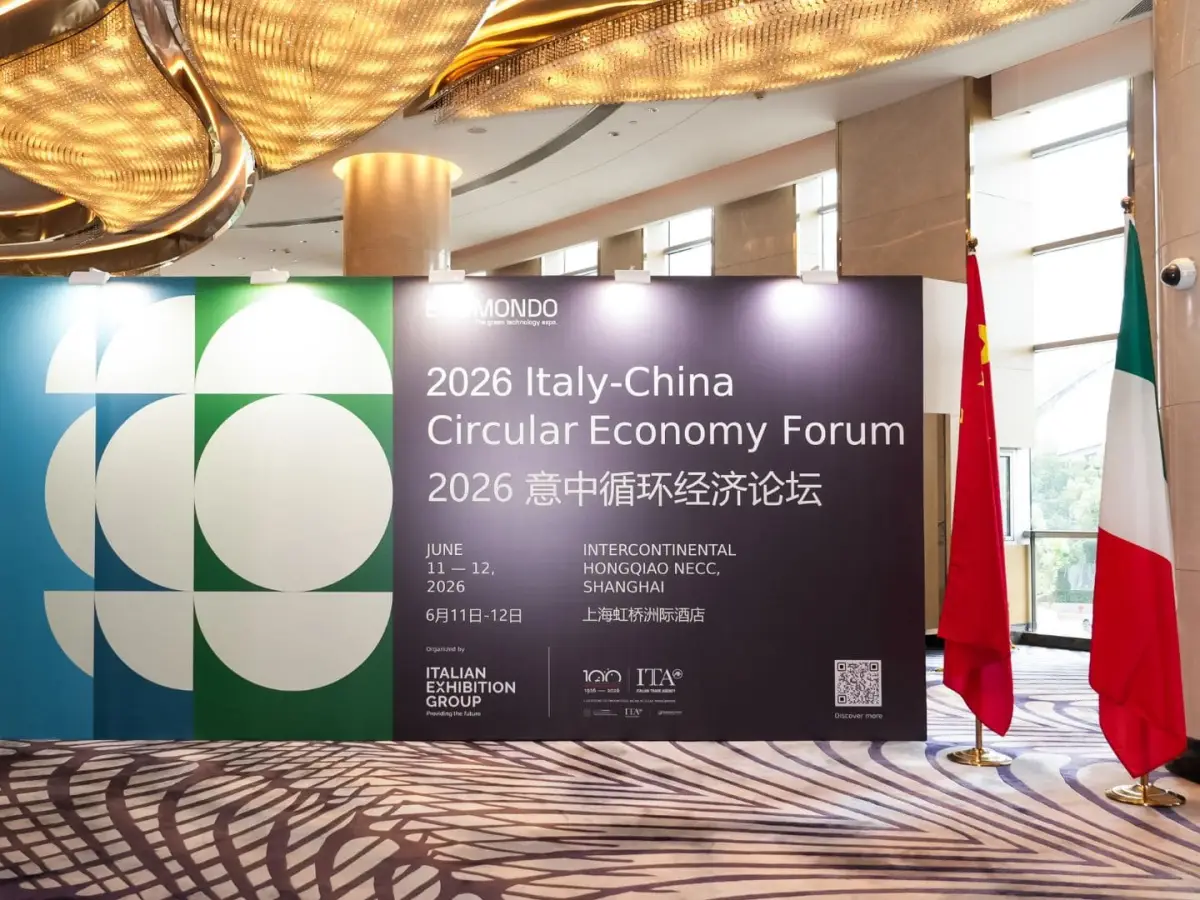

Shanghai – Circular economy, water security, decarbonisation of hard-to-abate sectors. A packed agenda of B2B talks and meetings awaited participants at the “Italy-China Circular Economy Forum”, held on 11 June at the colossal Intercontinental NECC Hongqiao in Shanghai. Organised by Ecomondo and ICE (Italian Trade Agency), the event represented yet another milestone in the series of missions and meetings between Rome and Beijing, reflecting growing commercial, technological and academic interest between the two countries. “Strengthening relations and knowledge between the two countries is essential, especially regarding green technologies,” noted former minister Corrado Clini, now a professor at Tsinghua University in Beijing, in one of the Forum’s most closely followed speeches. “Cooperation between the EU and China can act as a driving force for a shared global approach to the development of the circular economy,” he remarked from the stage.
Collaboration in strategic sectors
The Forum’s goal is very clear: connecting Italian and Chinese companies, creating new business contacts, showcasing practical technologies and paving the way for potential commercial partnerships in sectors gaining increasing strategic importance. “The Italian companies taking part in the Forum had the opportunity to present their technologies during specialised sessions devoted to three key sectors: the decarbonisation of hard-to-abate industrial sectors, waste management and water resource management,” explained Ilaria Cevoli, International Project Manager at Ecomondo.
Low-carbon technologies for the steel industry
A long list of Italian companies are interested in bringing the system expertise that European manufacturing has built up over decades to the Chinese market. Among the key participants is Danieli, the Friuli-based steel plant engineering giant, represented by Vice Chairwoman Anna Mareschi Danieli: the company is ideally positioned to support decarbonisation by offering low-carbon technologies across the entire steel and metal processing supply chain, with net-zero targets validated by SBTi and CDP. The group has recently signed a supply agreement in China with Henan Jiyuan Iron & Steel for its ECS Zerobucket electric arc furnace technology, intended to significantly reduce electricity consumption, carbon emissions and harmful gases in the production of special steels. On the Chinese side, Dalin Hu of Shanghai H-Ray S&T Co. provided an overview of the hydrogen technology market, which, according to the 15th Five-Year Plan, mandates stricter capacity swaps from 2026 onwards and the phasing out of obsolete coal-fired furnaces to force a structural plateau in emissions from the metallurgical sector.
From textiles to industrial wastewater
Among Italian SMEs, Igers Srl – represented by sales manager Carolina Andrea Colpani – showcased its circular economy model applied to the textile sector: in collaboration with Haiki+, the company has patented an innovative method for recovering textile fibres and is building the first integrated plant for recycling textile waste in the Novara area [Renewable Matter is owned by the Haiki+ group, ed.]. Iride Acque SB Srl, with Project Manager Alí Toosi, highlighted its EMER technology for the treatment of industrial wastewater: a patented nanotechnological catalyst derived from spent batteries, which positions Iride Acque as an example of a dual circular economy. The panel was concluded by LEO PUMP with Product Manager Dingxian Tang: established in 1995, the company operates as a global partner for smart fluid solutions in over 160 countries, delivering innovation across the domestic, commercial, industrial and solar pumping sectors, as well as boasting an established presence in China, making the forum an opportunity for consolidation rather than a debut.
The future of green hydrogen
On the second day, the guests attended a tour of companies in the Shanghai hinterland, specifically visiting Jiading Hydrogen Park (嘉定氢能港), one of the most ambitious hydrogen industrial clusters in Asia, inaugurated as a demonstration site in December 2024. The park brings together over 60 companies operating in the hydrogen value chain – from production to storage, from transport to end use – and draws on a pool of around 20,000 university students and R&D centres spread across the district in a model that replicates the logic of “special economic zones” applied to the energy transition. The project’s governance is explicitly part of China’s dual carbon neutrality framework (emissions peak by 2030, neutrality by 2060), and the exhibition material in the visitor centre specifically mentions the goal of building “a world-class industrial ecosystem” in the fuel cell sector.
“Today, green hydrogen in China costs almost as much as grey hydrogen. The current price stands at around 58 yuan per kilogram, with a government subsidy of 20 yuan reducing the effective price to below 25 yuan – a threshold considered critical for competitiveness against conventional fuels,” explains a spokesperson for Jiading Hydrogen Park.
As for mobility, the leading manufacturer of hydrogen engines is SHPT (Shanghai Hydrogen Propulsion Technology), a spin-off of the giant SAIC. Its current fleet of vehicles sold stands at 2,459 fuel-cell vehicles, including city buses and lorries. The target for 2030 is 100,000 vehicles, a leap in scale that requires resolving the remaining structural issue: the TCO (Total Cost of Ownership), i.e., the total cost of the vehicle’s life cycle, remains unfavourable compared to BEV alternatives, despite the current subsidy structure. But industrially, the sector is now ready to take off. Another piece in the unstoppable green transition made in China.