


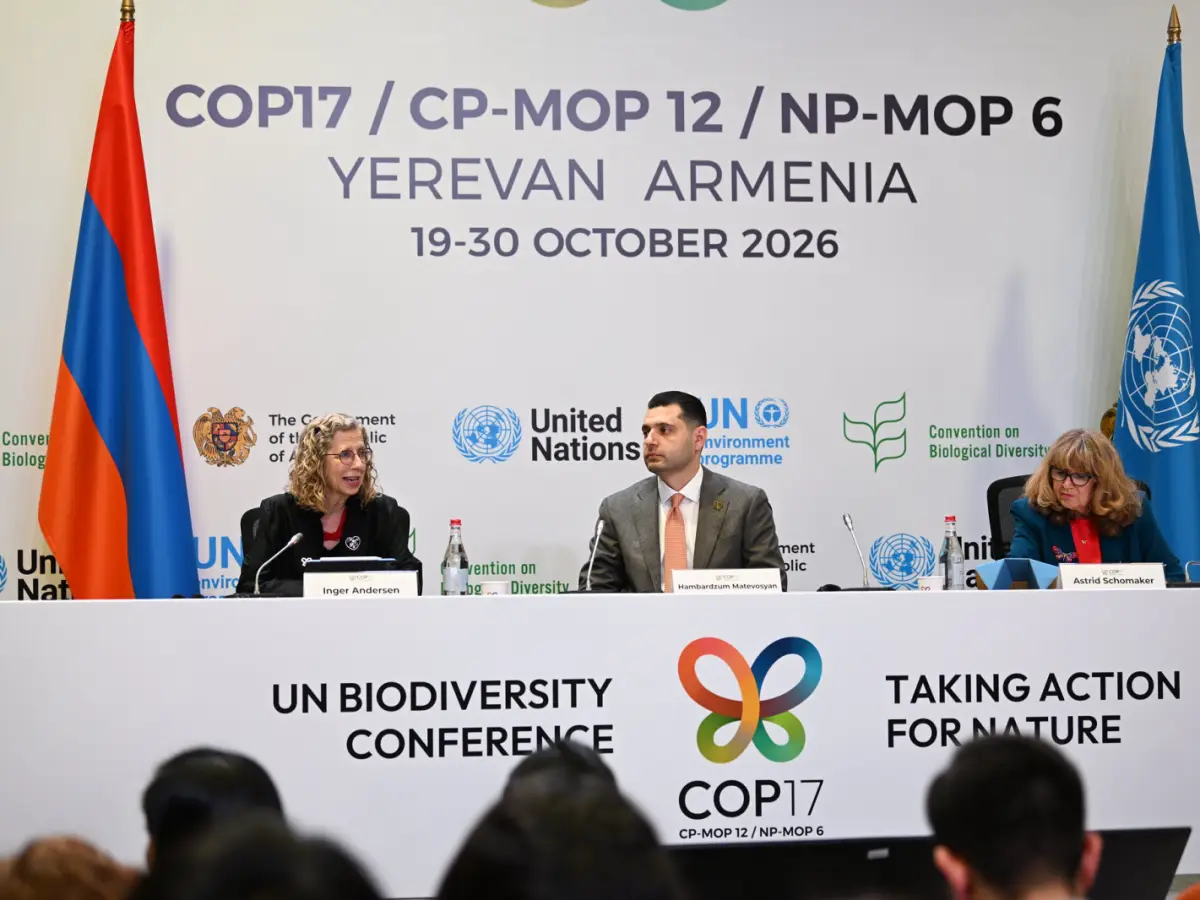

From Yerevan - COP17, the Conference of the Parties responsible for implementing the Global Biodiversity Framework, the global roadmap for protecting nature and the ecosystem services on which the human economy depends by 2030, closed on Saturday, 31 October.
Completely ignored by the media (the press room was almost empty for most of the conference) and politicians (no heads of state attended, and fewer than 10,000 total accredited), the negotiations nevertheless succeeded in completing the first Global Review of progress towards reversing biodiversity loss by 2030 and stepped up efforts to take action and allocate adequate financial resources.
Steps forward and steps backwards
The Global Review's final document sets out a shared response to concerns over the review of member countries' commitments. One particularly worrying finding is that, although more than 90% of countries have a National Biodiversity Strategy and Action Plan (NBSAP), fewer than half are on track, particularly on ocean protection. The document outlines a set of action priorities leading up to 2030 and the areas where progress will need to be accelerated. These include tackling subsidies and incentives that harm nature, increasing financial, scientific and technical support for developing countries, aligning national budgets and economic decisions with the Kunming-Montreal Global Biodiversity Framework (KMGBF) and strengthening mechanisms for implementation, monitoring, reporting and review.
“Over these two weeks we have demonstrated that differences can be bridged, commitments can become decisions and cooperation can deliver,” said COP 17 President Hambardzum Matevosyan. “With the adoption of the Yerevan Pathway, we demonstrate our collective determination to respond to one of the most urgent challenges of our time. It sets out priorities for collective action, from implementing national plans and mobilising financial resources to strengthening science, monitoring and the participation of all sectors of society.”
While the outcome of the negotiations offers a glimmer of hope that the Global Biodiversity Framework's 23 targets for 2030 might be achieved, it is becoming increasingly clear that, given the current political climate and the lack of any genuine commitment from the business world, the Kunming-Montreal Agreement is destined to fail unless the very architecture of the negotiating process is reformed. This would mean rapidly bringing together the three UN conventions on climate, biodiversity and desertification, while also incorporating UN Water and the plastics treaty. Numerous delegates called for action along these lines. Among them was Panama's Environment Minister, Juan Carlos Navarro, a longstanding environmentalist, who described the COP process as "designed to fail". He argues that decisions should be taken by majority vote, since a consensus-based process allows "a single idiot" to block an agreement. "A lot of what’s going on out here at the COP is just a bunch of baloney and beautiful speeches!" Navarro told AFP, reiterating that the United Nations should hold a single annual “Environment COP” to address climate change, biodiversity, plastics and other issues together. "This just makes my blood boil, because while we fiddle, Rome burns," he said. Navarro's calls fell on deaf ears. The final text does not refer to the other conventions, representing a step backwards even compared with COP16, driven by those who fear a reduction in the number of seats, a cut in international funding or the negotiations taking on too much weight.
Finance
As in every negotiation, finance set the agenda. Delegates highlighted declining aid levels and the prospect of a sharp 27% cut in environmental funding over the 2026–2030 period. We are a long way off the 20 billion dollars that developed countries were set to provide by 2025 (just over 1.8 billion) to support less developed nations rich in biodiversity; not to mention the 200 billion to be provided by all signatory countries by 2030. One of the most contentious issues was the demand by several developed countries to expand the list of nations expected to contribute funding. The message was aimed at countries such as China, Saudi Arabia, the United Arab Emirates and India, economies now able to mobilise resources.
But nothing came of it. The Parties agreed only that non-donor countries wishing to contribute could "express their interest" ahead of COP18, scheduled to take place in Quito, Ecuador, in 2028. In the meantime, however, they agreed to establish a permanent new financial mechanism to protect nature beyond 2030, with its details to be worked out in the next round of negotiations. A small step towards creating a key structure for safeguarding the interests of businesses and communities. The reasons for doing so were outlined by Guido Broekhoven, Global Director of Multilateral Policy at WWF International: “Biodiversity is not just about wildlife; it’s about the life support systems that sustain our lives and economies. Nature provides the food in our kitchens, the clean water from our taps, pollination for crops, and healthy soils that underpin global food security.”
Environmentally harmful subsidies
“Inside and outside the negotiating rooms, COP17 has seen exceptional momentum on the reform of incentives and subsidies. We now see that momentum recognized in the Global Review decision, as Parties committed to accelerate work to reform incentives,” commented Eva Zabey, CEO of Business for Nature. “This multilateral outcome sits alongside wider commitments to accelerate action on incentive reform, including through the launch of the ‘Friends of Target 18’ coalition of governments and an open letter signed by over 130 businesses and financial institutions.” Undoubtedly, the decision has brought the need to identify and eliminate environmentally harmful subsidies back to the top of the political agenda, an issue this magazine has covered in depth in recent days. Countries have four years to try to reduce the more than 500 billion dollars in public funds that directly finance biodiversity’s destruction.
Oceans and marine biodiversity
Although the negotiations took place in a landlocked country, seas and oceans featured prominently in discussions and side events. According to Pauli Merriman, Interim Senior Director of Oceans at WWF International: “We are not moving fast enough to deliver on the promise of the Global Biodiversity Framework, and the implementation gap is particularly stark in the ocean. Currently, only around 10% of the ocean is protected and conserved, and existing national commitments would take us to just 12% by 2030, far short of the 30% target. Progress in tackling unsustainable fishing – a key driver of marine biodiversity loss – is also uneven, while funding for ocean conservation remains a fraction of what is needed.” The document signed in Yerevan at COP17 must act as a catalyst for faster action, turning promises on paper into tangible measures to protect the aquatic environment through effective and equitable conservation, accessible long-term finance and stronger international cooperation. Despite the pressure, however, no reference was made to the agreement on biodiversity beyond national jurisdiction (the 'High Seas Treaty'), nor were any specific initiatives launched.
Italy recognised for urban nature restoration
One of the lighter moments of COP17 was the United Nations' presentation of the World Restoration Flagship award to ForestaMi, a metropolitan reforestation project and the only European initiative awarded. Launched in 2018 following research by the Politecnico di Milano and conceived by Stefano Boeri, the Milan Metropolitan Area's urban forestry programme aims to plant three million trees to bring nature back into the city. The achievement is the result of a network bringing together institutions, local authorities, communities, businesses and multidisciplinary teams. Maria Chiara Pastore, Scientific Director of Forestami and a lecturer at the Politecnico di Milano, told Renewable Matter: "This award brings visibility to a project that stems from a practical question: how can we make our cities better suited to embracing and supporting nature? Through ForestaMi, we are working to foster a new culture of nature in cities, so that it is recognised as a fundamental component of the design and transformation of modern cities.”
Looking towards COP18, and, above all, a new era of multilateralism
So what remains of the Armenian negotiations? Astrid Schomaker, Executive Secretary of the Convention on Biological Diversity, offered the following assessment: “We know what needs to change. We cannot protect nature while continuing to finance its destruction. Resources must reach the countries and communities that need them. And biodiversity must become part of everyday economic decisions. Ultimately, the test is not what governments agreed in Yerevan, but what they change when they return home.”
We therefore need to step up political pressure on issues relating to nature conservation, which are often overlooked in student protests and left to conservation organisations. Although networks of businesses recognising the double materiality of nature (both their own impacts and the risks they face as a result of biodiversity loss) are growing, as demonstrated by the dozens of side events on topics such as reporting, biodiversity credits and systemic regeneration, nature needs to become an even more prominent consideration at corporate board level, particularly in sectors most exposed to the loss of ecosystem services.
Finally, there are nature negotiations themselves. After a decade of populist politics and MAGA, the hope is that over the next two years the world can change course and return to the path it was following in the previous decade, once again strengthening multilateralism and nature negotiations through a major new post-2030 framework. To truly achieve the results that science points to as increasingly necessary when it comes to climate, biodiversity, pollution and water, before we reach the point of no return.
Cover image: Hambardzum Matevosyan, Armenia’s Minister of the Environment and President of COP17, attends a press conference on October 26 in Yerevan (official COP17 photo, via flickr)