



Summer 2026: on Via Cesare Correnti, in the centre of Milan, ground temperatures in direct sunlight reached 70 degrees. The news hit the front pages. The figure forces us to look downwards, where urban heat accumulates and is then slowly released: into the artificial surfaces covering roads, squares and pavements, as well as into the air. Yet, when it comes to climate adaptation, talk almost always centres on trees, parks and shade, while paving remains in the background, more closely associated with maintenance than with climate issues.
Marco Sandri, technical director of Ibuild Italia – the paving division of Heidelberg Materials (formerly Italceenti) – offers a simple explanation. Renewable Matter interviewed him at Ecomondo 2026, where the company had a booth: “Probably because, for a long time, we’ve viewed paving primarily as a technical surface: it must be durable, safe, passable and easy to maintain. Today, we must also consider it a component of the urban microclimate.”
In his view, materials and vegetation must be considered together, within a system in which greenery, water and surfaces work in harmony. Dark, impermeable paving absorbs solar energy and prevents water from infiltrating, and it does so at a time when cities are facing both extreme heat and heavy rainfall.
A problem that moves faster than cities
In this context, it is difficult to continue treating the issue as marginal. According to Copernicus, 2025 was the third hottest year on record, after 2024 and 2023, and the three-year period 2023–2025 is the first in which the global average temperature has exceeded pre-industrial levels by 1.5°C. Europe is warming faster than the rest of the planet: according to the European State of the Climate Report 2025, the continent has warmed by around 2.5°C compared with pre-industrial levels, roughly double the global average of +1.4°C. In Italy, Legambiente recorded 376 extreme weather events in 2025, with a 94% increase in events linked to record temperatures.
These trends are amplified in cities. In urban centres, temperatures can be 4-5°C higher than in the suburbs or the countryside, and research coordinated by CNR-IBE with ISPRA has identified heat islands in all the regional capitals analysed, with temperature differences between the city centre and the suburbs reaching 8-9°C in Genoa and Turin. Milan, where around 72% of the municipal area is urbanised, records an average temperature difference of 4.3°C, while “green islands” cover just 26% of the territory, compared with 30–35% in Rome and Naples. Looking ahead, according to the IPCC, the proportion of the urban population exposed to at least eight days a year with temperatures above 35°C would rise from 66% with a 1.5°C temperature rise to 85% with a 3°C rise.
On top of all this comes a typically Italian constraint. The National Climate Change Adaptation Plan, approved in 2023, is focused on greening and water features; however, in historic centres, such measures must take account of heritage and cultural protection. It is within this narrow margin that paving takes on greater significance, including from an economic perspective: according to the reinsurer Munich Re, natural disasters caused global losses of around 320 billion dollars in 2024.
From materials to performance
In terms of public policy, the clearest signal comes from Rome. In 2025, Rome City Council and La Sapienza University produced the Atlas of Pavements that reduce summer overheating in urban areas, one of the key elements of the Climate Adaptation Strategy approved by the City Council that same year. The document reviews seven types of surfacing, from asphalt to grass paving, separates traditional local materials from alternative ones, and assesses them in terms of solar reflectance, permeability, drainage capacity, durability and compliance with the Minimum Environmental Criteria. The underlying physics is well established: traditional asphalt typically has a reflectance of less than 0.1, while light-coloured concrete or stone can exceed 0.4 or 0.5, and the Minimum Environmental Criteria for Construction (Ministerial Decree 256/2022) already set a minimum solar reflectance index (SRI) of 29 for external surfaces. The Atlas also features products from Heidelberg Materials.
For Sandri, however, the decisive shift concerns the way in which public bodies commission works: “In my opinion, we need to move from prescriptive specifications to performance-based specifications. In other words, we should not simply specify a material, but rather establish the outcomes that the public space must achieve.” In addition to mechanical strength, durability and safety, specifications should therefore also include permeability, drainage, solar reflectance, thermo-hygrometric comfort, accessibility and rainwater management as standard parameters.

The lesson from Villa Glori
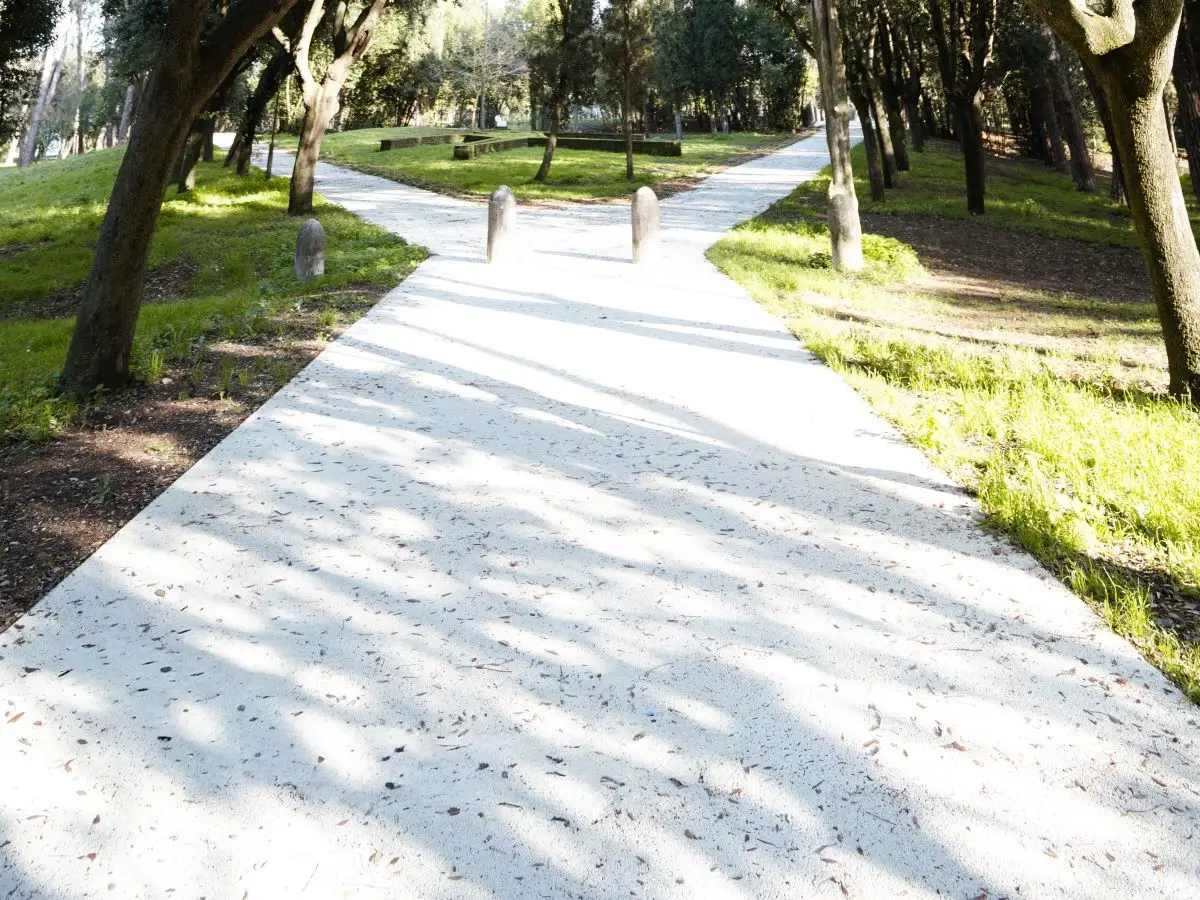
The case that best illustrates both the potential and the limitations is the Villa Glori park, in the northern part of Rome, between the Auditorium Parco della Musica and the MAXXI. The paths, originally characterised by light-coloured surfaces – probably gravel – had been tarmacked over time, becoming impermeable and incongruous with the character of the site. The regeneration project, led by the City Council, removed part of the tarmac and laid approximately 5,000 m² of i.idro DRAIN white permeable concrete, with a finish reminiscent of the original gravel. The material has a void ratio of between 15 and 25% and a drainage capacity of at least 200 mm/min. In the tests reported in the project documentation, the new surfaces showed temperatures up to 15–20°C lower than the tarmac.
Sandri himself clarifies this point: “It is important to talk about surface temperature, not just air temperature in general”. Similar findings emerge from ENVI-met simulations carried out in Rome relating to another material, the grey in-situ concrete i.pro PAVIMIX ECO CAM, in areas with trees: during the day, the surface temperature drops by 15.3°C, while the air temperature falls by just 0.3°C; meanwhile, the Perceived Thermal Comfort Index (PET) improves by 17.2°C. The benefit is felt primarily by the bodies of those moving through the space, and much less so in terms of air temperature.
From Villa Glori, Sandri thus derives a principle: “In contexts with restrictions, innovation works when it does not erase identity but interprets it.” And a second, perhaps more important point: the paving was not designed in isolation, but in conjunction with depaving, a vegetation system, drip irrigation and water reuse.
The carbon issue
The most troubling contradiction remains: a material which improves resilience to heat and rain can still have a significant carbon footprint over its life cycle. For Sandri, adaptation and mitigation must be assessed together, and circularity cannot be reduced to a percentage of recycled content, because in permeable paving, porosity, strength and infiltration capacity are in a delicate balance. “Circularity and decarbonisation,” explains Sandri, “must become additional performance characteristics, not substitutes for performance.”
The case of Montesilvano (PE) illustrates this balance. For the footpaths and cycle paths, Heidelberg Materials permeable concrete was used, consisting of blast furnace cement containing over 40% pre-consumer recycled material; the documentation indicates that emissions from the core processes are less than 550 kg CO₂/t, compared with values exceeding 750 kg/t for traditional CEM I concrete. The declared reduction in embodied CO₂ reaches 30%, with a compressive strength exceeding 15 MPa. This value is suitable for footpaths and light traffic, while the in-situ concrete i.pro PAVIMIX ECO CAM, classified by the Atlas as a traditional material, starts at 30 MPa.
What changes for public demand?
If climate comfort is included in the tender specifications, contracting authorities will have to compare solutions across several criteria simultaneously: “Microclimatic performance, embodied carbon, durability and maintenance”, to which Sandri adds water management and safety of use.
EPDs serve to make the environmental impacts clear alongside performance parameters, but the decisive criterion remains time: “A solution that appears advantageous solely during the production phase may no longer prove so if it needs to be replaced frequently or requires additional hydraulic works. […] Good paving of the future will not simply be ‘permeable’, ‘recycled’ or ‘low-carbon’: it must be all these things in the right balance, while also being durable, safe and in keeping with its surroundings,” concludes Sandri.
It remains to be seen who will define that balance, using which indicators and over what timeframe. It is this question, rather than the choice of material, that will determine the transformation of urban soil into climate infrastructure.
This content is produced thanks to the support of sponsors
Cover: Villa Glori, photo by Heidelberg