

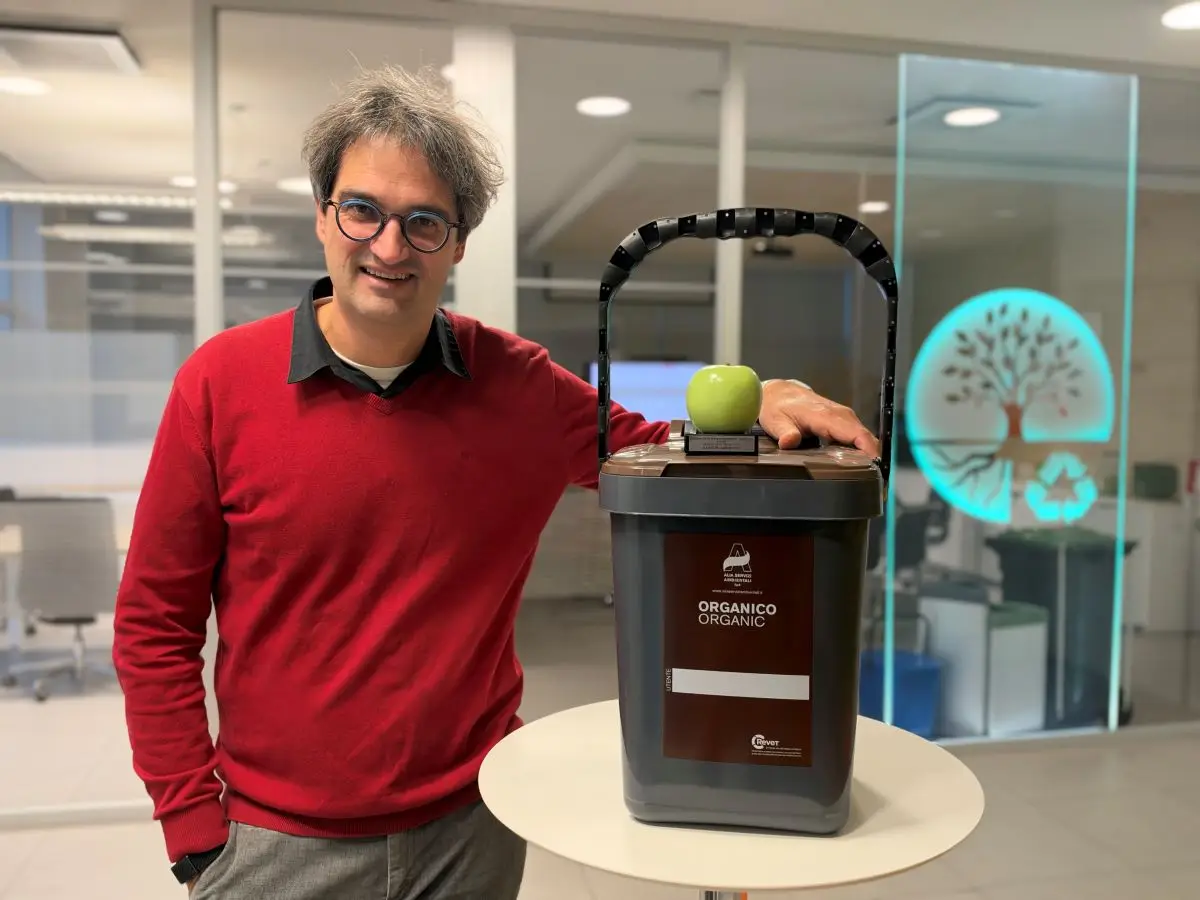

Every morning, it appears on the pavements of Italian cities: the door-to-door organic waste bin. Sartori Ambiente, a company based in Arco, Trentino, which manufactures efficient separate waste collection systems, has redesigned it starting from the perspective of those who lift it, empty it and set it back down hundreds of times per shift. With UrbaE, the company won the National Silver Winner award for Europe at The Green Organisation’s 2026 International Green Apple Environment Awards, presented at the House of Lords in London.
Made from recycled polypropylene certified under the “Plastica seconda vita” (Second Life Plastic) scheme, UrbaE has been awarded a four-star ergonomic certification and Human-Centred Design certification by ErgoCert, following the Sustainable Development Award at Ecomondo 2025 and the Special Award from the Italian Composting Consortium at Comuni ricicloni 2026. We discussed this with Leonardo Benuzzi, innovation manager at Sartori Ambiente, who accepted the award.
Why start with an organic waste bin?
It is a very humble product. Organic waste is the first step in the process: here, as in developing countries, tackling the issue of waste starts with this. It is the heaviest fraction of municipal solid waste, and the easiest to manage, because processing can begin at home with a compost bin and extend to plants that produce biogas and biomethane. Our team has focused on two aspects: the ergonomics of emptying the bins so that operators exert less effort, and the quality of the waste delivered, so that it increases.
How did you investigate workers' fatigue?
We had experience with bins, but not with ergonomics. We went to Ce.Ri.S.M. in Rovereto, a research centre that digitises the movements of athletes to improve their performance. Collecting rubbish is hard work. A waste collector can empty 400 bins a morning, ranging from one and a half kilos up to eight or nine kilos. My personal record is twelve kilos: a café that filled it to the brim with wet coffee grounds. We filmed the waste collectors with cameras, weighed the bins and cross-referenced weight, age, height and years of experience. The younger ones perform less well because they rely on brute force; the more experienced ones have learnt to use their legs for leverage rather than their backs. We then digitised their movements in the laboratory using infrared markers to analyse their movements and design the new bin based on the data collected.
What has changed with the design?
The corners are much more rounded, so the operator can hold the container close to their body, which reduces the lever arm for the same weight. Then there’s the handle. Previously, the operator would find it positioned low, about fifteen centimetres off the ground, and would have to bend down. We have patented a sort of spring in the pivot that keeps the handle upright, even in the wind: in most cases, the worker no longer has to bend over. Arrows, known in design as “affordance”, encourage members of the public to place the bin with the handle raised. And people have even started to keep competitors’ bins upright as well.
Which award matters most?
The real reward is that we’ve sold more than 700,000 of them in about a year. Knowing that every morning, a waste collector picks up a bin and finds the job less tiring. The market is trying to copy us, which is why we’ve had ourselves certified by a third-party organisation, ErgoCert. We’re the only ones to hold a four-star Human-Centred Design certification. To achieve the fifth star, we need to conduct interviews with operators after a period of use, and we’re working towards that.
And the quality of waste?
I like Simon Sinek’s approach: “start with why”. We collect waste to reduce the impact of communities on the environment. We’re called Sartori Ambiente, not “Sartori Plastic Containers”: who knows, maybe tomorrow we’ll make them out of mycelium. To improve what I collect, I need to win people’s cooperation, and that’s psychology. Together with the Faculty of Cognitive Sciences in Rovereto, we’ve set up a three-year PhD programme. Interviews revealed that citizens only take notice when they’re fined. But fines cost more to issue than they do to pay, and they act as a deterrent. We have therefore used the “nudge” technique: three stickers – a green one to leave on the bin as a badge of honour, and removable yellow and red ones, each with a QR code explaining the mistake. If I tell you that you’re a good recycler, you’ll want to live up to that. Just as you wouldn’t want to be the only one in the block with a red sticker.
How much of an impact do foreign markets have?
We generate half our turnover abroad and have sold our products in around fifty countries. Italy is the market leader almost by chance: when you’re poor, you throw away less and recycle more. You often find Italian companies involved in advanced separate waste collection schemes around the world. UrbaE is made from 85% urban waste plastic. Today we’re also working on social sustainability: the average age of waste collection workers in Italy is around 45 and is rising. My guiding principle is quality: both in waste collection and in the workers’ lives.
Cover: Leonardo Benuzzi