

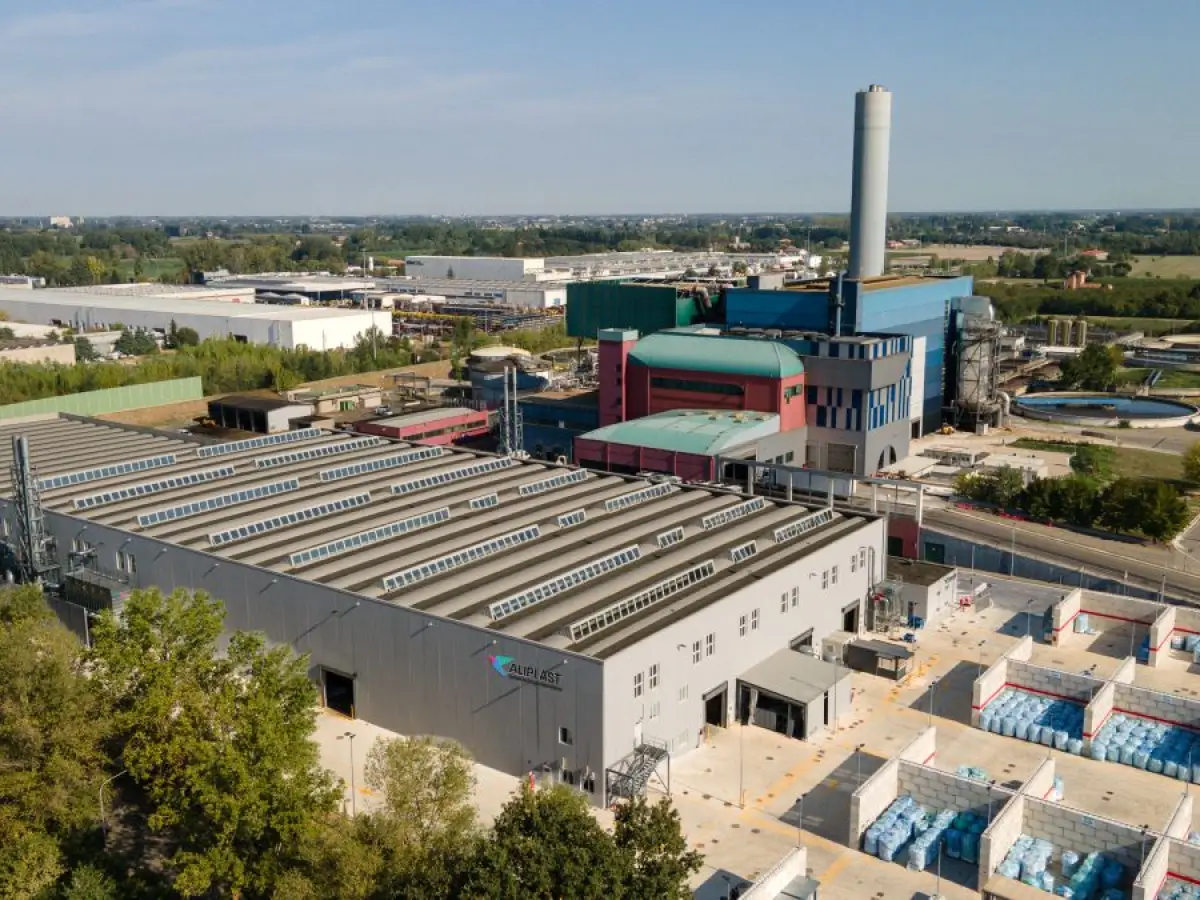

Fifty million euros to increase both the quantity and quality of recycled rigid plastics: this is the investment made by Aliplast (a subsidiary of the Hera Group), which also received a €7.7 million contribution from the NRRP fund, towards the construction of the new recycling plant inaugurated in Modena on 20 October 2026.
The R3GID plant (where the R3 stands for ‘Recover Recycle Regenerate Plastic’) will be able to process up to 30,000 tonnes a year of post-consumer waste and industrial scrap made of polypropylene (PP) and high-density polyethylene (HDPE). These two polymers are used to make a wide range of durable, lightweight and functional packaging and products, from consumer electronics to cosmetics packaging, and from furniture to automotive components.
Certified purity
The polymers produced in Modena will be pure enough to be reused even in the sectors they originally came from, with performance comparable to that of virgin materials. Developed using Nextchem’s engineering and technological expertise, the new plant is designed to separate polymers and colours, achieving a certified purity of over 99% (upcycling).
According to the company's estimates, the plastic recycled in a year will avoid the release of around 30,000 tonnes of carbon dioxide equivalent into the atmosphere.
“Italy is among the leading countries for rigid plastics recycling capacity, but that capacity is still not enough to meet the demand that will arise from European regulations,” explains Michele Petrone, Chief Executive Officer of Aliplast. “With our technologies, we are able to meet the high-end quality requirements demanded by manufacturers, matching the performance of virgin polymers.”
The inauguration of the Modena plant comes at a crucial moment in Europe’s circular transition, when recycling targets, which are becoming ever more stringent and ambitious, are expected to narrow the competitiveness gap between recycled and virgin plastics.
R3GID is part of the €2 billion investment in circular economy (out of €5.5 billion in total investment) earmarked in the Hera Group’s 2025-2029 business plan. Together with other projects currently being finalised in Italy and abroad, Aliplast will double its overall plastics recycling capacity, reaching 210,000 tonnes a year.
Plastics recycling and the challenge of EU regulations
At present, the likelihood that the plastics components of a washing machine will actually be recycled remains rather low: in Europe, only 40% of collected HDPE and PP waste is sent for recycling. The main reasons for the gap include contamination with other plastics and organic substances, the lack of ecodesign in products, and the limitations of sorting technologies. But without investment, the factor that could widen the gap between collection and actual recycling even further is the pressure exerted by European regulations.
According to estimates from Plastic Recyclers Europe, the Packaging and Packaging Waste Regulation (PPWR) sets targets so ambitious that they will require an additional 2 million tonnes of HDPE and PP recycling capacity by 2030 and 5.7 million tonnes by 2040. Another factor likely to stimulate demand is the End of Life Vehicles (ELV) Regulation, which would generate demand for a further 1.2 million tonnes of recycled plastic over the next 15 years by introducing a minimum recycled plastic content for new vehicles..
The closed-loop supply chain
The supply chain in which Aliplast operates is particularly interconnected and synergistic, from the collection of waste through to its processing. Post-consumer waste streams are purchased through consortium auctions, held on a monthly basis, whereas industrial scrap is managed through direct agreements with manufacturers, who in some cases can also become buyers of the recycled material. “We create what are known as closed loops: virtuous circuits in which the supplier of the scrap also becomes our customer, buying back the secondary raw material needed to make new products,” explains Petrone.
The new plant will therefore supply a certified, traceable, Made in Italy recycled material that can also be used in high-end applications. This quality is necessary to overcome one of the main limitations of mechanical recycling: the difficulty of reintroducing recycled material into products with demanding technical and aesthetic requirements.
This content is produced thanks to the support of sponsors
Cover: Aliplast plant in Modena