Issue #65

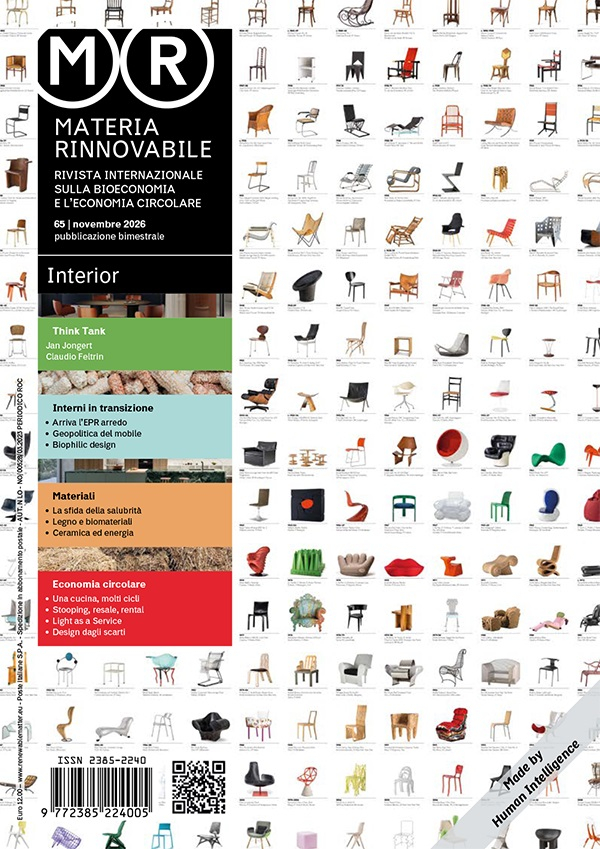
Amidst the drive towards sustainability and increasingly complex global markets, the furniture and interior design sector is experiencing a period of transition. Through RM65, we have explored the challenges of circularity and the healthiness of materials, new business models focused on reuse, rental and product-as-a-service, and radical shifts in approach such as biophilia. We have given a voice to both the worlds of research and industry.
Summary
EDITORIALS
A seat at the circular table
Emanuele Bompan
The furniture and interior design sector is generally analysed more for its style than for its actual impact. And that is precisely why Renewable Matter has decided to focus on an industry that today has significant value and influence but also a growing environmental impact.
Design has learned to talk about materials. Now it must be held accountable
Maria Chiara Voci
These days, materials are everywhere in the narrative of design: at trade fairs, in catalogues, in marketing campaigns. It was about time. But talking about materials is not the same as addressing the issue: there is still not enough discussion about what they contain, where they end up, and what they release into the air in our homes.
THINK TANK
Reshaping circular interior design
Interview with Jan Jongert
Emanuele Bompan
If the circular economy is only now tentatively making its mark in the world of architecture and design, the Dutch firm Superuse Studios has been a true pioneer in the field, having embraced the concept as far back as thirty years ago. And today, they are setting the standard worldwide.
The difficult art of making furniture
Interview with Claudio Feltrin
Roberto Giovannini
Chinese competition, US tariffs, geopolitical turmoil, spiralling energy costs: the global furniture market is becoming increasingly difficult to navigate. That is why, says Arper’s chairman, Europe must now defend its market
INSIGHTS
EPR for furniture: Italy is drafting regulations, while France addresses the challenge of reuse
Giorgio Kaldor
The consultation on the Italian extended producer responsibility scheme concluded on 18 September 2026. A comparison with the French system highlights one key issue: funding end-of-life management is not enough to extend the useful life of furniture.
Geopolitics is reshaping the furniture industry, but the key to success lies in wood traceability
Mariarita Persichetti
Tariffs and environmental regulations are redefining the global furniture landscape. Behind the growth of certain markets lie supply chains deeply tied to China, while the traceability of timber is becoming increasingly crucial for gaining access to international markets.
From Japan to China: crafting furniture in harmony with nature
Mariarita Persichetti
“If we use a tree that has lived for a hundred years, we want to make furniture worthy of those growth rings, furniture that can be used for a hundred years or more.” The philosophy of Karimoku, a long-established Japanese furniture manufacturer, rests on this relationship between the responsible use of timber and the health of forests.
Not all wood is the same
Giorgio Kaldor
Wood is generally regarded as healthy and climate-positive. But the differences between solid wood and panels, finished and semi-finished furniture, and carbon stored and actually kept in the cycle are significant.
Biomaterials redefining interior design: when the forest is no longer inside
Antonella Ilaria Totaro
Hemp, mycelium, seaweed and agricultural waste: behind the bio-based component of panels, seating and home accessories stands a growing market. For many companies, the challenge now is to move from the prototype stage to large-scale distribution.
Rising energy costs put the ceramic industry to the test
Simone Fant
The ceramics districts of Sassuolo and Valencia, challenged by rising energy prices, are opposing the additional costs incurred by the CO₂ emissions trading scheme. However, circularity and electrification are promising levers for decarbonisation.
Mattresses deserve a second life too
Simone Fant
The variety of materials used in their manufacture makes recycling challenging, but with efficient collection schemes and the right technologies, some companies are proving that recycling end-of-life mattresses can be a sustainable business.
How biophilic design can cure our nature deficit
Giorgia Marino
In a society where we spend most of our time in artificial, man-made environments, biophilia strives to restore our lost connection with the natural world through design. But beware: a touch of greenery is not enough.
Healthier furniture: from marketing claims to material transparency
Maria Chiara Voci
Furniture, coatings and panelling used to decorate our homes often contain health-damaging chemicals, such as formaldehyde, phthalates, PFAS and VOCs. Through a combination of regulations, voluntary declarations and innovation, here’s how the sector is moving towards greater health and safety.
One kitchen, many cycles
Maria Carla Rota
From wood to metals, from glass to worktops, a kitchen brings together materials and components with different life cycles. The first step is to design for durability, repair and disassembly; however, to truly close the loop, collaboration between supply chains, operators and consumers is necessary.
Stooping, resale, rental: the end of throwaway furniture
Antonella Ilaria Totaro
A sofa abandoned on the street, a cabinet resold online, a desk rented rather than bought. These are the different facets of circularity in the furniture sector, ranging from informal practices emerging on social media to business models such as buy-back and rental schemes.
When light becomes a service
Antonella Ilaria Totaro
Lighting companies no longer sell light bulbs. They sell light, retaining ownership of the fittings and charging a fee for the service. The model began with Philips (now Signify), and its viability rests on three factors: measurable contracts, sensors, and predictive maintenance.
CASE STUDIES
From stoppers to furnishings: cork as a design material
Giorgio Kaldor
Used cork stoppers are all too often treated as single-use items, yet they have enormous potential for circularity. Through the ETICO project and the Suber collection, Amorim Cork Italia is turning them into materials for green construction and designer furniture.
The rice house project: from experimentation to industrialisation
Marco Moro
The journey of the Italian company Ricehouse, which has evolved over the course of a decade from an experimental start-up into a business operating across the European market, paves the way for a contemporary manufacturing sector aligned with the goals of circularity and sustainability.
From forest to pallet: Veneto tries to rebuild a short timber supply chain
Emanuele Bompan
With the RADICE project, the Veneto Region is bringing together every player in the timber sector and attempting to re-establish domestic production of sustainable timber for packaging and furniture.
Bills go beyond kilowatt-hours with Sorgenia
Emanuele Bompan
With its Beyond Energy service, Sorgenia aims to tackle the energy illiteracy that all too often keeps households from making informed decisions to reduce their energy use and cut costs.
The art of designing railway stations
Giorgia Marino
Train stations are not merely places of transit: they are a city’s business card, offering a glimpse of its personality and spirit. And they often bear the signature of renowned international architects and designers, as is the case with some of the new stations on the Rete Ferroviaria Italiana.
In Genoa, reuse designers are taught circular urban design
Stefania Divertito
The University of Genoa is taking part in the European Erasmus+ CiD programme for bio-based and circular innovation in urban design, starting with locally based pilot projects.
End-of-life tyres: from the roads to our homes
Roberto Giovannini
Rubber recycled from end-of-life tyres is making its way into Italian construction, from impact-absorbing floor layers to sound-absorbing panels for concert halls. A material once considered waste is becoming a resource for building better and more quietly.
Used oils: quality rules are lacking despite plans for a single EU market
Giorgio Kaldor
The Circular Economy Act aims to create a single market for secondary raw materials. For used oils, however, the CONOU consortium points to a problem: without common standards for regenerated base oils, even mandatory quotas risk weakening the market.
From PMMA to critical metals: how Nextchem is strengthening industrial circularity
Editorial Staff
Chemical recycling of plastics and the recovery of strategic raw materials are two complementary levers for building more resilient European industrial supply chains that depend less on virgin resources.
Rapolano Terme: where end-of-life solar panels become raw material again
Stefania Divertito
The Semia Green plant, part of the Iren Group, is the first in Tuscany to be accredited by the WEEE Coordination Centre for recycling solar modules. It can process 9,000 tonnes a year, as Italy prepares to dismantle the panels installed under the Conto Energia scheme.
Rigid plastics: Aliplast’s new plant for high-performance recycling
Simone Fant
The R3GID plant in Modena, owned by the Hera Group subsidiary, will increase its capacity to process polypropylene and polyethylene waste, producing high-quality polymers to feed back into industrial supply chains.
Circularity on the move across Europe’s roads
Maria Carla Rota
From fuels and tolls to geolocation and VAT recovery, UTA Edenred positions itself as a single point of contact for companies operating in the circular economy supply chain, providing services to support heavy fleet mobility.
STARTUP
by Antonella Ilaria Totaro
Furlenco, the Indian company that rents out furniture instead of selling it
Loopfront, the digital platform for reusing furniture and building materials
Stykka: made-to-measure furniture designed never to end up in landfill
The Good Floor: turning river plastic into designer flooring
OUROBOROS
The circular economy has a taste problem
Ana Birliga Sutherland
Attempts to make furniture more “circular” often overlook emotion and aesthetics. Design aimed at disassembly or take-back schemes has its merits, but it overlooks a fundamental question: what drives us, in the first place, to want to keep our furniture?
CIRCULAR FUTURES: DISPATCHES FROM TOMORROW
Furniture 2058: From flat-pack to home-grown
Patrick Schröder
In 2058 buying a chair means choosing a shape and style – and then waiting for it to grow. A scratched table surface can repair itself and a partition in your house changes with the seasons of the year.
READING MATTER
Libreria di design
Giorgia Marino
An atlas of over a thousand pages on the history of furniture design, a handbook on the many ways to make interior design sustainable, and a comprehensive guide to the positive economic impacts of biophilia: the essential library for any designer who takes a responsible view of the future.