


2026 will go down as a landmark year for FS Group for the major acceleration and complexity of the transformation of Italy’s rail network. From the 11.6 billion euros in investment mobilised in 2025 to the 1,300 construction sites currently active across the country’s 17,000-kilometre network, the Italian railway ecosystem is transforming on a scale never seen before in recent years. It is a complex challenge facing the group’s new leadership team. On 13 July, the new board of directors, chaired by Tommaso Tanzilli, appointed Gianpiero Strisciuglio as the group’s chief executive officer and general manager.
The priorities are numerous, including the construction of new high-speed lines to increase by 30% the population served by fast rail connections. Other objectives include strengthening links with ports, airports and logistics terminals, digitising the network and improving climate resilience.
Investment volumes at RFI alone, the company responsible for the rail infrastructure, have risen by 49% compared with 2023, an acceleration driven above all by the implementation of the NRRP.
The resulting impact on the wider economy is significant. Projects carried out in 2025 generated 20.5 billion euros in national production value and 8.6 billion euros in GDP, mobilising 112,000 jobs across the supply chains involved. These figures place rail construction among the few areas of public spending capable of generating a measurable economic multiplier in real time.
Of the 25 billion euros in NRRP funding allocated to FS Group, all targets have been met. Looking at how the spending is distributed, RFI provides a breakdown worth highlighting: 37% of investment is allocated to maintenance and improving infrastructure resilience, while 63% is devoted to major strategic projects. This split says much about the underlying philosophy of the plan: it is not only about building new lines, but also about ensuring the structural strength of a network that must cope with rising levels of traffic.
The downside is reflected in the number of planned service interruptions: around 272,000 each year, an increase of approximately 115% since 2023. RFI describes this rise as the result of a change in the operating model: longer interruptions, but concentrated during periods of lower traffic, allowing multiple construction projects to be carried out within the same timeframe, optimising technical and economic resources and, in principle, reducing the overall impact on services over the medium to long term.
The projects that are about to become operational
Which projects are currently under construction and due to become operational by 2027? At the end of June, the Napoli–Cancello line was activated, an additional section of the Naples–Bari high-speed/high-capacity line. It enables interchange with Napoli Afragola station and becomes a key hub for regional mobility in Campania.
The second half of 2026 will see the completion of some of the plan’s most visible projects. In Genoa, the sixfold increase of the Principe–Brignole segment will come into operation, designed to finally separate metropolitan and regional traffic flows from long-distance traffic: a project that will have a direct impact on the capacity, frequency and reliability of the service at one of the most congested transport hubs in northern Italy.
In Rome, the first phase of work on the new Pigneto stop will be completed, creating an interchange hub between the FL1/FL3 lines and Metro C. In Sicily, the Giachery–Politeama section of Palermo’s railway ring will become operational; between Campania and Basilicata, work to upgrade the Battipaglia–Potenza line will be completed; and in the Marche region, electrification of the Civitanova–Albacina line will be finished. At the same time, the technological upgrade of the ERTMS system on the Rome–Naples high-speed/high-capacity line will continue.
The first half of 2027 will bring another series of significant actions: the Brescia–Verona line, a section of the Milan–Venice high-speed/high-capacity corridor, and the first four conventional lines equipped with the ERTMS system (Terni-Sulmona, Lamezia Terme-Catanzaro Lido, Siracusa-Canicattì, Roccasecca-Avezzano). This marks a sign that digital signalling is not limited to high-speed rail but is beginning to spread across the conventional network as well. In Sardinia, Lotto 2 of the Decimomannu–Villamassargia doubling project will enter service. And on the Brenner front, where Italy is involved in a project that is both infrastructural and geopolitical, work continues on the Fortezza–Ponte Gardena segment, the first priority section of the southern access line to the Base Tunnel, designed to accommodate the increase in freight and passenger traffic along the Munich–Verona route once the Alpine tunnel comes into operation.
Summer travel: where the construction sites are located
The inevitable trade-off of a programme of this scale is the summer timetable of disruptions, when RFI’s industrial plan meets, with little room for compromise, the reality experienced by tourists (and commuters still heading to the office). As the saying goes, “if you want to look your best, you have to suffer a little”. So arm yourself with patience and await the positive effects on the networks, which in some cases will already become visible from the autumn onwards.
Among the most significant closures planned for the coming months: on the Milan–Venice high-speed line, a 15-day closure between Verona and Vicenza from 2 to 16 August, due to works on the Vicenza crossing and at Montebello station; at the Florence rail hub, from 27 July until 11:00 on 30 July, the second phase of the interruption for the replacement of the Ponte al Pino railway overpass will take place, with bus shuttles operating between Santa Maria Novella and Campo di Marte. On the Milan–Bologna line, there will be an eight-day interruption between Piacenza Est and Melegnano from 10 to 17 August for points renewal works; on the Milan–Genoa line, a complete closure between 20 July and 28 August for major maintenance on the Po Bridge; and on the Florence–Rome line, from 10 to 28 August for works on the Fabro tunnel and the Paglia viaduct between Chiusi Sud and Orvieto Nord.
RFI says the timetable has been designed to protect the routes with the strongest tourism demand, namely the Adriatic, Tyrrhenian and Ligurian corridors, as well as connections to Puglia, whilst seeking to minimise as much as possible any inconvenience on the lines used daily by hundreds of thousands of tourists.
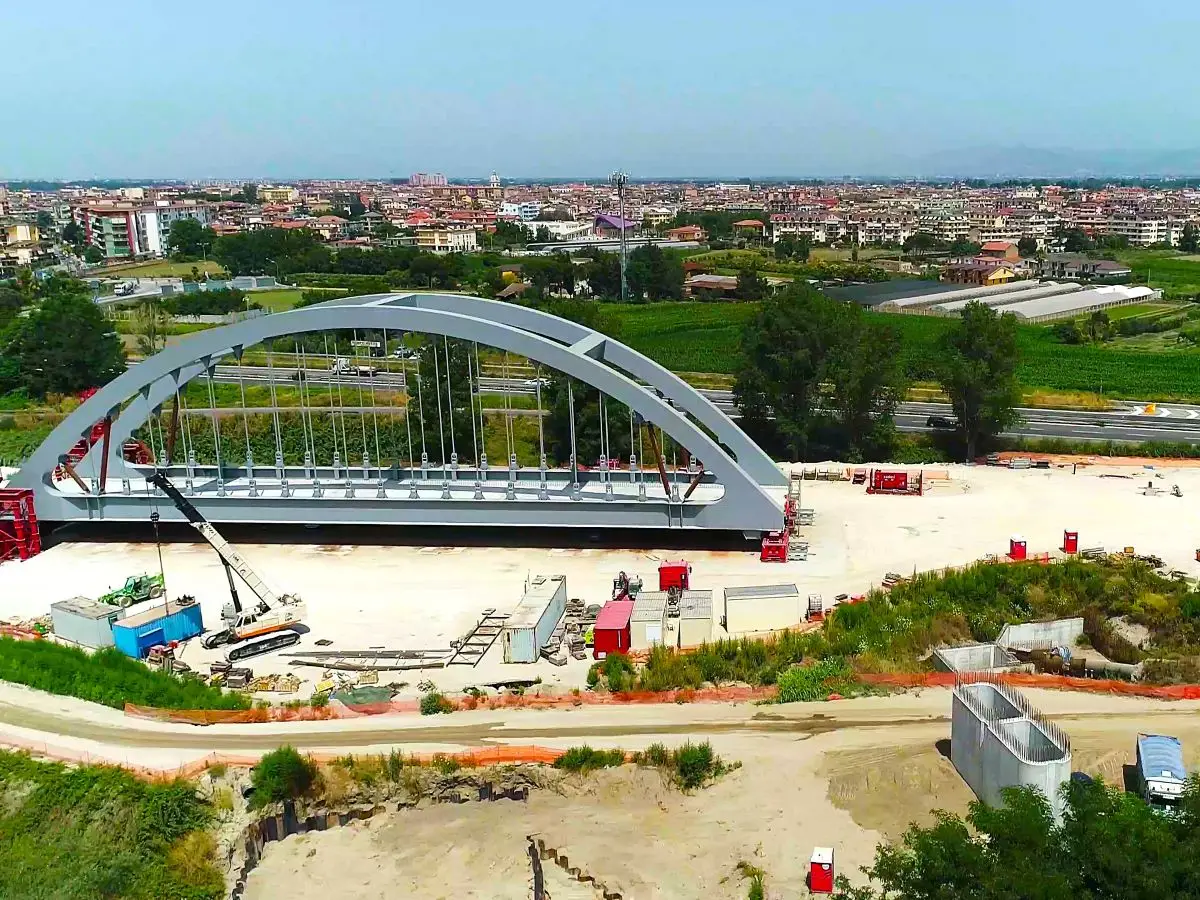
Cover: a photo of the works on the Naples–Bari line