


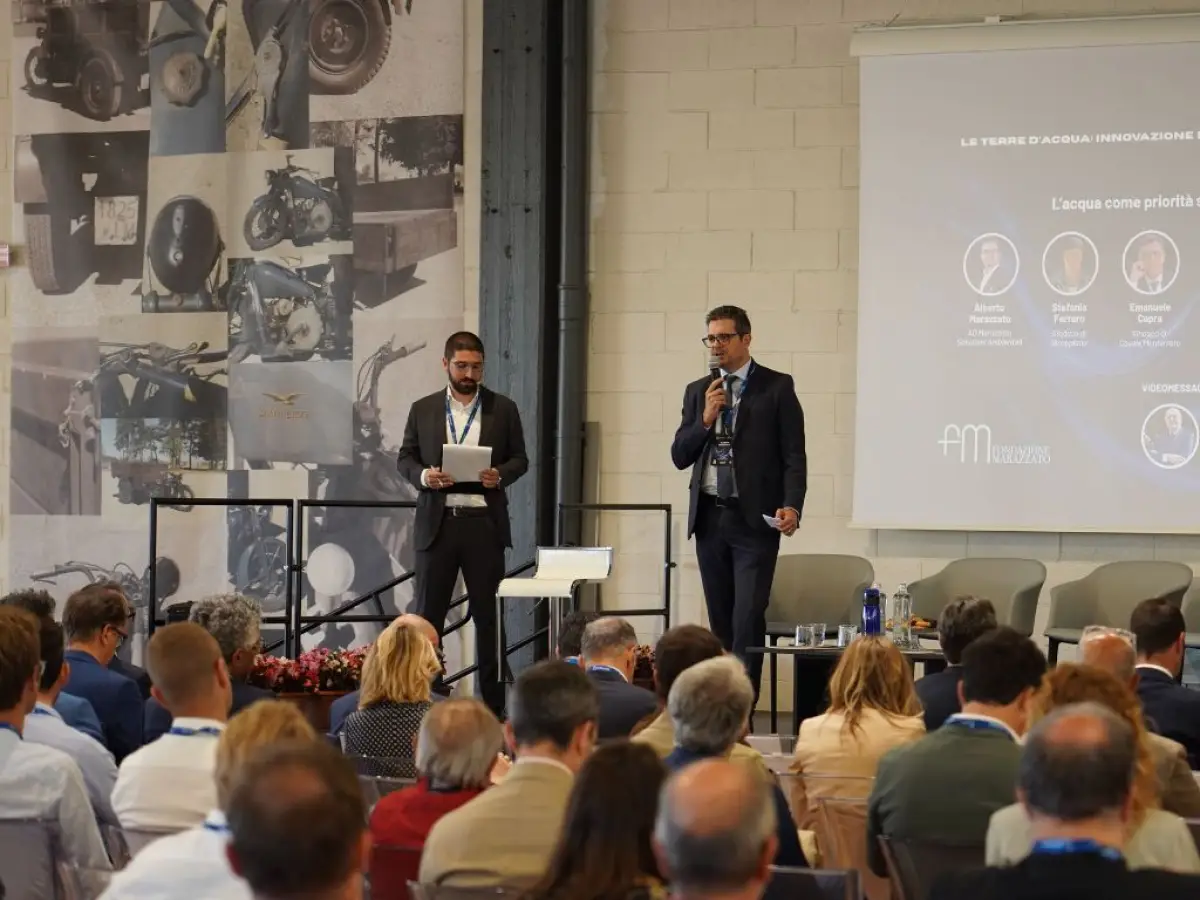

On 11 June, in Stroppiana (in the northern Italy province of Vercelli), the convention “Le terre d’Acqua” (Lands of Water), hosted by the Marazzato Foundation and moderated by Renewable Matter, brought together institutions, experts and academics to explore water resource management and governance, treating the local area as a testing ground for the key tensions affecting the country. In fact, the rice fields of the Vercelli area offer a unique vantage point: here, even before serving as a feature of the landscape, water is first and foremost a productive resource. In this context, some of the most significant challenges of the ecological transition are particularly evident, ranging from climate change to security of supply, right through to energy requirements and new industrial uses of water.
Starting with the official greetings, the discussion took on a practical tone. In a video message, the Minister for the Environment and Energy Security, Gilberto Pichetto Fratin, emphasised the strategic role of water and hydroelectric power, highlighting the need to strengthen their management through a joint effort. Alberto Marazzato, Chief Executive of the Marazzato Group and Vice-President of Confindustria Novara Vercelli Valsesia with responsibility for sustainability, pointed to two key words for tackling future challenges: planning and courage. His message called for the ability to invest for the long term and to build strategic infrastructure – as was done in the past with the Cavour Canal – focusing today on innovation and technological development.
Industry and agriculture: towards new management models
The first round-table discussion, dedicated to water use in industry and agriculture, immediately expanded its scope to include public health. The Rector of the University of Eastern Piedmont, Menico Rizzi, pointed out that “water is related to actual emergencies during the summer, but we must not forget that it is also a potential carrier of viruses and diseases such as encephalitis, transmitted by mosquitoes”, and announced a project for the diagnosis and identification of pathogens and the training of professionals with “a high level of sensitivity and expertise”. Andrea Amalberto, president of Confindustria Piemonte, pointed out errors and shortcomings in management over recent years, while Secondo Barbero, director of ARPA Piemonte, stressed the importance of planning and monitoring systems; regarding tools, Michele Falcone (Gruppo CAP) outlined “water credits” to track the reuse of treated water, Diego Terruzzi (Ovest Sesia) reconstructed the dynamics of the “rice-growing system”, and Lisa Casali (Pool Ambiente) reported on the gap between the impact of droughts and floods and “the scarcity of available financial resources”, citing the “Ambiente Protetto” document as a new technical practice for preventing environmental damage.
From research to the local area
The second panel, “From research to the local area – Technology and skills for the future of water”, tied water resources to national security. The Rector of the Polytechnic University of Turin, Stefano Paolo Corgnati, highlighted that high energy costs stem from “a lack of long-term policies” and that a specific strategy is needed for water, “a resource we take for granted today but which may no longer be available tomorrow”, with a focus on technology transfer: “transferring knowledge into technology, legislation and collective know-how – into something that makes an impact… Bringing innovation to water: a matter of national security.” Carlo Robiglio (Confindustria Novara, Vercelli and Valsesia) reminded us that data centres and artificial intelligence require ever-increasing amounts of water for cooling and set out the challenge of “understanding how to develop future professional roles that we cannot yet envisage”; Vittorio Viora (ANBI) raised the issue of storage once again, while Daniele Barbone, managing director of AcquaNovara.VCO, reminded us that floods are no longer isolated incidents: “We have drawn up a plan based on an awareness of climate change, in line with the 2036 agenda, and to date the investment – quantified at over €100 per inhabitant – is the largest ever made in this area,” also mentioning strategies for removing PFAS from wastewater.
A new water governance
The third panel discussed pricing policy and regulation. Sandro Baraggioli, president of Confservizi Nord Ovest, emphasised the need to reduce regional inequalities against a backdrop of growing demand by creating “a level of uniformity that is currently lacking”. Tullio Montagnoli, Chief Executive of A2A Ciclo Idrico, insisted on an integrated approach between industrial and agricultural sectors, highlighting the issue of decentralising wastewater treatment plants and implementing “compensation” policies for the most disadvantaged areas. Paolo Foietta, Chair of the Piedmont Waste Authority, provided the example of the Gerbido waste-to-energy plant, which accounts for two-thirds of the metropolitan area’s waste disposal capacity at a cost of €118 per tonne – the lowest in Italy – as evidence of the role of regulation; Paolo Torassa (ASM Vercelli and IRETI) referred to the alignment with European standards envisaged by the National Recovery and Resilience Plan (PNRR) and the central importance of digital security; while Alessandro Iacopino (Integrated Water Service of Biella and Vercelli/Baraggia Consortium) stressed the need for specialist expertise to manage diverse requirements such as irrigation and energy. For Massimo Lamperti, president of Suez Italia, the overarching issue remains the “difficulty in communication between organisations and public bodies” and the effort required to build shared visions capable of attracting international private investment into the national water system.
For the Marazzato Group – active in environmental services with eight sites in the North-West, 300 employees and over 250 vehicles – the programme will continue between September and November 2026, with appearances at Remtech and Ecomondo and an event on 9 October that will include a webinar on PFAS.
Cover image: Gruppo Marazzato