



Since its launch at the World Coffee Conference in Bangalore at the end of 2023, the Center for Circular Economy in Coffee (C4CEC) has grown to counting about a hundred members, just under half of them from the Global South. New members include major players such as Embrapa, the Brazilian agricultural research agency, and the International Women’s Coffee Alliance, while the scientific committee has expanded, with new members bringing extensive international experience. As C4CEC's activities multiply, what is really shifting is the work’s centre of gravity: while the technical feasibility of valorising coffee by-products – from cascara to biochar to mushrooms grown using pulp – is now increasingly well proven, the open question concerns actual adoption of these practices by growers themselves. This is where the hardest challenge plays out.
Managing cultural barriers
In Kenya, where the supply chain is largely made up of smallholder farmers organised into cooperatives, most farms are run by older farmers, for whom changing practices established over decades is anything but straightforward. The Center, therefore, works on three levels: science, outreach, and – with a strategic approach – culture.
“Innovation doesn’t have to be high-tech, but it does have to be accessible even in resource-limited settings,” Dario Toso, R&D Product Sustainability Manager at Gruppo Lavazza and coordinator of C4CEC's scientific committee, tells Renewable Matter. “Concrete implementation is crucial. This lies on closing the cultural gap and demonstrating that new practices actually work.” Training and education are key to this shift in practices, and they are also the levers that can support the generational handover needed on coffee plantations, as it is on countless farms worldwide in the coming years.
Bringing young people closer to the sector and giving them a role in experimentation makes change not just possible, but desirable. An episode in Yemen illustrates well just how decisive culture can be: an attempt to valorise pruning waste clashed with the culinary habits of farmers’ wives, who used that same biomass for cooking. This real-life experience is a useful reminder that circular solutions need to fit into local practices, not override them. Hence the value of cultural closeness among those who train and experiment directly in the field, sharing the same culture as the communities they work with. This closeness reduces resistance and makes the difference between an innovation that stays on paper and one that actually takes root.
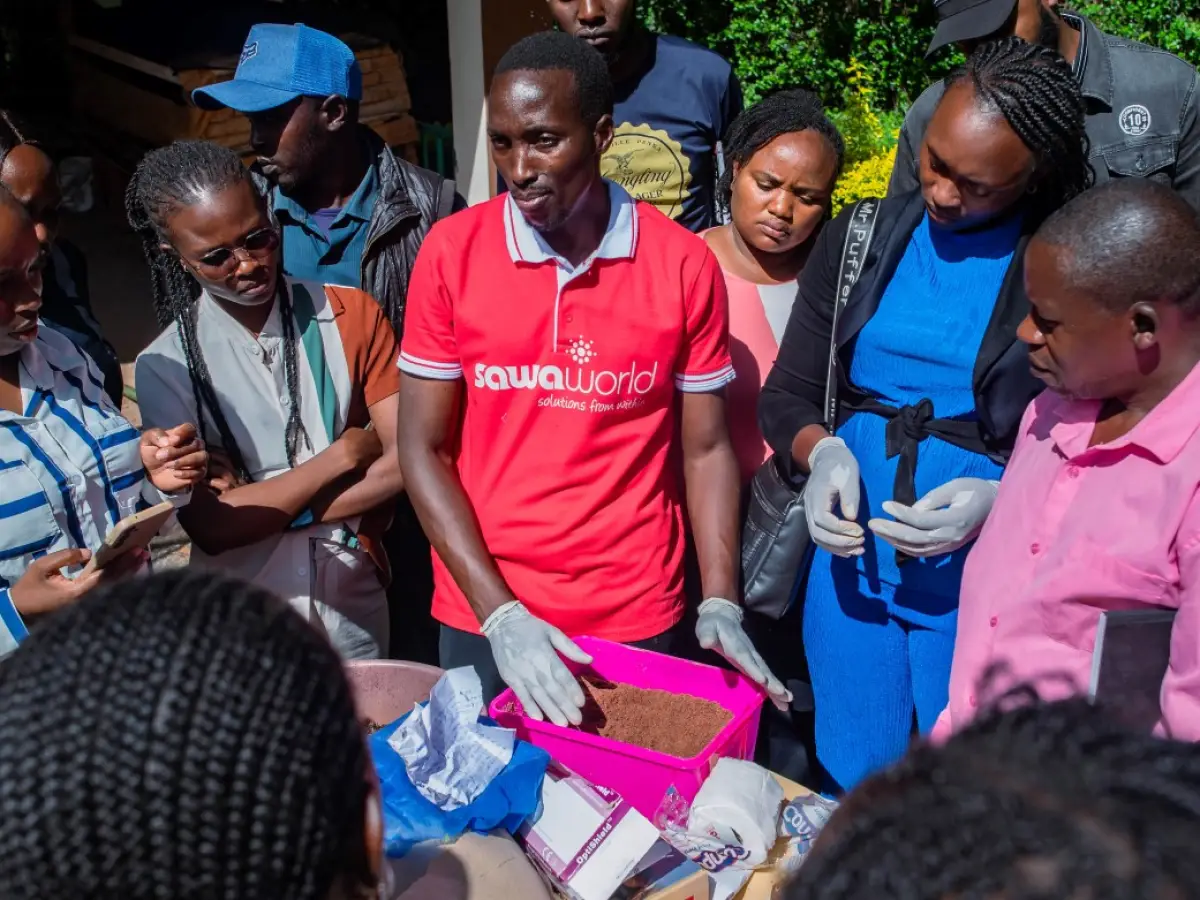
It is with this in mind that the NGO Sawa World, active in Uganda and Kenya, was chosen as a partner for the training course held last March at the Coffee Training Centre in Ruiru, Kenya, aimed at developing sustainable livelihood practices that allow coffee-growing communities to increase their sources of income. The CTC is currently under construction, made possible thanks to support from Cooperazione Italiana and the ACT Coffee Programme – Advancing Climate-resilience and Transformation in African Coffee – implemented by UNIDO, the United Nations Industrial Development Organization.
Coffee Training Centres are one of the programme’s key tools: training and hands-on experimentation centres designed to take root within growers’ communities, transfer technical skills, and support the adoption of more sustainable practices directly in the field. The ACT Coffee programme plans to build these in all five target countries – Ethiopia, Kenya, Uganda, Tanzania, and Malawi – with the aim of building a widespread network of innovation along the African coffee supply chain, from producers all the way to international markets.
From theory to the field: training the trainers
Alongside a global webinar on financing opportunities in the circular coffee economy held in February 2026, the five-day practical training course, running from 23 to 27 March, marked the conclusion of the first phase of C4CEC’s Kenyan pilot project. The training track, focused specifically on training the trainers, brought together 34 participants from across the supply chain. Notably, it exceeded the inclusion targets that had been set: women made up 62% of participants, and 65% of them were young people aged 25 to 34, a figure that speaks directly to the generational renewal identified as a precondition for change.
The training programme was built around valorising the coffee by-products generated during primary processing, with a particular focus on coffee pulp and husk. Combining theoretical and technical learning with hands-on, direct application, participants explored a range of circular economy solutions that turn these materials into valuable products and new livelihood opportunities. The programme covered biochar production, mushroom cultivation, and black soldier fly farming, showing how coffee by-products can be converted into soil conditioners, food products, and animal feeds.
Rounding out the classroom lessons and practical sessions, participants took part in two field visits that showed circularity in practice. At the Cascara Lab at Dedan Kimathi University of Technology (DeKUT), they explored the commercial potential of cascara through demonstrations and tastings of value-added products, including flour, biscuits, and wine. A second visit, to Ruwawa Farm, offered a first-hand view of an integrated circular farming system, in which crop production, livestock farming, and renewable energy solutions are interconnected, illustrating the feasibility of circular business models that go beyond the coffee sector alone.
From technique to enterprise
Beyond the transfer of knowledge, the first phase of the project allowed participants to test and question the practical applicability and economic sustainability of each solution. This shift from technical learning to entrepreneurial thinking emerged as one of the key outcomes of the course, confirming that the real leap is not understanding how to produce biochar, but imagining what kind of business could be built and grown from it.
This is the ground on which the second phase, already underway, is building. At its core, it is a collaboration with E4Impact, the foundation established by the Università Cattolica del Sacro Cuore with the mission of training a new generation of African entrepreneurs capable of creating jobs and responding to the practical needs of their own context. The joint work unfolds on several levels: training in entrepreneurship and business development; the creation of training toolkits and multimedia content designed to outlast the project itself; and a series of knowledge-exchange webinars that progressively expand the community of practice. The goal is not to train individuals one by one, but to build an ecosystem in which knowledge circulates, takes root, and generates value.
The horizon is long-term: it is not enough to show what can be done; cooperatives need ongoing support until that potential becomes everyday practice and, where conditions allow, an actual business venture.
A growing network
A further frontier is data sharing. C4CEC has joined the Biochar Resilience Network, promoted by the International Biochar Initiative, a pre-competitive platform that gathers and compares results from field trials. “The goal is to look beyond carbon credits and document a more immediate benefit for growers,” Toso explains. “Biochar works as a soil conditioner that helps retain water and fertiliser near the roots.” As demonstrated practically during the training course in Kenya, the benefit in terms of improved soil properties is tangible in a context marked by soil degradation and rising input costs.
The path to closing the loop in the coffee world may only be just beginning, but it is already clear that the transition depends less on available technology than on people and on their willingness, generation after generation, to change everyday practices and turn them into a business.
Cover image: a moment from the training in Kenya (ph C4CEC)