



This article is part of our Heat Pumps feature: discover it here
Designing, manufacturing, testing and supporting a product long after it has been sold. In an increasingly competitive HVAC (Heating, Ventilation and Air Conditioning) market, shaped by technological and regulatory change, MAXA, a company based in Arcole, near Verona, is opting for on an industrial model built around direct control of its supply chain, keeping its design and manufacturing hub in Italy.
The journey of the company began in 1992, when the founder, Luciano Tredicesimo Ferroli, set up a business specialised in sales of domestic air-conditioning equipment. Over the years, the company gradually shifted towards direct manufacturing. Eventually, it built a portfolio in which heat pumps are its main area of specialisation The portfolio includes solutions for the residential, commercial, industrial and service sectors. Currently, the company, which is part of Advantix S.p.A., is run by the second generation of the Ferroli family: Simone Ferroli is CEO, David Ferroli is the President and Operations Manager, while Paolo Ferroli serves as CTO. Alongside manufacturing products under the MAXA brand, the company also operates as an original equipment amnufacturer for mid-to-high-end and premium brands. These two distinct business lines draw from the same technological and manufacturing expertise.
The customer base is split between the Italian and international markets, which account respectively for the 40% and the 60% of sales. In Europe, the main markets are the UK, Germany, France, Spain and Greece. Globally, MAXA is also present in Australia, New Zealand and several African countries.
Research and technology in the DNA of the company
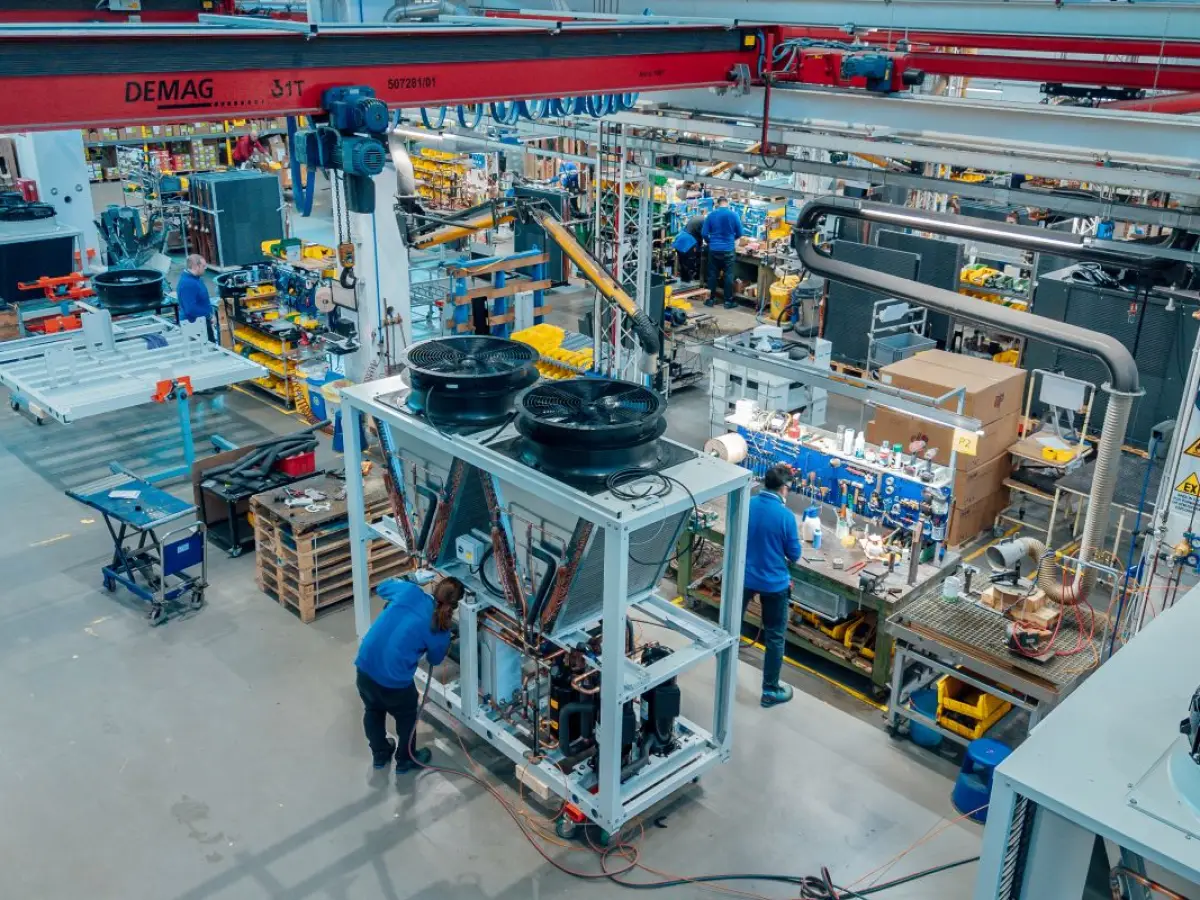
All stages of the production process, from design through R&D to manufacturing and testing, take place at the Arcole plant. “The site covers 42.000 square metres, it has eight production lines and employs 220 people – 105 in production lines and 115 in the offices”, David Ferroli tells us.
Two climate chambers capable of testing units of up to 800 kW, called M1 and M2, allow the company to verify product performance under controlled conditions. “We invest in technologies that enable us to improve our products and meet customer expectations. We build relationships based on trust, rather than on mere commercial transactions. We are now working to cut testing times through data analysis and video analytics systems. Collecting large volumes of information will support the development of artificial intelligence applications. Moreover, it will help us anticipate potential issues in the production cycle itself and take more targeted action.”
“Research and technology are in our DNA. They are what have driven us to become the company we are today”, Paolo Ferroli continues. “We have never just bought and resold products already available on the market. From the outset, we have developed dedicated electronic control systems for our devices, and we adapted products to different applications. This approach has enabled us not only to develop tailored solutions, including unique solutions, but also to collaborate with major industrial players. The latter see us as a reference partner for their technological development. Alongside AI, we are exploring applications in robotics and opportunities to develop expertise in collaboration with several Italian universities.”
Restructuring and market performance
Starting from 2024, the company has embarked upon a major restructuring process, at a challenging time for the HVAC sector. The objective was not only to respond to the contraction of the heat pump market – partly driven by the end of incentives linked to Italy's Superbonus 110% scheme – but to lay the foundations for more sustainable growth through a rethink of its organisational structure, resources and processes.
The first positive results came in 2025, with turnover exceeding €50 million. “We are growing at a faster rate than the domestic market, which is instead experiencing a slight downturn”, Simone Ferroli points out. “We are currently recording a double-digit growth, at around 21%, while we closed last year with an increase of 13.8%. We are a company that keeps investing even in challenging times: for example, when the heat pump market went through its downturn between 2022 and 2024, we built a new production facility”.
Growth is driven primarily by hydronic heat pumps, a segment in which MAXA has focused an important share of its industrial expertise. According to preliminary figures of the company, in the Italian market this segment grew by 35% in the first half of 2026, compared with the same period of 2025. Sales of monobloc heat pumps in the 6 to 18 kW range rose by 60%, while those in the 20 to 30 kW range increased by 50%. Heat pump water heaters recorded 20% growth, while 50 to 350 kW industrial solutions were up by 19%.
Design and quality: a team effort
Growth has also been supported by efforts to strengthen the commercial reach of the company. This process was launched in October 2023, as explained by Attilio Verzilli, Sales and Marketing Manager: “We have built a more structured sales network, with professionals equipped with the technical expertise required in a market where selling can no longer be limited to offering a single piece of equipment, but must encompass an entire service package”.
This shift is changing both the role of the manufacturer and its relationship with other players across the supply chain, including distributors, installers, designers and heating engineers. For this reason, alongside the sales network, MAXA has strengthened its pre-sales support by setting up an in-house team dedicated to maintaining day-to-day contact with professionals in the field, besides preparing quotations. In addition, we have followed the same approach with after-sales support, expanding our network of service centres to ensure that customers have expert assistance available throughout the service life of the machine”.
The wide range of applications and the pace at which market requirements evolve have a direct impact on the work of the technical department. “There are numerous requirements to consider, and their weight varies in different markets: energy performance, acoustic comfort, reliability, ease of manufacturing and ease of maintenance”, explains Andrea Rizzo, R&D Project Manager. “The initial project phase is the most delicate: we need to collect and interpret needs, identify priorities and translate them into shared objectives”. The development process is then structured into several stages and review points that involve different departments across the company. “Through synergies we obtain the best results”.
The work of the quality department of the company is driven by the relationship between design, manufacturing and process improvement. From the perspective of Quality Manager Elisa Spimpolo, this job cannot be reduced to a set of procedures, instructions and documents, however essential these may be to ensure consistent standards. “These tools must become part and parcel of the way the entire organisation works”, she explains. “Every mistake we correct becomes shared knowledge, that helps to build quality and efficiency. Analysis of root causes, problem-solving and continuous improvement allow us to turn experience into new standards. This in turn reduces squandering and the costs associated with managing and solving problems”.
In a market where competition is increasingly less about individual products and more about the ability to deliver a reliable system, the challenge is to turn accumulated industrial and technological expertise into a distinctive market position. This benefits from an organisation capable of monitoring the product throughout its entire life cycle.
Cover: photo MAXA