



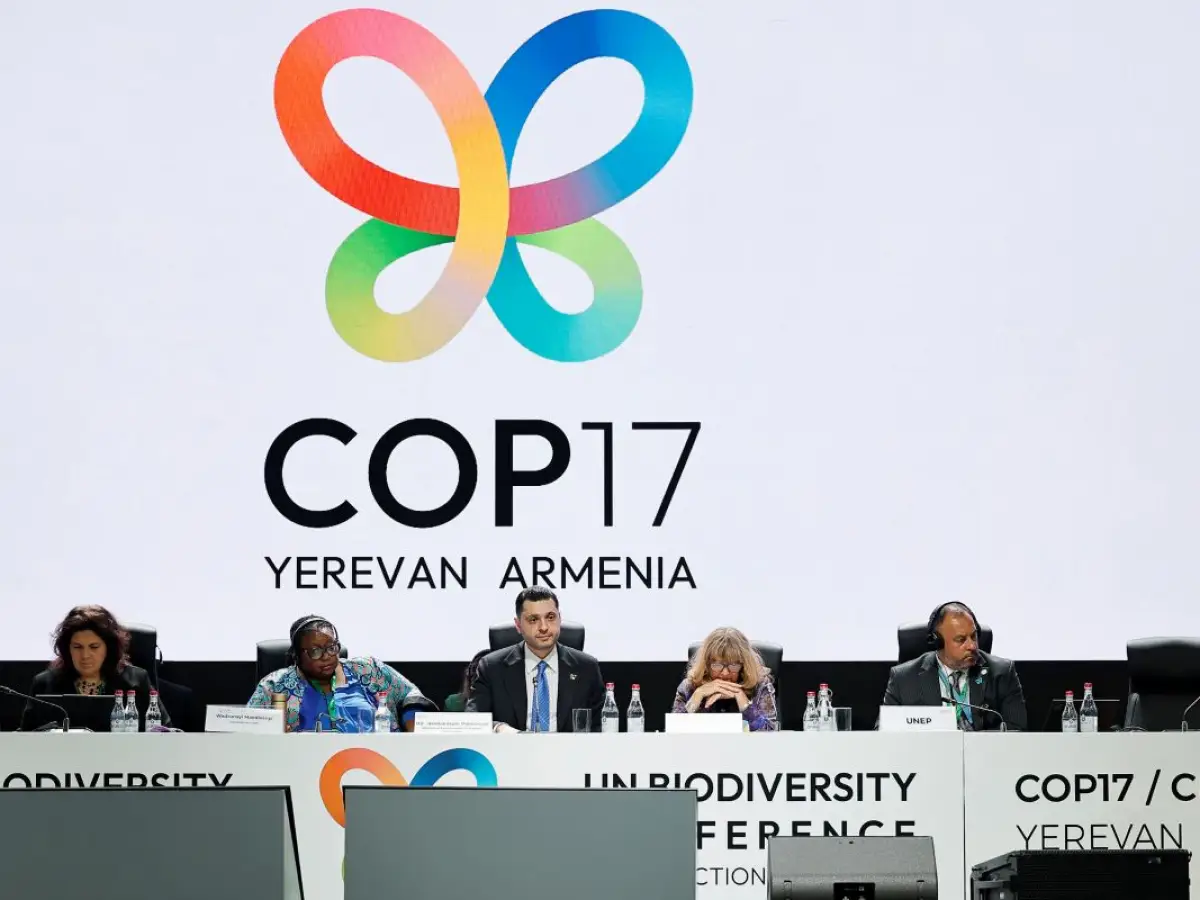

Yerevan - With the high-level segment of the United Nations Conference on Biodiversity (COP17) now underway, attention is turning to a key issue: financing for nature, including the mobilisation of economic resources and the phasing out of incentives harmful to biodiversity. Italy is represented by Undersecretary Claudio Barbaro, among the 140 ministers and deputy ministers responsible for finance and the environment.
When the Kunming-Montreal Global Biodiversity Framework (KMGBF) was adopted in 2022, signatory countries committed to mobilising at least $200 billion a year in international public finance for biodiversity by 2025. Developing countries pledged to contribute at least $20 billion a year by 2025 and $30 billion by 2030. All parties also committed to reducing harmful incentives by at least $500 billion a year by 2030, starting with the most harmful, and to increasing positive incentives.
Just as in families and social relationships, money is a sensitive subject. But here we’re talking about spending money on the economic resilience of nations, rather than simply ‘preserving nature’. Inger Andersen, Under-Secretary-General of the United Nations and Executive Director of the United Nations Environment Programme, explains the reasoning behind this: “Nature is not a luxury we protect when economies can afford it. Nature is what makes economies possible. The arrival of finance ministers at COP 17 sends an important signal. Biodiversity loss is not simply an environmental problem. It is an economic problem, and the solutions must reach into the heart of economic decision-making”.
The Armenian Presidency is keen to highlight the commitments made by the participating countries up to 27 October: “COP 17 is enabling a total mobilization of more than $1.8 billion from all sources – governments, philanthropic organizations and investors – in support of strong biodiversity action,” said Hambardzum Matevosyan. “The first week has shown that cooperation can deliver progress. The second week must demonstrate that political commitment can deliver action.”
Public finance for nature
To bridge these gaps, however, governments will have to overcome significant differences in the course of negotiations. Fundamental questions remain unresolved regarding who should contribute to international biodiversity financing, how much funding should be mobilised, and through which mechanisms. The parties also remain divided over the wording of commitments to reduce or phase out of harmful incentives, including agricultural subsidies.
Several options are on the table for the negotiators. Proposals have been put forward to increase available resources both by broadening the donor base (thereby encouraging other countries to contribute) and by mobilising financial resources ‘from all sources’ (private, philanthropic and public). However, these proposals remain in square brackets, indicating that they have not yet been agreed upon.
The negotiating text also sets out a list of criteria for managing the Convention’s funds, alongside a roadmap leading up to COP18. Under this roadmap, the Subsidiary Body for Implementation (SBI) will take stock of the Global Biodiversity Framework Fund (GBFF) and prepare options for establishing a new fund or confirming existing ones. The expansion of the donor base – that is, determining which countries should contribute – also remains under discussion. Meanwhile, at Finance Day during COP17 in Yerevan, the Global Biodiversity Framework Fund surpassed half a billion dollars, following $60 million in new government pledges. These included the first contribution from a city, Berlin. New donors include Spain, which pledged €50 million, and Uzbekistan, which pledged $4.5 million.
Reforming environmentally harmful subsidies
The other major issue at COP17 is Target 18, which concerns the reform of the $500 billion in annual subsidies that are harmful to nature. Governments are being asked to commit to identifying and redirecting, within two years, subsidies that negatively affect biodiversity.
To facilitate progress, the Armenian Presidency has launched the ‘Yerevan Call on Positive Incentives for Biodiversity’, a political initiative aimed to encourage participating governments to take action. It has also presented the voluntary ‘Friends of Target 18’ platform, which seeks to support political commitment, facilitate the exchange of national experiences, promote concrete solutions and foster continued cooperation beyond COP17. Matevosyan called on countries to support the Yerevan Call on Positive Incentives for Biodiversity and consider joining the platform.
At a press conference, Patricia Zurita of Conservation International told Renewable Matter that “at least ten countries are expected to join the platform” – a figure that is hardly enough to be considered a success. Colombia and Costa Rica are among the first signatories, while France is expected to sign. Zurita also reiterated the importance of ensuring that the final text includes a clear commitment from countries to step up their efforts to cut funding.
The initiative has received strong support from various organisations in the business sector. “We are investing to help build more resilient agricultural supply chains, but only through collaboration between businesses, policymakers and value-chains stakeholders will we be able to make a significant impact,” commented Christopher Adamo, Head of Global Sustainability and B Corp Certification at Danone. “No company can lead this transition on its own. Appropriate incentives and policies can accelerate the transition, while strengthening the competitiveness, resilience and long-term sustainability of agricultural systems.”
According to Raphaëlle Archambeaud-Sicot, Head of Sustainability at L’Occitane en Provence, “when nature is compromised, our supply chains are also affected. Yet, all too often, public funds continue to reward harmful practices rather than incentivising sustainable ones. The Yerevan Appeal and the Friends of Target 18 send an important signal that governments are listening and are ready for change. Reforming tax and financial incentives can reward sustainable producers and give businesses the confidence they need to invest in long-term resilience.”
The Italian and European positions
“Italy is already well ahead: we have drawn up a catalogue of environmentally harmful and environmentally beneficial subsidies, an initiative recognised at COP17 as a best practice in implementing Target 18 of the Global Framework. This initiative can serve as a model for other countries,” Claudio Barbaro, Undersecretary at the Ministry of Ecological Sustainability and Environment (MASE), told Renewable Matter. However, he has yet to announce Italy’s membership of the Friends of Target 18 group. “We will assess the possibility of joining in consultation with the relevant authorities, as membership would allow us not only to benefit from the exchange of experiences but also to share our methodology.”
The Catalogue of Environmentally Harmful and Environmentally Beneficial Subsidies, updated annually by the Italian Ministry of the Environment and Energy Security, serves as a tool for implementing the National Biodiversity Strategy 2030 and gradually aligning economic incentives with environmental and climate objectives.
“In this context, between 2022 and 2023, Italy reduced environmentally harmful subsidies by more than €280 million a year, phasing out various incentives for fossil fuel that negatively affect biodiversity and bringing financial flows more closely into line with the objectives of the Kunming-Montreal Global Biodiversity Framework,” Barbaro explains. However, much remains to be done, and Rome has yet to announce any new pledges.
“Italy has contributed to international efforts to mobilise financial resources for biodiversity by allocating a portion of its development cooperation funding to initiatives promoting the conservation and sustainable use of biodiversity in partner countries, as part of the bilateral funding provided from OECD-DAC member countries”, adds the Under-Secretary, reiterating a general commitment to “further strengthening the mobilisation of resources from all sources, both public and private, as well as consolidating international cooperation and the involvement of the financial sector”.
For European Commissioner Jessica Roswall, the next EU budget will be a key opportunity to reform environmentally harmful subsidies: “For the next long-term budget, the Commission is proposing to allocate 35% to climate action, nature and the environment,” she tells Renewable Matter. “This is a way of encouraging sustainable agriculture and other sustainable investments. The ‘do no significant harm’ principle provides an additional safeguard, ensuring that public funds support activities that do not harm nature. This discussion is important because, while more funding is needed, existing resources must also be used efficiently. Redirecting funds currently allocated to reactive measures is a straightforward approach.”
A measurable impact
According to UNEP’s State of Finance for Nature 2026, for every dollar of private finance invested in protecting nature, over $200 are channelled into activities that harm it. This figure is reshaping the conversation around finance beyond the negotiating rooms at the Meridian Expo in Yerevan. The focus is shifting away from how much funding is needed towards how existing resources are managed and where they are directed.
The same report reinforces the view that finance is ‘flowing in the wrong direction’. The figures reveal a stark imbalance in global financial flows: for every dollar of public funding invested in protecting nature, around $12 goes towards subsidies that harm biodiversity. In the private sector, the ratio rises to $213 to 1. In 2023, an estimated $7.3 trillion went towards activities that negatively affect ecosystems, compared with just $220 billion invested in nature-based solutions.
And yet, private-sector interest remains limited. Even the financial press is conspicuously absent from COP17, observes an expert adviser who wishes to remain anonymous. Banks such as JP Morgan, Deutsche Bank and BNP Paribas are represented, but very few financial journalists are present. Nothing will change unless these negotiations receive greater attention.
Also read: COP17: the key challenge after the first week is to turn words into action
Cover: Opening plenary of the High-Level Segment (HLS) and opening remarks, held at the Blue Zone of CBD COP17 in Yerevan, Armenia, on 27 October 2026 © COP17 Yerevan/Davit Hakobyan, via Flickr