

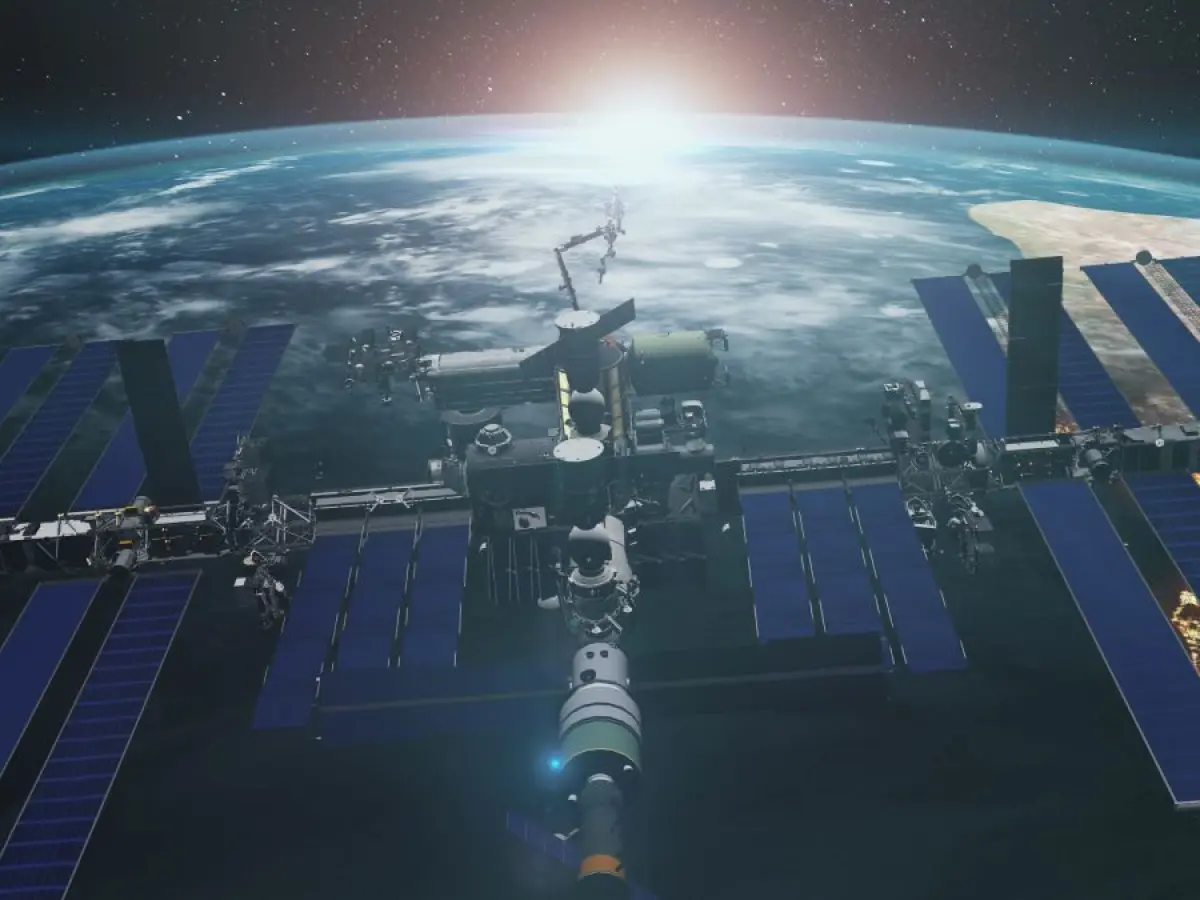

In orbit, nothing is wasted. Every gram of material loaded before launch has a weight, a cost and an already planned second life. On the International Space Station, most of the water – including water vapour from breathing – is recovered and returned to a drinkable state. A space station is the most rigorous closed system ever built by human engineering, a place where living within finite resources is a condition for survival even before it is a choice. It is the circular economy taken to its physical limit, long before circularity became an industrial buzzword.
Anyone working on the ecological transition recognises a familiar problem in that logic. In such an environment, waste is treated as a design flaw: every object is created with its future recovery and reuse in mind, as carrying a spare part on board costs as much as jettisoning it. This is the same principle that the circular economy seeks to apply in factories and cities, where, however, the pressure to adhere to it is weaker and the margins for waste remain wide.
For years, as head of IEG’s Green & Technology division, with Ecomondo and KEY, I have observed entire sectors grappling with the same question: how to balance production, consumption and the regeneration of resources within the limits imposed on us by the planet. Space addresses that question in an extreme form and, for this reason, has something to teach those tackling it on Earth.
Then there is a second aspect, less evocative and more practical. For sustainability to move beyond mere intention, verifiable data is required, and today much of that data comes from orbit.
Satellites measure emissions, monitor soil and water conditions, and verify crop yields. A farm that regulates irrigation and treatments based on satellite imagery demonstrably reduces consumption and waste. The same measurement capabilities are needed by businesses required to report on their environmental impacts in accordance with European regulations. In this context, Earth observation ceases to be merely a technical support tool and becomes the infrastructure of the transition: it is what makes sustainability measurable, comparable and therefore credible.
These two worlds, the space sector and the terrestrial industry, are converging more rapidly than public debate recognises. Companies in traditional sectors – from transport to agriculture – are now taking the lead, adopting space services as end-users and integrating them into their own products and processes. The World Economic Forum estimates that the global space economy will grow from $630 billion in 2023 to $1.8 trillion by 2035, at a rate exceeding that of global GDP. Much of that value is generated on the ground, in agriculture, energy, logistics and water management. In Italy, this trend is already evident: according to the Space Economy Observatory at the Politecnico di Milano, 43% of companies in the space sector integrate their activities with adjacent industrial sectors, from aviation to metalworking and the automotive industry. In short, this convergence is a reality rather than a prediction.
These signals are worth considering together. The green transition and the space economy address, from opposite directions, the same question: how to make a system with finite resources work without depleting them. At the point where these two approaches converge, new avenues for innovation open up that neither field would be able to achieve on its own. For an Earth-based business, this means designing more durable and efficient products, able to remain competitive when raw materials are in short supply. The expertise gained by the space industry in material efficiency and reuse can accelerate circular processes on Earth, while demand from Earth-based sectors offers space a real market, rooted in tangible needs. It is this vision that has given rise to BEX, the expo-conference we are bringing to Rimini in September.
For decades, space has represented the unknown, the frontier to be reached. The emerging space economy tells a more practical story: it is a tool for better understanding and managing the planet we already inhabit, with the same care we would reserve for a resource that cannot be replaced.
Cover: photo by Envato