


President Trump, giving a speech in an Atlanta suburb in summer 2026, mentioned communism or communist fifteen times, starting less than a minute into an hour -long speech. The Secretary of State, Marco Rubio, has likewise pointed to the “communist danger.” In neither case is this solely a revival of the old Soviet boogeyman, although Cuba does somewhat fill that role for the Cuban American Rubio, and it provides ideological cover for taking over Venezuela’s oil fields. This is because the communists are mainly at home. It is an attempt to identify an internal enemy, in this case Democrats in general and especially so-called democratic socialists, as a distraction from bad news in terms of price inflation and a war on Iran without a proffered clear objective.
“The Reds under the Bed,” in this case, are political activists associated with causes such as civil rights, reproductive rights, climate change and other environmental concerns, and using the income-tax code to support public goods rather than the lifestyles of the rich and famous. Labeling political opponents as mortal ideological enemies has been a central theme in Trump’s rise to power.
The results of the midterm elections concluding on 3 November suggest this labeling strategy may well have passed its sell-by date. It revealed a congressional landslide for the Democratic Party countrywide, from Maine to Texas by way of North Carolina, Ohio, Iowa, Kansas and Georgia, with parallel success in many states for the governor’s position. Given the color-coding of the two parties (strangely given the worldwide association of the left with red: red for Republicans and blue for Democrats), it’s being called a “blue tsunami.”
Not even the most optimistic of Democratic operatives could have expected the magnitude of this victory. Pundits are tending to explain the scale of the turnabout since 2024 in terms of affordability worries on the part of voters, the mobilising of younger ethnic voters fearing for their economic futures and the decreased turnout by some old-time Trump voters dismayed by his recent psychotic behavior at rallies and in interviews. I think these were all probably at work. I think that lurking behind them, however, are some more existential concerns about the overall direction of the country in political and cultural as much as economic terms.
Many of the successful candidates on 3 November identified issues relating to climate change, public health, education and physical infrastructure (roads, sewers, water supply, power grids, etc.) as key policy issues facing the country and that were either decried (“climate change is a hoax,” says Trump) or ignored by the current government and its candidates. Indeed, all of the successful candidates for the US Senate in Michigan, Ohio, North Carolina and Texas explicitly mentioned sustainability and its relationship to health and welfare as important parts of their agendas if elected.
So, it looks as if Trump’s labeling strategy has come back to haunt him. “The communists,” as he would have it, have won, at least for now. Of course, if the Democratic Party, once in control of the US Congress, fails to do much about the real issues that got them labeled in the first place, and focuses, for example, exclusively on punishing Trump and his fellow corrupt minions, then the presidential election of 2028 rather than providing a renewed boost for dealing with the real social and environmental challenges facing the country, may well just revive the name-calling and finger-pointing that is central to Trump-style performative politics.
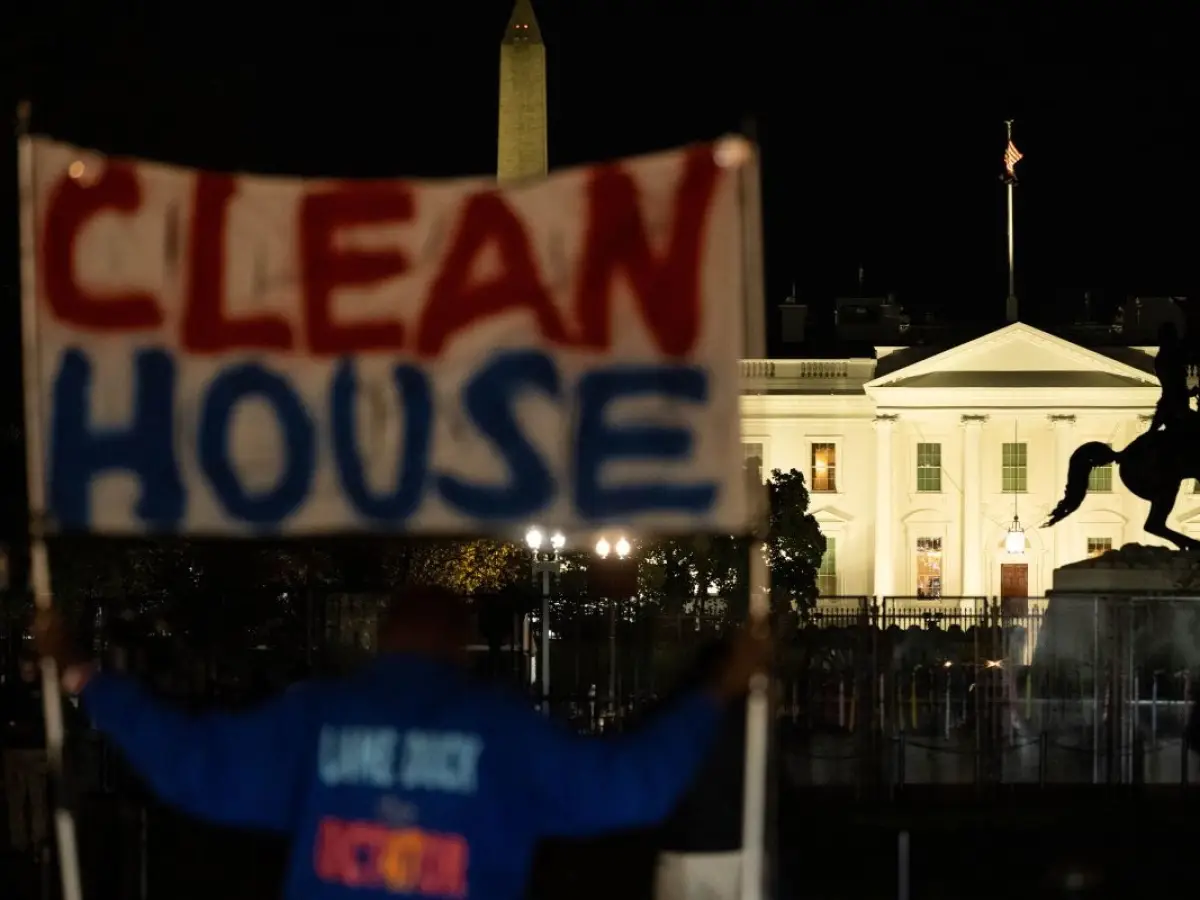
Cover: a protester stands outside the White House on election night during the 2026 midterm elections in Washington, DC, on November 3, 2026. Photo by Matt Kaminsky/Sipa USA, IPA Agency